





AndalucíaAndalucía
MadridMadrid
CataluñaCataluña
GaliciaGalicia
MurciaMurcia
ValenciaValencia
En construcciónAñadimos comunidades, materias, años y soluciones de forma progresiva y constante.

Matrices y determinantes

31 ejercicios
Operaciones con matrices y sistemas de ecuaciones matriciales
Problema
2025 · Ordinaria · Suplente
1
Examen

Se considera la matriz:

A=(210012222)A = \begin{pmatrix} 2 & 1 & 0 \\ 0 & 1 & 2 \\ 2 & 2 & 2 \end{pmatrix}
a) Resuelva el sistema de ecuaciones matriciales: (A+I3)X+Y=AI3(A + I_3) \cdot X + Y = A - I_3 XY=I3X - Y = I_3b) Halle el rango de las matrices A+I3A + I_3 y AI3A - I_3. ¿Son matrices invertibles?
MatricesSistemas de ecuaciones matricialesRango+1
a) Resuelva el sistema de ecuaciones matriciales:

Tenemos el sistema de ecuaciones matriciales:

{(A+I3)X+Y=AI3(1)XY=I3(2)\begin{cases} (A + I_3) \cdot X + Y = A - I_3 \quad (1) \\ X - Y = I_3 \quad (2) \end{cases}

De la ecuación (2), despejamos YY: Y=XI3Y = X - I_3. Sustituimos esta expresión de YY en la ecuación (1):

(A+I3)X+(XI3)=AI3(A + I_3) \cdot X + (X - I_3) = A - I_3

Distribuimos y agrupamos términos con XX:

(A+I3)X+I3X=AI3+I3(A+I3+I3)X=A(A+2I3)X=A(A + I_3)X + I_3 X = A - I_3 + I_3 \\ (A + I_3 + I_3)X = A \\ (A + 2I_3)X = A

Ahora calculamos la matriz A+2I3A + 2I_3:

A+2I3=(210012222)+2(100010001)=(210012222)+(200020002)=(410032224)A + 2I_3 = \begin{pmatrix} 2 & 1 & 0 \\ 0 & 1 & 2 \\ 2 & 2 & 2 \end{pmatrix} + 2\begin{pmatrix} 1 & 0 & 0 \\ 0 & 1 & 0 \\ 0 & 0 & 1 \end{pmatrix} = \begin{pmatrix} 2 & 1 & 0 \\ 0 & 1 & 2 \\ 2 & 2 & 2 \end{pmatrix} + \begin{pmatrix} 2 & 0 & 0 \\ 0 & 2 & 0 \\ 0 & 0 & 2 \end{pmatrix} = \begin{pmatrix} 4 & 1 & 0 \\ 0 & 3 & 2 \\ 2 & 2 & 4 \end{pmatrix}

Para resolver X=(A+2I3)1AX = (A + 2I_3)^{-1}A, primero calculamos el determinante de (A+2I3)(A + 2I_3):

det(A+2I3)=det(410032224)=4(3422)1(0422)+0=4(124)1(04)=4(8)(4)=32+4=36\det(A + 2I_3) = \det\begin{pmatrix} 4 & 1 & 0 \\ 0 & 3 & 2 \\ 2 & 2 & 4 \end{pmatrix} = 4(3 \cdot 4 - 2 \cdot 2) - 1(0 \cdot 4 - 2 \cdot 2) + 0 = 4(12 - 4) - 1(0 - 4) = 4(8) - (-4) = 32 + 4 = 36

Como el determinante es 36036 \neq 0, la matriz (A+2I3)(A + 2I_3) es invertible. Ahora calculamos su inversa. Primero, la matriz de cofactores:

C=(+(124)(04)+(06)(40)+(160)(82)+(20)(80)+(120))=(84641662812)C = \begin{pmatrix} +(12-4) & -(0-4) & +(0-6) \\ -(4-0) & +(16-0) & -(8-2) \\ +(2-0) & -(8-0) & +(12-0) \end{pmatrix} = \begin{pmatrix} 8 & 4 & -6 \\ -4 & 16 & -6 \\ 2 & -8 & 12 \end{pmatrix}

Luego, la matriz adjunta es la traspuesta de la matriz de cofactores:

Adj(A+2I3)=CT=(84241686612)\text{Adj}(A + 2I_3) = C^T = \begin{pmatrix} 8 & -4 & 2 \\ 4 & 16 & -8 \\ -6 & -6 & 12 \end{pmatrix}

Y la inversa es:

(A+2I3)1=136(84241686612)(A + 2I_3)^{-1} = \frac{1}{36} \begin{pmatrix} 8 & -4 & 2 \\ 4 & 16 & -8 \\ -6 & -6 & 12 \end{pmatrix}

Finalmente, calculamos X=(A+2I3)1AX = (A + 2I_3)^{-1}A:

X=136(84241686612)(210012222)X=136(8(2)4(0)+2(2)8(1)4(1)+2(2)8(0)4(2)+2(2)4(2)+16(0)8(2)4(1)+16(1)8(2)4(0)+16(2)8(2)6(2)6(0)+12(2)6(1)6(1)+12(2)6(0)6(2)+12(2))X=136(16+0+484+408+48+0164+16160+321612+0+2466+24012+24)X=136(20848416121212)=(20/368/364/368/364/3616/3612/3612/3612/36)X=(5/92/91/92/91/94/91/31/31/3)X = \frac{1}{36} \begin{pmatrix} 8 & -4 & 2 \\ 4 & 16 & -8 \\ -6 & -6 & 12 \end{pmatrix} \begin{pmatrix} 2 & 1 & 0 \\ 0 & 1 & 2 \\ 2 & 2 & 2 \end{pmatrix} \\ X = \frac{1}{36} \begin{pmatrix} 8(2)-4(0)+2(2) & 8(1)-4(1)+2(2) & 8(0)-4(2)+2(2) \\ 4(2)+16(0)-8(2) & 4(1)+16(1)-8(2) & 4(0)+16(2)-8(2) \\ -6(2)-6(0)+12(2) & -6(1)-6(1)+12(2) & -6(0)-6(2)+12(2) \end{pmatrix} \\ X = \frac{1}{36} \begin{pmatrix} 16+0+4 & 8-4+4 & 0-8+4 \\ 8+0-16 & 4+16-16 & 0+32-16 \\ -12+0+24 & -6-6+24 & 0-12+24 \end{pmatrix} \\ X = \frac{1}{36} \begin{pmatrix} 20 & 8 & -4 \\ -8 & 4 & 16 \\ 12 & 12 & 12 \end{pmatrix} = \begin{pmatrix} 20/36 & 8/36 & -4/36 \\ -8/36 & 4/36 & 16/36 \\ 12/36 & 12/36 & 12/36 \end{pmatrix} \\ X = \begin{pmatrix} 5/9 & 2/9 & -1/9 \\ -2/9 & 1/9 & 4/9 \\ 1/3 & 1/3 & 1/3 \end{pmatrix}

Ahora calculamos Y=XI3Y = X - I_3:

Y=(5/92/91/92/91/94/91/31/31/3)(100010001)Y=(5/912/91/92/91/914/91/31/31/31)=(4/92/91/92/98/94/91/31/32/3)Y = \begin{pmatrix} 5/9 & 2/9 & -1/9 \\ -2/9 & 1/9 & 4/9 \\ 1/3 & 1/3 & 1/3 \end{pmatrix} - \begin{pmatrix} 1 & 0 & 0 \\ 0 & 1 & 0 \\ 0 & 0 & 1 \end{pmatrix} \\ Y = \begin{pmatrix} 5/9 - 1 & 2/9 & -1/9 \\ -2/9 & 1/9 - 1 & 4/9 \\ 1/3 & 1/3 & 1/3 - 1 \end{pmatrix} = \begin{pmatrix} -4/9 & 2/9 & -1/9 \\ -2/9 & -8/9 & 4/9 \\ 1/3 & 1/3 & -2/3 \end{pmatrix}
b) Halle el rango de las matrices A+I3A + I_3 y AI3A - I_3. ¿Son matrices invertibles?

Primero, calculamos A+I3A + I_3:

A+I3=(210012222)+(100010001)=(310022223)A + I_3 = \begin{pmatrix} 2 & 1 & 0 \\ 0 & 1 & 2 \\ 2 & 2 & 2 \end{pmatrix} + \begin{pmatrix} 1 & 0 & 0 \\ 0 & 1 & 0 \\ 0 & 0 & 1 \end{pmatrix} = \begin{pmatrix} 3 & 1 & 0 \\ 0 & 2 & 2 \\ 2 & 2 & 3 \end{pmatrix}

Para determinar el rango y la invertibilidad, calculamos su determinante:

det(A+I3)=3(2322)1(0322)+0=3(64)1(04)=3(2)(4)=6+4=10\det(A + I_3) = 3(2 \cdot 3 - 2 \cdot 2) - 1(0 \cdot 3 - 2 \cdot 2) + 0 = 3(6 - 4) - 1(0 - 4) = 3(2) - (-4) = 6 + 4 = 10

Dado que det(A+I3)=100\det(A + I_3) = 10 \neq 0, el rango de A+I3A + I_3 es 3. Una matriz cuadrada es invertible si y solo si su determinante es distinto de cero. Por lo tanto, A+I3A + I_3 es invertible.Ahora, calculamos AI3A - I_3:

AI3=(210012222)(100010001)=(110002221)A - I_3 = \begin{pmatrix} 2 & 1 & 0 \\ 0 & 1 & 2 \\ 2 & 2 & 2 \end{pmatrix} - \begin{pmatrix} 1 & 0 & 0 \\ 0 & 1 & 0 \\ 0 & 0 & 1 \end{pmatrix} = \begin{pmatrix} 1 & 1 & 0 \\ 0 & 0 & 2 \\ 2 & 2 & 1 \end{pmatrix}

Calculamos su determinante:

det(AI3)=1(0122)1(0122)+0=1(04)1(04)=4(4)=4+4=0\det(A - I_3) = 1(0 \cdot 1 - 2 \cdot 2) - 1(0 \cdot 1 - 2 \cdot 2) + 0 = 1(0 - 4) - 1(0 - 4) = -4 - (-4) = -4 + 4 = 0

Dado que det(AI3)=0\det(A - I_3) = 0, el rango de AI3A - I_3 no es 3. Para encontrar el rango, buscamos un menor de orden 2 con determinante distinto de cero. Consideramos el menor formado por las filas 1 y 2 y las columnas 1 y 3:

det(1002)=1200=2\det\begin{pmatrix} 1 & 0 \\ 0 & 2 \end{pmatrix} = 1 \cdot 2 - 0 \cdot 0 = 2

Como existe un menor de orden 2 con determinante 202 \neq 0, el rango de AI3A - I_3 es 2. Dado que el determinante es cero, AI3A - I_3 no es invertible.

Operaciones matriciales y matriz inversa
Problema
2025 · Ordinaria · Titular
1
Examen

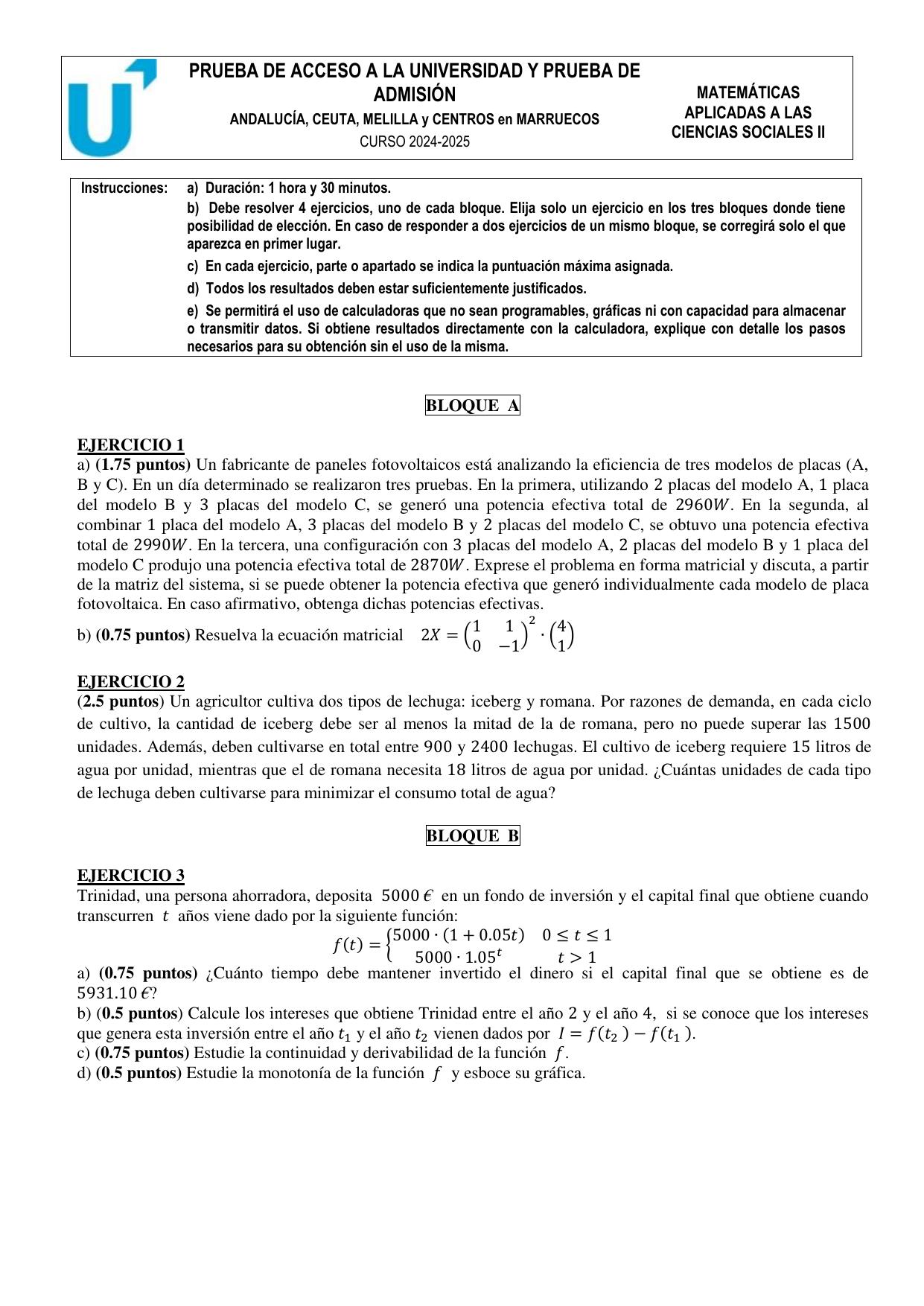
a) Plantee y resuelva el siguiente problema de forma matricial: El gerente de una empresa de productos hospitalarios desea introducir un nuevo producto en el mercado nacional. Para ello contrata a 3 vendedores que se han encargado de las zonas A, B y C del país, respectivamente. El vendedor de la zona A ha trabajado 40 horas, ha realizado 10 demostraciones y 5 viajes para dicha promoción. El vendedor de la zona B ha trabajado el doble de horas que el de la zona A, realizando 15 demostraciones y 8 viajes. En cuanto al vendedor de la zona C, ha trabajado 100 horas, ha realizado 25 demostraciones y 10 viajes. El gerente debe abonarles 75€ por hora trabajada, 300€ por demostración y 250€ por viaje realizado. Teniendo en cuenta que, además, debe aplicárseles una retención en concepto del impuesto del IRPF del 15% si la cantidad a abonar al vendedor es menor de diez mil euros y del 18% en caso contrario, determine la cantidad final que cobrará cada vendedor. b) Sea

A=(2213a12403)A = \begin{pmatrix} -2 & 2 & 1 \\ 3 & a - 1 & 2 \\ 4 & 0 & 3 \end{pmatrix}

¿Para qué valores de a es la matriz A invertible?

MatricesProblema contextualizadoInversa de una matriz+1

a) En primer lugar, definimos la matriz de actividad M, donde las filas representan a los vendedores (A, B y C) y las columnas representan las horas, demostraciones y viajes respectivamente. Asimismo, definimos el vector de precios P.

M=(40105801581002510),P=(75300250)M = \begin{pmatrix} 40 & 10 & 5 \\ 80 & 15 & 8 \\ 100 & 25 & 10 \end{pmatrix}, \quad P = \begin{pmatrix} 75 \\ 300 \\ 250 \end{pmatrix}

Calculamos la cantidad bruta devengada por cada vendedor mediante el producto de la matriz M por el vector P:

G=MP=(40105801581002510)(75300250)=(4075+10300+52508075+15300+825010075+25300+10250)G = M \cdot P = \begin{pmatrix} 40 & 10 & 5 \\ 80 & 15 & 8 \\ 100 & 25 & 10 \end{pmatrix} \begin{pmatrix} 75 \\ 300 \\ 250 \end{pmatrix} = \begin{pmatrix} 40 \cdot 75 + 10 \cdot 300 + 5 \cdot 250 \\ 80 \cdot 75 + 15 \cdot 300 + 8 \cdot 250 \\ 100 \cdot 75 + 25 \cdot 300 + 10 \cdot 250 \end{pmatrix}
G=(3000+3000+12506000+4500+20007500+7500+2500)=(72501250017500) eurosG = \begin{pmatrix} 3000 + 3000 + 1250 \\ 6000 + 4500 + 2000 \\ 7500 + 7500 + 2500 \end{pmatrix} = \begin{pmatrix} 7250 \\ 12500 \\ 17500 \end{pmatrix} \text{ euros}

Ahora aplicamos la retención del IRPF según las condiciones: 15% si el bruto es menor a 10.000 € y 18% en caso contrario.Para el vendedor A (7.250 < 10.000):

NetoA=7250(10.15)=72500.85=6162.50 eurosNeto_A = 7250 \cdot (1 - 0.15) = 7250 \cdot 0.85 = 6162.50 \text{ \,\text{euros}}

Para el vendedor B (12.500 > 10.000):

NetoB=12500(10.18)=125000.82=10250.00 eurosNeto_B = 12500 \cdot (1 - 0.18) = 12500 \cdot 0.82 = 10250.00 \text{ \,\text{euros}}

Para el vendedor C (17.500 > 10.000):

NetoC=17500(10.18)=175000.82=14350.00 eurosNeto_C = 17500 \cdot (1 - 0.18) = 17500 \cdot 0.82 = 14350.00 \text{ \,\text{euros}}

b) Una matriz cuadrada es invertible si y solo si su determinante es distinto de cero. Calculamos el determinante de la matriz A utilizando la regla de Sarrus.

A=2213a12403=[(2)(a1)(3)+(2)(2)(4)+(1)(3)(0)][(1)(a1)(4)+(2)(3)(3)+(2)(2)(0)]|A| = \begin{vmatrix} -2 & 2 & 1 \\ 3 & a - 1 & 2 \\ 4 & 0 & 3 \end{vmatrix} = [(-2)(a-1)(3) + (2)(2)(4) + (1)(3)(0)] - [(1)(a-1)(4) + (2)(3)(3) + (-2)(2)(0)]
A=[6(a1)+16+0][4(a1)+18+0]|A| = [-6(a-1) + 16 + 0] - [4(a-1) + 18 + 0]
A=6a+6+16(4a4+18)=6a+22(4a+14)|A| = -6a + 6 + 16 - (4a - 4 + 18) = -6a + 22 - (4a + 14)
A=6a+224a14=10a+8|A| = -6a + 22 - 4a - 14 = -10a + 8

Para que la matriz sea invertible, igualamos el determinante a cero para encontrar los valores excluidos:

10a+8=0    10a=8    a=810=0.8-10a + 8 = 0 \implies 10a = 8 \implies a = \frac{8}{10} = 0.8

Por lo tanto, la matriz A es invertible para cualquier valor de a tal que:
a0.8\mathbf{a \neq 0.8}
Operaciones con matrices, matriz inversa y ecuaciones matriciales
Problema
2024 · Ordinaria · Titular
1
Examen
BLOQUE A

Se consideran las matrices

A=(112a3a1102a)A = \begin{pmatrix} 1 & 1 & -2 \\ a - 3 & a - 1 & 1 \\ 0 & 2 & a \end{pmatrix}

\quad B = (-1 \quad 3 \quad 2) \quad C = (-2 \quad 1 \quad 4),siendo, siendo a$ un número real.

a) Obtenga los valores de aa para los que la matriz AA tenga inversa.b) Para a=1a = 1, resuelva la ecuación XAB=CAX \cdot A - B = C \cdot A.c) Determine razonadamente la dimensión de la matriz DD que permita realizar la operación BA+DCtBB \cdot A + D \cdot C^t \cdot B.
MatricesMatriz inversaEcuación matricial+1
a) Obtenga los valores de aa para los que la matriz AA tenga inversa.

La matriz AA tiene inversa si y solo si su determinante es distinto de cero. Calculamos el determinante de AA:

A=(112a3a1102a)A = \begin{pmatrix} 1 & 1 & -2 \\ a - 3 & a - 1 & 1 \\ 0 & 2 & a \end{pmatrix}
det(A)=1a112a1a310a+(2)a3a102\det(A) = 1 \cdot \begin{vmatrix} a-1 & 1 \\ 2 & a \end{vmatrix} - 1 \cdot \begin{vmatrix} a-3 & 1 \\ 0 & a \end{vmatrix} + (-2) \cdot \begin{vmatrix} a-3 & a-1 \\ 0 & 2 \end{vmatrix}
det(A)=1((a1)a12)1((a3)a10)2(2(a3)(a1)0)\det(A) = 1 \cdot ((a-1)a - 1 \cdot 2) - 1 \cdot ((a-3)a - 1 \cdot 0) - 2 \cdot (2(a-3) - (a-1) \cdot 0)
\det(A) = (a^2 - a - 2) - (a^2 - 3a) - 2(2a - 6)
det(A)=a2a2a2+3a4a+12\det(A) = a^2 - a - 2 - a^2 + 3a - 4a + 12
\det(A) = (a^2 - a^2) + (-a + 3a - 4a) + (-2 + 12)
det(A)=2a+10\det(A) = -2a + 10

Para que la matriz AA tenga inversa, su determinante debe ser distinto de cero:

2a+100-2a + 10 \neq 0
2a10-2a \neq -10
a5a \neq 5

Por lo tanto, la matriz AA tiene inversa para todos los valores de aRa \in \mathbb{R} excepto para a=5a=5.

b) Para a=1a = 1, resuelva la ecuación XAB=CAX \cdot A - B = C \cdot A.

Sustituimos a=1a=1 en la matriz AA:

A=(11213111021)=(112201021)A = \begin{pmatrix} 1 & 1 & -2 \\ 1 - 3 & 1 - 1 & 1 \\ 0 & 2 & 1 \end{pmatrix} = \begin{pmatrix} 1 & 1 & -2 \\ -2 & 0 & 1 \\ 0 & 2 & 1 \end{pmatrix}

Dado que a=15a=1 \neq 5, la matriz AA tiene inversa. Reordenamos la ecuación para despejar XX:

XAB=CAX \cdot A - B = C \cdot A
XA=CA+BX \cdot A = C \cdot A + B

Multiplicamos por la derecha por A1A^{-1}:

XAA1=(CA+B)A1X \cdot A \cdot A^{-1} = (C \cdot A + B) \cdot A^{-1}
X=CAA1+BA1X = C \cdot A \cdot A^{-1} + B \cdot A^{-1}
X=C+BA1X = C + B \cdot A^{-1}

Calculamos A1A^{-1} para a=1a=1. El determinante de AA para a=1a=1 es:

det(A)=2(1)+10=8\det(A) = -2(1) + 10 = 8

Calculamos la matriz de cofactores de AA:

Cof(A)11=0121=2Cof(A)12=2101=2Cof(A)13=2002=4\text{Cof}(A)_{11} = \begin{vmatrix} 0 & 1 \\ 2 & 1 \end{vmatrix} = -2 \qquad \text{Cof}(A)_{12} = -\begin{vmatrix} -2 & 1 \\ 0 & 1 \end{vmatrix} = 2 \qquad \text{Cof}(A)_{13} = \begin{vmatrix} -2 & 0 \\ 0 & 2 \end{vmatrix} = -4
Cof(A)21=1221=(1(4))=5Cof(A)22=1201=1Cof(A)23=1102=(20)=2\text{Cof}(A)_{21} = -\begin{vmatrix} 1 & -2 \\ 2 & 1 \end{vmatrix} = -(1 - (-4)) = -5 \qquad \text{Cof}(A)_{22} = \begin{vmatrix} 1 & -2 \\ 0 & 1 \end{vmatrix} = 1 \qquad \text{Cof}(A)_{23} = -\begin{vmatrix} 1 & 1 \\ 0 & 2 \end{vmatrix} = -(2 - 0) = -2
Cof(A)31=1201=1Cof(A)32=1221=(14)=3Cof(A)33=1120=0(2)=2\text{Cof}(A)_{31} = \begin{vmatrix} 1 & -2 \\ 0 & 1 \end{vmatrix} = 1 \qquad \text{Cof}(A)_{32} = -\begin{vmatrix} 1 & -2 \\ -2 & 1 \end{vmatrix} = -(1 - 4) = 3 \qquad \text{Cof}(A)_{33} = \begin{vmatrix} 1 & 1 \\ -2 & 0 \end{vmatrix} = 0 - (-2) = 2
Cof(A)=(224512132)\text{Cof}(A) = \begin{pmatrix} -2 & 2 & -4 \\ -5 & 1 & -2 \\ 1 & 3 & 2 \end{pmatrix}

La matriz adjunta (transpuesta de la matriz de cofactores) es:

Adj(A)=Cof(A)t=(251213422)\text{Adj}(A) = \text{Cof}(A)^t = \begin{pmatrix} -2 & -5 & 1 \\ 2 & 1 & 3 \\ -4 & -2 & 2 \end{pmatrix}

La inversa de AA es:

A1=1det(A)Adj(A)=18(251213422)A^{-1} = \frac{1}{\det(A)} \text{Adj}(A) = \frac{1}{8} \begin{pmatrix} -2 & -5 & 1 \\ 2 & 1 & 3 \\ -4 & -2 & 2 \end{pmatrix}

Ahora calculamos BA1B \cdot A^{-1}:

BA1=(132)18(251213422)B \cdot A^{-1} = (-1 \quad 3 \quad 2) \cdot \frac{1}{8} \begin{pmatrix} -2 & -5 & 1 \\ 2 & 1 & 3 \\ -4 & -2 & 2 \end{pmatrix}
BA1=18((1)(2)+3(2)+2(4)(1)(5)+3(1)+2(2)(1)(1)+3(3)+2(2))B \cdot A^{-1} = \frac{1}{8} \left( (-1)(-2) + 3(2) + 2(-4) \quad (-1)(-5) + 3(1) + 2(-2) \quad (-1)(1) + 3(3) + 2(2) \right)
BA1=18((2+68)(5+34)(1+9+4))B \cdot A^{-1} = \frac{1}{8} \left( (2+6-8) \quad (5+3-4) \quad (-1+9+4) \right)
BA1=18(0412)=(048128)=(01232)B \cdot A^{-1} = \frac{1}{8} \left( 0 \quad 4 \quad 12 \right) = (0 \quad \frac{4}{8} \quad \frac{12}{8}) = (0 \quad \frac{1}{2} \quad \frac{3}{2})

Finalmente, calculamos X=C+BA1X = C + B \cdot A^{-1}:

X=(214)+(01232)X = (-2 \quad 1 \quad 4) + (0 \quad \frac{1}{2} \quad \frac{3}{2})
X=(2+01+124+32)X = \left(-2+0 \quad 1+\frac{1}{2} \quad 4+\frac{3}{2}\right)
X=(22+128+32)X = \left(-2 \quad \frac{2+1}{2} \quad \frac{8+3}{2}\right)
X=(232112)X = \left(-2 \quad \frac{3}{2} \quad \frac{11}{2}\right)
c) Determine razonadamente la dimensión de la matriz DD que permita realizar la operación BA+DCtBB \cdot A + D \cdot C^t \cdot B.

Analizamos las dimensiones de las matrices dadas:

A es de dimensioˊ3×3A \text{ es de dimensión } 3 \times 3
B es de dimensioˊ1×3B \text{ es de dimensión } 1 \times 3
C es de dimensioˊ1×3C \text{ es de dimensión } 1 \times 3

Para que la operación BA+DCtBB \cdot A + D \cdot C^t \cdot B sea posible, debemos seguir las reglas de multiplicación y suma de matrices.1. Dimensión de BAB \cdot A:

dim(B)=1×3\text{dim}(B) = 1 \times 3
dim(A)=3×3\text{dim}(A) = 3 \times 3

El producto BAB \cdot A es posible y su dimensión es 1×31 \times 3.

dim(BA)=1×3\text{dim}(B \cdot A) = 1 \times 3

2. Dimensión de CtC^t:

dim(C)=1×3    dim(Ct)=3×1\text{dim}(C) = 1 \times 3 \implies \text{dim}(C^t) = 3 \times 1

3. Dimensión de CtBC^t \cdot B:

dim(Ct)=3×1\text{dim}(C^t) = 3 \times 1
dim(B)=1×3\text{dim}(B) = 1 \times 3

El producto CtBC^t \cdot B es posible y su dimensión es 3×33 \times 3.

dim(CtB)=3×3\text{dim}(C^t \cdot B) = 3 \times 3

4. Dimensión de DCtBD \cdot C^t \cdot B: Sea DD una matriz de dimensión m×nm \times n. Para que el producto D(CtB)D \cdot (C^t \cdot B) sea posible, el número de columnas de DD debe ser igual al número de filas de (CtB)(C^t \cdot B).

n=3n = 3

Así, la matriz DD tiene dimensión m×3m \times 3. El resultado del producto DCtBD \cdot C^t \cdot B tendrá dimensión m×3m \times 3.

dim(DCtB)=m×3\text{dim}(D \cdot C^t \cdot B) = m \times 3

5. Dimensión de la suma BA+DCtBB \cdot A + D \cdot C^t \cdot B: Para que la suma de dos matrices sea posible, ambas deben tener la misma dimensión. Hemos determinado que:

dim(BA)=1×3\text{dim}(B \cdot A) = 1 \times 3
dim(DCtB)=m×3\text{dim}(D \cdot C^t \cdot B) = m \times 3

Por lo tanto, para que la suma sea posible, mm debe ser igual a 11.

m=1m = 1

Concluimos que la dimensión de la matriz DD debe ser 1×31 \times 3.

Ecuaciones matriciales
Problema
2024 · Ordinaria · Reserva
1
Examen
EJERCICIO 1

Se consideran las matrices

A=(111210),B=(011012) y C=(132111031)A = \begin{pmatrix} 1 & -1 & 1 \\ -2 & 1 & 0 \end{pmatrix}, B = \begin{pmatrix} 0 & -1 \\ 1 & 0 \\ -1 & 2 \end{pmatrix} \text{ y } C = \begin{pmatrix} 1 & 3 & 2 \\ 1 & 1 & 1 \\ 0 & 3 & 1 \end{pmatrix}
a) Resuelva la siguiente ecuación ABXC=(100010)A \cdot B \cdot X \cdot C = \begin{pmatrix} 1 & 0 & 0 \\ 0 & 1 & 0 \end{pmatrix}.b) Halle las dimensiones de las matrices DD y EE para que tenga sentido la igualdad AD=EBA \cdot D = E \cdot B
MatricesEcuación matricialDimensiones
a) Resuelva la siguiente ecuación ABXC=(100010)A \cdot B \cdot X \cdot C = \begin{pmatrix} 1 & 0 & 0 \\ 0 & 1 & 0 \end{pmatrix}.

Primero, calculamos el producto ABA \cdot B:

AB=(111210)(011012)=((1)(0)+(1)(1)+(1)(1)(1)(1)+(1)(0)+(1)(2)(2)(0)+(1)(1)+(0)(1)(2)(1)+(1)(0)+(0)(2))A \cdot B = \begin{pmatrix} 1 & -1 & 1 \\ -2 & 1 & 0 \end{pmatrix} \cdot \begin{pmatrix} 0 & -1 \\ 1 & 0 \\ -1 & 2 \end{pmatrix} = \begin{pmatrix} (1)(0)+(-1)(1)+(1)(-1) & (1)(-1)+(-1)(0)+(1)(2) \\ (-2)(0)+(1)(1)+(0)(-1) & (-2)(-1)+(1)(0)+(0)(2) \end{pmatrix}
AB=(0111+0+20+1+02+0+0)=(2112)A \cdot B = \begin{pmatrix} 0-1-1 & -1+0+2 \\ 0+1+0 & 2+0+0 \end{pmatrix} = \begin{pmatrix} -2 & 1 \\ 1 & 2 \end{pmatrix}

Denominamos P=ABP = A \cdot B. La ecuación se transforma en PXC=RP \cdot X \cdot C = R, donde R=(100010)R = \begin{pmatrix} 1 & 0 & 0 \\ 0 & 1 & 0 \end{pmatrix}. Para resolver para XX, necesitamos las inversas de PP y CC. La matriz PP es de 2×22 \times 2 y la matriz CC es de 3×33 \times 3. La matriz RR es de 2×32 \times 3. Para que la ecuación tenga sentido, las dimensiones de XX deben ser 2×32 \times 3 (ya que (P2×2X2×3C3×3)2×3=R2×3(P_{2 \times 2} \cdot X_{2 \times 3} \cdot C_{3 \times 3})_{2 \times 3} = R_{2 \times 3}).Calculamos la inversa de P=(2112)P = \begin{pmatrix} -2 & 1 \\ 1 & 2 \end{pmatrix}:

det(P)=(2)(2)(1)(1)=41=5\det(P) = (-2)(2) - (1)(1) = -4 - 1 = -5
P1=15(2112)=(2/51/51/52/5)P^{-1} = \frac{1}{-5} \begin{pmatrix} 2 & -1 \\ -1 & -2 \end{pmatrix} = \begin{pmatrix} -2/5 & 1/5 \\ 1/5 & 2/5 \end{pmatrix}

Calculamos la inversa de C=(132111031)C = \begin{pmatrix} 1 & 3 & 2 \\ 1 & 1 & 1 \\ 0 & 3 & 1 \end{pmatrix}:

det(C)=1(1113)3(1110)+2(1310)=1(13)3(10)+2(30)=1(2)3(1)+2(3)=23+6=1\det(C) = 1(1 \cdot 1 - 1 \cdot 3) - 3(1 \cdot 1 - 1 \cdot 0) + 2(1 \cdot 3 - 1 \cdot 0) \\ = 1(1-3) - 3(1-0) + 2(3-0) \\ = 1(-2) - 3(1) + 2(3) = -2 - 3 + 6 = 1

Calculamos la matriz de cofactores de CC:

Cof(C)=(+(13)(10)+(30)(36)+(10)(30)+(32)(12)+(13))=(213313112)Cof(C) = \begin{pmatrix} +(1-3) & -(1-0) & +(3-0) \\ -(3-6) & +(1-0) & -(3-0) \\ +(3-2) & -(1-2) & +(1-3) \end{pmatrix} = \begin{pmatrix} -2 & -1 & 3 \\ 3 & 1 & -3 \\ 1 & 1 & -2 \end{pmatrix}

La adjunta de CC es la traspuesta de la matriz de cofactores:

adj(C)=Cof(C)T=(231111332)adj(C) = Cof(C)^T = \begin{pmatrix} -2 & 3 & 1 \\ -1 & 1 & 1 \\ 3 & -3 & -2 \end{pmatrix}

La inversa de CC es:

C1=1det(C)adj(C)=11(231111332)=(231111332)C^{-1} = \frac{1}{\det(C)} adj(C) = \frac{1}{1} \begin{pmatrix} -2 & 3 & 1 \\ -1 & 1 & 1 \\ 3 & -3 & -2 \end{pmatrix} = \begin{pmatrix} -2 & 3 & 1 \\ -1 & 1 & 1 \\ 3 & -3 & -2 \end{pmatrix}

La ecuación PXC=RP \cdot X \cdot C = R se resuelve como X=P1RC1X = P^{-1} \cdot R \cdot C^{-1}. Primero, calculamos P1RP^{-1} \cdot R:

P1R=(2/51/51/52/5)(100010)=(2/51/501/52/50)P^{-1} \cdot R = \begin{pmatrix} -2/5 & 1/5 \\ 1/5 & 2/5 \end{pmatrix} \cdot \begin{pmatrix} 1 & 0 & 0 \\ 0 & 1 & 0 \end{pmatrix} = \begin{pmatrix} -2/5 & 1/5 & 0 \\ 1/5 & 2/5 & 0 \end{pmatrix}

Finalmente, calculamos X=(P1R)C1X = (P^{-1} \cdot R) \cdot C^{-1}:

X=(2/51/501/52/50)(231111332)X = \begin{pmatrix} -2/5 & 1/5 & 0 \\ 1/5 & 2/5 & 0 \end{pmatrix} \cdot \begin{pmatrix} -2 & 3 & 1 \\ -1 & 1 & 1 \\ 3 & -3 & -2 \end{pmatrix}
X=((2/5)(2)+(1/5)(1)+(0)(3)(2/5)(3)+(1/5)(1)+(0)(3)(2/5)(1)+(1/5)(1)+(0)(2)(1/5)(2)+(2/5)(1)+(0)(3)(1/5)(3)+(2/5)(1)+(0)(3)(1/5)(1)+(2/5)(1)+(0)(2))X = \begin{pmatrix} (-2/5)(-2)+(1/5)(-1)+(0)(3) & (-2/5)(3)+(1/5)(1)+(0)(-3) & (-2/5)(1)+(1/5)(1)+(0)(-2) \\ (1/5)(-2)+(2/5)(-1)+(0)(3) & (1/5)(3)+(2/5)(1)+(0)(-3) & (1/5)(1)+(2/5)(1)+(0)(-2) \end{pmatrix}
X=(4/51/5+06/5+1/5+02/5+1/5+02/52/5+03/5+2/5+01/5+2/5+0)X = \begin{pmatrix} 4/5-1/5+0 & -6/5+1/5+0 & -2/5+1/5+0 \\ -2/5-2/5+0 & 3/5+2/5+0 & 1/5+2/5+0 \end{pmatrix}
X=(3/55/51/54/55/53/5)X = \begin{pmatrix} 3/5 & -5/5 & -1/5 \\ -4/5 & 5/5 & 3/5 \end{pmatrix}
X=(3/511/54/513/5)X = \begin{pmatrix} 3/5 & -1 & -1/5 \\ -4/5 & 1 & 3/5 \end{pmatrix}
b) Halle las dimensiones de las matrices DD y EE para que tenga sentido la igualdad AD=EBA \cdot D = E \cdot B.

Las dimensiones de las matrices dadas son: AA: 2×32 \times 3 BB: 3×23 \times 2 Para que el producto ADA \cdot D esté definido, el número de columnas de AA debe ser igual al número de filas de DD. Por lo tanto, si DD tiene dimensiones rD×cDr_D \times c_D, entonces rD=3r_D = 3. La matriz resultante ADA \cdot D tendrá dimensiones 2×cD2 \times c_D.Para que el producto EBE \cdot B esté definido, el número de columnas de EE debe ser igual al número de filas de BB. Por lo tanto, si EE tiene dimensiones rE×cEr_E \times c_E, entonces cE=3c_E = 3. La matriz resultante EBE \cdot B tendrá dimensiones rE×2r_E \times 2.Para que la igualdad AD=EBA \cdot D = E \cdot B tenga sentido, las matrices resultantes deben tener las mismas dimensiones. Es decir, (AD)2×cD(A \cdot D)_{2 \times c_D} debe ser igual a (EB)rE×2(E \cdot B)_{r_E \times 2}. Esto implica que: 2=rE2 = r_E cD=2c_D = 2 Por lo tanto, las dimensiones de DD son 3×23 \times 2 (ya que rD=3r_D = 3 y cD=2c_D = 2). Y las dimensiones de EE son 2×32 \times 3 (ya que rE=2r_E = 2 y cE=3c_E = 3). Verificación: A2×3D3×2(AD)2×2A_{2 \times 3} \cdot D_{3 \times 2} \rightarrow (A \cdot D)_{2 \times 2} E2×3B3×2(EB)2×2E_{2 \times 3} \cdot B_{3 \times 2} \rightarrow (E \cdot B)_{2 \times 2} Las dimensiones son consistentes.

Operaciones con matrices y ecuaciones matriciales
Problema
2024 · Ordinaria · Suplente
1
Examen

Se consideran las matrices

P=(101010111)J=(210020001)P = \begin{pmatrix} 1 & 0 & 1 \\ 0 & 1 & 0 \\ 1 & -1 & -1 \end{pmatrix} \quad J = \begin{pmatrix} 2 & 1 & 0 \\ 0 & 2 & 0 \\ 0 & 0 & -1 \end{pmatrix}
a) Halle la matriz AA que satisface la ecuación P1AP=JP^{-1} \cdot A \cdot P = J.b) Compruebe que A3=PJ3P1A^3 = P \cdot J^3 \cdot P^{-1}.
MatricesEcuación matricialDiagonalización
Resolución del ejercicio de Matrices
a) Halle la matriz AA que satisface la ecuación P1AP=JP^{-1} \cdot A \cdot P = J.

Para hallar la matriz AA, debemos despejarla de la ecuación dada. Multiplicando por PP por la izquierda y por P1P^{-1} por la derecha en ambos lados de la ecuación, obtenemos:

P(P1AP)P1=PJP1P \cdot (P^{-1} \cdot A \cdot P) \cdot P^{-1} = P \cdot J \cdot P^{-1}
(PP1)A(PP1)=PJP1(P \cdot P^{-1}) \cdot A \cdot (P \cdot P^{-1}) = P \cdot J \cdot P^{-1}
IAI=PJP1I \cdot A \cdot I = P \cdot J \cdot P^{-1}
A=PJP1A = P \cdot J \cdot P^{-1}

Primero, calculamos la inversa de la matriz PP, P1P^{-1}.

P=(101010111)P = \begin{pmatrix} 1 & 0 & 1 \\ 0 & 1 & 0 \\ 1 & -1 & -1 \end{pmatrix}

Calculamos el determinante de PP:

det(P)=1det(1011)0det(0011)+1det(0111)\det(P) = 1 \cdot \det\begin{pmatrix} 1 & 0 \\ -1 & -1 \end{pmatrix} - 0 \cdot \det\begin{pmatrix} 0 & 0 \\ 1 & -1 \end{pmatrix} + 1 \cdot \det\begin{pmatrix} 0 & 1 \\ 1 & -1 \end{pmatrix}
det(P)=1(1(1)0(1))0+1(0(1)11)\det(P) = 1 \cdot (1 \cdot (-1) - 0 \cdot (-1)) - 0 + 1 \cdot (0 \cdot (-1) - 1 \cdot 1)
det(P)=1(1)+1(1)=11=2\det(P) = 1 \cdot (-1) + 1 \cdot (-1) = -1 - 1 = -2

Calculamos la matriz de cofactores de PP:

C11=det(1011)=1C_{11} = \det\begin{pmatrix} 1 & 0 \\ -1 & -1 \end{pmatrix} = -1
C12=det(0011)=0C_{12} = -\det\begin{pmatrix} 0 & 0 \\ 1 & -1 \end{pmatrix} = 0
C13=det(0111)=1C_{13} = \det\begin{pmatrix} 0 & 1 \\ 1 & -1 \end{pmatrix} = -1
C21=det(0111)=(0(1))=1C_{21} = -\det\begin{pmatrix} 0 & 1 \\ -1 & -1 \end{pmatrix} = -(0 - (-1)) = -1
C22=det(1111)=11=2C_{22} = \det\begin{pmatrix} 1 & 1 \\ 1 & -1 \end{pmatrix} = -1 - 1 = -2
C23=det(1011)=(10)=1C_{23} = -\det\begin{pmatrix} 1 & 0 \\ 1 & -1 \end{pmatrix} = -(-1 - 0) = 1
C31=det(0110)=1C_{31} = \det\begin{pmatrix} 0 & 1 \\ 1 & 0 \end{pmatrix} = -1
C32=det(1100)=0C_{32} = -\det\begin{pmatrix} 1 & 1 \\ 0 & 0 \end{pmatrix} = 0
C33=det(1001)=1C_{33} = \det\begin{pmatrix} 1 & 0 \\ 0 & 1 \end{pmatrix} = 1

La matriz de cofactores es:

C=(101121101)C = \begin{pmatrix} -1 & 0 & -1 \\ -1 & -2 & 1 \\ -1 & 0 & 1 \end{pmatrix}

La matriz adjunta de PP es la traspuesta de la matriz de cofactores:

adj(P)=CT=(111020111)\text{adj}(P) = C^T = \begin{pmatrix} -1 & -1 & -1 \\ 0 & -2 & 0 \\ -1 & 1 & 1 \end{pmatrix}

Finalmente, la inversa de PP es:

P1=1det(P)adj(P)=12(111020111)=(1/21/21/20101/21/21/2)P^{-1} = \frac{1}{\det(P)} \text{adj}(P) = \frac{1}{-2} \begin{pmatrix} -1 & -1 & -1 \\ 0 & -2 & 0 \\ -1 & 1 & 1 \end{pmatrix} = \begin{pmatrix} 1/2 & 1/2 & 1/2 \\ 0 & 1 & 0 \\ 1/2 & -1/2 & -1/2 \end{pmatrix}

Ahora, calculamos A=PJP1A = P \cdot J \cdot P^{-1}.Primero, calculamos el producto PJP \cdot J:

PJ=(101010111)(210020001)P \cdot J = \begin{pmatrix} 1 & 0 & 1 \\ 0 & 1 & 0 \\ 1 & -1 & -1 \end{pmatrix} \begin{pmatrix} 2 & 1 & 0 \\ 0 & 2 & 0 \\ 0 & 0 & -1 \end{pmatrix}
PJ=((12+00+10)(11+02+10)(10+00+1(1))(02+10+00)(01+12+00)(00+10+0(1))(12+(1)0+(1)0)(11+(1)2+(1)0)(10+(1)0+(1)(1)))P \cdot J = \begin{pmatrix} (1\cdot 2 + 0\cdot 0 + 1\cdot 0) & (1\cdot 1 + 0\cdot 2 + 1\cdot 0) & (1\cdot 0 + 0\cdot 0 + 1\cdot (-1)) \\ (0\cdot 2 + 1\cdot 0 + 0\cdot 0) & (0\cdot 1 + 1\cdot 2 + 0\cdot 0) & (0\cdot 0 + 1\cdot 0 + 0\cdot (-1)) \\ (1\cdot 2 + (-1)\cdot 0 + (-1)\cdot 0) & (1\cdot 1 + (-1)\cdot 2 + (-1)\cdot 0) & (1\cdot 0 + (-1)\cdot 0 + (-1)\cdot (-1)) \end{pmatrix}
PJ=(211020211)P \cdot J = \begin{pmatrix} 2 & 1 & -1 \\ 0 & 2 & 0 \\ 2 & -1 & 1 \end{pmatrix}

Finalmente, calculamos A=(PJ)P1A = (P \cdot J) \cdot P^{-1}:

A=(211020211)(1/21/21/20101/21/21/2)A = \begin{pmatrix} 2 & 1 & -1 \\ 0 & 2 & 0 \\ 2 & -1 & 1 \end{pmatrix} \begin{pmatrix} 1/2 & 1/2 & 1/2 \\ 0 & 1 & 0 \\ 1/2 & -1/2 & -1/2 \end{pmatrix}
A=((21/2+1011/2)(21/2+111(1/2))(21/2+101(1/2))(01/2+20+01/2)(01/2+21+0(1/2))(01/2+20+0(1/2))(21/210+11/2)(21/211+1(1/2))(21/210+1(1/2)))A = \begin{pmatrix} (2\cdot 1/2 + 1\cdot 0 - 1\cdot 1/2) & (2\cdot 1/2 + 1\cdot 1 - 1\cdot (-1/2)) & (2\cdot 1/2 + 1\cdot 0 - 1\cdot (-1/2)) \\ (0\cdot 1/2 + 2\cdot 0 + 0\cdot 1/2) & (0\cdot 1/2 + 2\cdot 1 + 0\cdot (-1/2)) & (0\cdot 1/2 + 2\cdot 0 + 0\cdot (-1/2)) \\ (2\cdot 1/2 - 1\cdot 0 + 1\cdot 1/2) & (2\cdot 1/2 - 1\cdot 1 + 1\cdot (-1/2)) & (2\cdot 1/2 - 1\cdot 0 + 1\cdot (-1/2)) \end{pmatrix}
A=(11/21+1+1/21+1/20201+1/2111/211/2)A = \begin{pmatrix} 1 - 1/2 & 1 + 1 + 1/2 & 1 + 1/2 \\ 0 & 2 & 0 \\ 1 + 1/2 & 1 - 1 - 1/2 & 1 - 1/2 \end{pmatrix}
A=(1/25/23/20203/21/21/2)A = \begin{pmatrix} 1/2 & 5/2 & 3/2 \\ 0 & 2 & 0 \\ 3/2 & -1/2 & 1/2 \end{pmatrix}
b) Compruebe que A3=PJ3P1A^3 = P \cdot J^3 \cdot P^{-1}.

Sabemos del apartado anterior que A=PJP1A = P \cdot J \cdot P^{-1}. Podemos calcular A2A^2 y A3A^3 usando esta relación.

A2=AA=(PJP1)(PJP1)A^2 = A \cdot A = (P \cdot J \cdot P^{-1}) \cdot (P \cdot J \cdot P^{-1})

Dado que la multiplicación de matrices es asociativa y P1P=IP^{-1} \cdot P = I (matriz identidad):

A2=PJ(P1P)JP1A^2 = P \cdot J \cdot (P^{-1} \cdot P) \cdot J \cdot P^{-1}
A2=PJIJP1A^2 = P \cdot J \cdot I \cdot J \cdot P^{-1}
A2=PJ2P1A^2 = P \cdot J^2 \cdot P^{-1}

Ahora, calculamos A3A^3:

A3=A2A=(PJ2P1)(PJP1)A^3 = A^2 \cdot A = (P \cdot J^2 \cdot P^{-1}) \cdot (P \cdot J \cdot P^{-1})
A3=PJ2(P1P)JP1A^3 = P \cdot J^2 \cdot (P^{-1} \cdot P) \cdot J \cdot P^{-1}
A3=PJ2IJP1A^3 = P \cdot J^2 \cdot I \cdot J \cdot P^{-1}
A3=PJ3P1A^3 = P \cdot J^3 \cdot P^{-1}

De este modo, queda comprobado que A3=PJ3P1A^3 = P \cdot J^3 \cdot P^{-1}.

Operaciones con matrices y ecuaciones matriciales
Problema
2024 · Extraordinaria · Reserva
1
Examen

Se consideran las matrices

A=(0110)B=(3220)C=(1011)A = \begin{pmatrix} 0 & 1 \\ 1 & 0 \end{pmatrix} \quad B = \begin{pmatrix} 3 & 2 \\ 2 & 0 \end{pmatrix} \quad C = \begin{pmatrix} 1 & 0 \\ 1 & 1 \end{pmatrix}
a) Determine las matrices XX e YY que satisfacen simultáneamente las ecuaciones 2XY=4A2 \cdot X - Y = 4 \cdot A y X+Y=BX + Y = Bb) Calcule la matriz C2024C^{2024}.c) Si DD es una matriz de dimensión 2×32 \times 3, razone si las siguientes operaciones se pueden realizar y, en aquellos casos en los que sea posible, indique la dimensión de la matriz resultante:
AtB+DDtDBt+ADtAt+DA^t \cdot B + D \cdot D^t \quad D \cdot B^t + A \quad D^t \cdot A^t + D
Ecuaciones matricialesPotencia de una matrizDimensión de matrices
a) Determine las matrices XX e YY que satisfacen simultáneamente las ecuaciones 2XY=4A2 \cdot X - Y = 4 \cdot A y X+Y=BX + Y = B

Tenemos el siguiente sistema de ecuaciones matriciales:

{2XY=4A(1)X+Y=B(2)\begin{cases} 2X - Y = 4A \quad (1) \\ X + Y = B \quad \,(2) \end{cases}

Sumamos la ecuación (1) y la ecuación (2):

(2XY)+(X+Y)=4A+B(2X - Y) + (X + Y) = 4A + B
3X=4A+B3X = 4A + B
X=13(4A+B)X = \frac{1}{3}(4A + B)

Primero, calculamos 4A4A:

4A=4(0110)=(0440)4A = 4 \begin{pmatrix} 0 & 1 \\ 1 & 0 \end{pmatrix} = \begin{pmatrix} 0 & 4 \\ 4 & 0 \end{pmatrix}

Ahora, calculamos 4A+B4A + B:

4A+B=(0440)+(3220)=(0+34+24+20+0)=(3660)4A + B = \begin{pmatrix} 0 & 4 \\ 4 & 0 \end{pmatrix} + \begin{pmatrix} 3 & 2 \\ 2 & 0 \end{pmatrix} = \begin{pmatrix} 0+3 & 4+2 \\ 4+2 & 0+0 \end{pmatrix} = \begin{pmatrix} 3 & 6 \\ 6 & 0 \end{pmatrix}

Por lo tanto, la matriz XX es:

X=13(3660)=(1220)X = \frac{1}{3} \begin{pmatrix} 3 & 6 \\ 6 & 0 \end{pmatrix} = \begin{pmatrix} 1 & 2 \\ 2 & 0 \end{pmatrix}

Para hallar la matriz YY, utilizamos la ecuación (2): Y=BXY = B - X.

Y=(3220)(1220)=(31222200)=(2000)Y = \begin{pmatrix} 3 & 2 \\ 2 & 0 \end{pmatrix} - \begin{pmatrix} 1 & 2 \\ 2 & 0 \end{pmatrix} = \begin{pmatrix} 3-1 & 2-2 \\ 2-2 & 0-0 \end{pmatrix} = \begin{pmatrix} 2 & 0 \\ 0 & 0 \end{pmatrix}

Las matrices son:

X=(1220),Y=(2000)X = \begin{pmatrix} 1 & 2 \\ 2 & 0 \end{pmatrix}, \quad Y = \begin{pmatrix} 2 & 0 \\ 0 & 0 \end{pmatrix}
b) Calcule la matriz C2024C^{2024}.

Tenemos la matriz C=(1011)C = \begin{pmatrix} 1 & 0 \\ 1 & 1 \end{pmatrix}. Calculamos las primeras potencias de CC para buscar un patrón:

C1=(1011)C^1 = \begin{pmatrix} 1 & 0 \\ 1 & 1 \end{pmatrix}
C2=CC=(1011)(1011)=(11+0110+0111+1110+11)=(1021)C^2 = C \cdot C = \begin{pmatrix} 1 & 0 \\ 1 & 1 \end{pmatrix} \begin{pmatrix} 1 & 0 \\ 1 & 1 \end{pmatrix} = \begin{pmatrix} 1 \cdot 1 + 0 \cdot 1 & 1 \cdot 0 + 0 \cdot 1 \\ 1 \cdot 1 + 1 \cdot 1 & 1 \cdot 0 + 1 \cdot 1 \end{pmatrix} = \begin{pmatrix} 1 & 0 \\ 2 & 1 \end{pmatrix}
C3=C2C=(1021)(1011)=(11+0110+0121+1120+11)=(1031)C^3 = C^2 \cdot C = \begin{pmatrix} 1 & 0 \\ 2 & 1 \end{pmatrix} \begin{pmatrix} 1 & 0 \\ 1 & 1 \end{pmatrix} = \begin{pmatrix} 1 \cdot 1 + 0 \cdot 1 & 1 \cdot 0 + 0 \cdot 1 \\ 2 \cdot 1 + 1 \cdot 1 & 2 \cdot 0 + 1 \cdot 1 \end{pmatrix} = \begin{pmatrix} 1 & 0 \\ 3 & 1 \end{pmatrix}

Observamos un patrón: Cn=(10n1)C^n = \begin{pmatrix} 1 & 0 \\ n & 1 \end{pmatrix}.Aplicando este patrón para n=2024n=2024:

C2024=(1020241)C^{2024} = \begin{pmatrix} 1 & 0 \\ 2024 & 1 \end{pmatrix}
c) Si DD es una matriz de dimensión 2×32 \times 3, razone si las siguientes operaciones se pueden realizar y, en aquellos casos en los que sea posible, indique la dimensión de la matriz resultante:

Las dimensiones de las matrices dadas son:

dim(A)=2×2\text{dim}(A) = 2 \times 2
dim(B)=2×2\text{dim}(B) = 2 \times 2
dim(D)=2×3\text{dim}(D) = 2 \times 3

Las dimensiones de las matrices traspuestas son:

dim(At)=2×2\text{dim}(A^t) = 2 \times 2
dim(Bt)=2×2\text{dim}(B^t) = 2 \times 2
dim(Dt)=3×2\text{dim}(D^t) = 3 \times 2
Primera operación: $A^t \cdot B + D \cdot D^t$

Para el producto AtBA^t \cdot B:

dim(At)=2×2,dim(B)=2×2\text{dim}(A^t) = 2 \times 2, \quad \text{dim}(B) = 2 \times 2

El número de columnas de AtA^t (2) coincide con el número de filas de BB (2), por lo tanto, el producto es posible. La dimensión de AtBA^t \cdot B es 2×22 \times 2.Para el producto DDtD \cdot D^t:

dim(D)=2×3,dim(Dt)=3×2\text{dim}(D) = 2 \times 3, \quad \text{dim}(D^t) = 3 \times 2

El número de columnas de DD (3) coincide con el número de filas de DtD^t (3), por lo tanto, el producto es posible. La dimensión de DDtD \cdot D^t es 2×22 \times 2.Para la suma de los resultados:

dim(AtB)=2×2,dim(DDt)=2×2\text{dim}(A^t \cdot B) = 2 \times 2, \quad \text{dim}(D \cdot D^t) = 2 \times 2

Ambas matrices resultantes tienen la misma dimensión, por lo tanto, la suma es posible. La dimensión de la matriz resultante es 2×22 \times 2.

Segunda operación: $D \cdot B^t + A$

Para el producto DBtD \cdot B^t:

dim(D)=2×3,dim(Bt)=2×2\text{dim}(D) = 2 \times 3, \quad \text{dim}(B^t) = 2 \times 2

El número de columnas de DD (3) NO coincide con el número de filas de BtB^t (2). Por lo tanto, el producto DBtD \cdot B^t NO es posible.Dado que el producto DBtD \cdot B^t no se puede realizar, la operación completa DBt+AD \cdot B^t + A NO es posible.

Tercera operación: $D^t \cdot A^t + D$

Para el producto DtAtD^t \cdot A^t:

dim(Dt)=3×2,dim(At)=2×2\text{dim}(D^t) = 3 \times 2, \quad \text{dim}(A^t) = 2 \times 2

El número de columnas de DtD^t (2) coincide con el número de filas de AtA^t (2), por lo tanto, el producto es posible. La dimensión de DtAtD^t \cdot A^t es 3×23 \times 2.Para la suma DtAt+DD^t \cdot A^t + D:

dim(DtAt)=3×2,dim(D)=2×3\text{dim}(D^t \cdot A^t) = 3 \times 2, \quad \text{dim}(D) = 2 \times 3

Las matrices resultantes NO tienen la misma dimensión (3×22×33 \times 2 \neq 2 \times 3), por lo tanto, la suma NO es posible.

Operaciones con matrices, inversa y ecuaciones matriciales
Problema
2024 · Extraordinaria · Suplente
1
Examen
BLOQUE A

Se consideran las matrices

M=(101210111),N=(322521740),V=(5a2a1a2)M = \begin{pmatrix} 1 & 0 & 1 \\ 2 & 1 & 0 \\ 1 & 1 & 1 \end{pmatrix}, \quad N = \begin{pmatrix} 3 & 2 & 2 \\ 5 & 2 & 1 \\ 7 & 4 & 0 \end{pmatrix}, \quad V = \begin{pmatrix} 5 - a^2 \\ a - 1 \\ a^2 \end{pmatrix}

, siendo aa un número real.

a) Halle el valor de aa para que se verifique que MtV=(515)tM^t \cdot V = \begin{pmatrix} 5 & 1 & 5 \end{pmatrix}^t.b) Calcule M1M^{-1} y resuelva la ecuación matricial XMI3=NX \cdot M - I_3 = N.c) Razone si las operaciones 2VNt2 \cdot V \cdot N^t y (N+Mt)V(N + M^t) \cdot V se pueden realizar y, en aquellos casos en que sea posible, indique la dimensión de la matriz resultante.
ÁlgebraMatricesEcuación matricial+1
a) Para hallar el valor de aa, primero calculamos la traspuesta de la matriz MM, MtM^t.
M=(101210111)    Mt=(121011101)M = \begin{pmatrix} 1 & 0 & 1 \\ 2 & 1 & 0 \\ 1 & 1 & 1 \end{pmatrix} \implies M^t = \begin{pmatrix} 1 & 2 & 1 \\ 0 & 1 & 1 \\ 1 & 0 & 1 \end{pmatrix}

Ahora, realizamos el producto matricial MtVM^t \cdot V:

MtV=(121011101)(5a2a1a2)=(1(5a2)+2(a1)+1(a2)0(5a2)+1(a1)+1(a2)1(5a2)+0(a1)+1(a2))M^t \cdot V = \begin{pmatrix} 1 & 2 & 1 \\ 0 & 1 & 1 \\ 1 & 0 & 1 \end{pmatrix} \cdot \begin{pmatrix} 5 - a^2 \\ a - 1 \\ a^2 \end{pmatrix} = \begin{pmatrix} 1(5-a^2) + 2(a-1) + 1(a^2) \\ 0(5-a^2) + 1(a-1) + 1(a^2) \\ 1(5-a^2) + 0(a-1) + 1(a^2) \end{pmatrix}
=(5a2+2a2+a2a1+a25a2+a2)=(2a+3a2+a15)= \begin{pmatrix} 5 - a^2 + 2a - 2 + a^2 \\ a - 1 + a^2 \\ 5 - a^2 + a^2 \end{pmatrix} = \begin{pmatrix} 2a + 3 \\ a^2 + a - 1 \\ 5 \end{pmatrix}

Se nos indica que este producto debe ser igual a (515)t=(515)\begin{pmatrix} 5 & 1 & 5 \end{pmatrix}^t = \begin{pmatrix} 5 \\ 1 \\ 5 \end{pmatrix}. Igualando las matrices, obtenemos un sistema de ecuaciones:

{2a+3=5a2+a1=15=5\begin{cases} 2a + 3 = 5 \\ a^2 + a - 1 = 1 \\ 5 = 5 \end{cases}

Resolvemos la primera ecuación:

2a+3=5    2a=2    a=12a + 3 = 5 \implies 2a = 2 \implies a = 1

Resolvemos la segunda ecuación:

a2+a1=1    a2+a2=0a^2 + a - 1 = 1 \implies a^2 + a - 2 = 0

Usando la fórmula cuadrática a=b±b24ac2aa = \frac{-b \pm \sqrt{b^2 - 4ac}}{2a}:

a=1±124(1)(2)2(1)=1±1+82=1±92=1±32a = \frac{-1 \pm \sqrt{1^2 - 4(1)(-2)}}{2(1)} = \frac{-1 \pm \sqrt{1 + 8}}{2} = \frac{-1 \pm \sqrt{9}}{2} = \frac{-1 \pm 3}{2}
a1=1+32=1;a2=132=2a_1 = \frac{-1 + 3}{2} = 1 \quad ; \quad a_2 = \frac{-1 - 3}{2} = -2

Para que se verifiquen ambas ecuaciones, el valor de aa debe ser 11.

b) Primero calculamos la inversa de MM, M1M^{-1}. Para ello, calculamos el determinante de MM:
det(M)=det(101210111)=1(1101)0(2101)+1(2111)=1(1)0+1(1)=2\det(M) = \det\begin{pmatrix} 1 & 0 & 1 \\ 2 & 1 & 0 \\ 1 & 1 & 1 \end{pmatrix} = 1(1 \cdot 1 - 0 \cdot 1) - 0(2 \cdot 1 - 0 \cdot 1) + 1(2 \cdot 1 - 1 \cdot 1) = 1(1) - 0 + 1(1) = 2

Como det(M)=20\det(M) = 2 \neq 0, la matriz MM tiene inversa. Calculamos la matriz de cofactores:

C=(+det(1011)det(2011)+det(2111)det(0111)+det(1111)det(1011)+det(0110)det(1120)+det(1021))C = \begin{pmatrix} +\det\begin{pmatrix} 1 & 0 \\ 1 & 1 \end{pmatrix} & -\det\begin{pmatrix} 2 & 0 \\ 1 & 1 \end{pmatrix} & +\det\begin{pmatrix} 2 & 1 \\ 1 & 1 \end{pmatrix} \\ -\det\begin{pmatrix} 0 & 1 \\ 1 & 1 \end{pmatrix} & +\det\begin{pmatrix} 1 & 1 \\ 1 & 1 \end{pmatrix} & -\det\begin{pmatrix} 1 & 0 \\ 1 & 1 \end{pmatrix} \\ +\det\begin{pmatrix} 0 & 1 \\ 1 & 0 \end{pmatrix} & -\det\begin{pmatrix} 1 & 1 \\ 2 & 0 \end{pmatrix} & +\det\begin{pmatrix} 1 & 0 \\ 2 & 1 \end{pmatrix} \end{pmatrix}
C=(121101121)C = \begin{pmatrix} 1 & -2 & 1 \\ 1 & 0 & -1 \\ -1 & 2 & 1 \end{pmatrix}

La matriz adjunta es la traspuesta de la matriz de cofactores:

Adj(M)=Ct=(111202111)\text{Adj}(M) = C^t = \begin{pmatrix} 1 & 1 & -1 \\ -2 & 0 & 2 \\ 1 & -1 & 1 \end{pmatrix}

Finalmente, la inversa de MM es M1=1det(M)Adj(M)M^{-1} = \frac{1}{\det(M)} \text{Adj}(M):

M1=12(111202111)=(1/21/21/21011/21/21/2)M^{-1} = \frac{1}{2} \begin{pmatrix} 1 & 1 & -1 \\ -2 & 0 & 2 \\ 1 & -1 & 1 \end{pmatrix} = \begin{pmatrix} 1/2 & 1/2 & -1/2 \\ -1 & 0 & 1 \\ 1/2 & -1/2 & 1/2 \end{pmatrix}

Ahora, resolvemos la ecuación matricial XMI3=NX \cdot M - I_3 = N. Primero despejamos XX:

XM=N+I3X \cdot M = N + I_3

Multiplicamos por M1M^{-1} por la derecha en ambos lados de la ecuación:

XMM1=(N+I3)M1X \cdot M \cdot M^{-1} = (N + I_3) \cdot M^{-1}
X=(N+I3)M1X = (N + I_3) \cdot M^{-1}

Calculamos N+I3N + I_3:

N+I3=(322521740)+(100010001)=(422531741)N + I_3 = \begin{pmatrix} 3 & 2 & 2 \\ 5 & 2 & 1 \\ 7 & 4 & 0 \end{pmatrix} + \begin{pmatrix} 1 & 0 & 0 \\ 0 & 1 & 0 \\ 0 & 0 & 1 \end{pmatrix} = \begin{pmatrix} 4 & 2 & 2 \\ 5 & 3 & 1 \\ 7 & 4 & 1 \end{pmatrix}

Finalmente, calculamos X=(N+I3)M1X = (N + I_3) \cdot M^{-1}:

X=(422531741)12(111202111)X = \begin{pmatrix} 4 & 2 & 2 \\ 5 & 3 & 1 \\ 7 & 4 & 1 \end{pmatrix} \cdot \frac{1}{2} \begin{pmatrix} 1 & 1 & -1 \\ -2 & 0 & 2 \\ 1 & -1 & 1 \end{pmatrix}
X=12(4(1)+2(2)+2(1)4(1)+2(0)+2(1)4(1)+2(2)+2(1)5(1)+3(2)+1(1)5(1)+3(0)+1(1)5(1)+3(2)+1(1)7(1)+4(2)+1(1)7(1)+4(0)+1(1)7(1)+4(2)+1(1))X = \frac{1}{2} \begin{pmatrix} 4(1)+2(-2)+2(1) & 4(1)+2(0)+2(-1) & 4(-1)+2(2)+2(1) \\ 5(1)+3(-2)+1(1) & 5(1)+3(0)+1(-1) & 5(-1)+3(2)+1(1) \\ 7(1)+4(-2)+1(1) & 7(1)+4(0)+1(-1) & 7(-1)+4(2)+1(1) \end{pmatrix}
X=12(44+24+024+4+256+15+015+6+178+17+017+8+1)X = \frac{1}{2} \begin{pmatrix} 4-4+2 & 4+0-2 & -4+4+2 \\ 5-6+1 & 5+0-1 & -5+6+1 \\ 7-8+1 & 7+0-1 & -7+8+1 \end{pmatrix}
X=12(222042062)=(111021031)X = \frac{1}{2} \begin{pmatrix} 2 & 2 & 2 \\ 0 & 4 & 2 \\ 0 & 6 & 2 \end{pmatrix} = \begin{pmatrix} 1 & 1 & 1 \\ 0 & 2 & 1 \\ 0 & 3 & 1 \end{pmatrix}
c) Analizamos la operación 2VNt2 \cdot V \cdot N^t:

Las dimensiones de las matrices son:

V:3×1V: 3 \times 1
N:3×3    Nt:3×3N: 3 \times 3 \implies N^t: 3 \times 3

Para que el producto VNtV \cdot N^t sea posible, el número de columnas de VV debe ser igual al número de filas de NtN^t. Es decir, 1=31 = 3. Esto no es cierto.Por lo tanto, la operación 2VNt2 \cdot V \cdot N^t no se puede realizar.Analizamos la operación (N+Mt)V(N + M^t) \cdot V:Las dimensiones de las matrices son:

N:3×3N: 3 \times 3
M:3×3    Mt:3×3M: 3 \times 3 \implies M^t: 3 \times 3
V:3×1V: 3 \times 1

Primero, la suma N+MtN + M^t: para que la suma sea posible, las matrices deben tener las mismas dimensiones. Ambas son 3×33 \times 3, por lo que la suma es posible y la matriz resultante N+MtN + M^t tendrá dimensiones 3×33 \times 3.Luego, el producto (N+Mt)V(N + M^t) \cdot V: se multiplicaría una matriz de 3×33 \times 3 por una matriz de 3×13 \times 1. El número de columnas de la primera matriz (3) coincide con el número de filas de la segunda matriz (3), por lo que el producto es posible.La dimensión de la matriz resultante será el número de filas de la primera matriz por el número de columnas de la segunda matriz, es decir, 3×13 \times 1.

Ecuaciones matriciales
Problema
2024 · Extraordinaria · Titular
1
Examen

Dada la matriz

A=(120012201)A = \begin{pmatrix} 1 & 2 & 0 \\ 0 & -1 & 2 \\ -2 & 0 & 1 \end{pmatrix}

resuelva la ecuación

A2X+A4=AA^2 \cdot X + A^4 = A
MatricesEcuación matricialÁlgebra lineal

Dada la ecuación matricial A2X+A4=AA^2 \cdot X + A^4 = A, nuestro objetivo es despejar la matriz XX. Primero, reorganizamos la ecuación para aislar XX:

A2X=AA4A^2 \cdot X = A - A^4

Para poder despejar XX, necesitamos determinar si la matriz AA es invertible. Calculamos su determinante:

det(A)=det(120012201)\det(A) = \det \begin{pmatrix} 1 & 2 & 0 \\ 0 & -1 & 2 \\ -2 & 0 & 1 \end{pmatrix}

Usando la regla de Sarrus o el desarrollo por cofactores:

det(A)=1((1)(1)(2)(0))2((0)(1)(2)(2))+0((0)(0)(1)(2))det(A)=1(10)2(0(4))+0det(A)=124det(A)=18=9\det(A) = 1 \cdot ((-1)(1) - (2)(0)) - 2 \cdot ((0)(1) - (2)(-2)) + 0 \cdot ((0)(0) - (-1)(-2)) \\ \det(A) = 1 \cdot (-1 - 0) - 2 \cdot (0 - (-4)) + 0 \\ \det(A) = -1 - 2 \cdot 4 \\ \det(A) = -1 - 8 = -9

Dado que det(A)=90\det(A) = -9 \neq 0, la matriz AA es invertible. Por lo tanto, también lo es A2A^2, y podemos multiplicar por (A2)1=(A1)2(A^2)^{-1} = (A^{-1})^2 por la izquierda:

X=(A1)2(AA4)X=(A1)2A(A1)2A4X=A1A1AA1A1A4X=A1IA1A3X=A1A2X = (A^{-1})^2 \cdot (A - A^4) \\ X = (A^{-1})^2 \cdot A - (A^{-1})^2 \cdot A^4 \\ X = A^{-1} \cdot A^{-1} \cdot A - A^{-1} \cdot A^{-1} \cdot A^4 \\ X = A^{-1} \cdot I - A^{-1} \cdot A^3 \\ X = A^{-1} - A^2

Ahora, calculamos A2A^2 y A1A^{-1}.

Cálculo de $A^2$
A2=AA=(120012201)(120012201)A2=(1(1)+2(0)+0(2)1(2)+2(1)+0(0)1(0)+2(2)+0(1)0(1)+(1)(0)+2(2)0(2)+(1)(1)+2(0)0(0)+(1)(2)+2(1)(2)(1)+0(0)+1(2)(2)(2)+0(1)+1(0)(2)(0)+0(2)+1(1))A2=(104410441)A^2 = A \cdot A = \begin{pmatrix} 1 & 2 & 0 \\ 0 & -1 & 2 \\ -2 & 0 & 1 \end{pmatrix} \cdot \begin{pmatrix} 1 & 2 & 0 \\ 0 & -1 & 2 \\ -2 & 0 & 1 \end{pmatrix} \\ A^2 = \begin{pmatrix} 1(1)+2(0)+0(-2) & 1(2)+2(-1)+0(0) & 1(0)+2(2)+0(1) \\ 0(1)+(-1)(0)+2(-2) & 0(2)+(-1)(-1)+2(0) & 0(0)+(-1)(2)+2(1) \\ (-2)(1)+0(0)+1(-2) & (-2)(2)+0(-1)+1(0) & (-2)(0)+0(2)+1(1) \end{pmatrix} \\ A^2 = \begin{pmatrix} 1 & 0 & 4 \\ -4 & 1 & 0 \\ -4 & -4 & 1 \end{pmatrix}
Cálculo de $A^{-1}$

La inversa de una matriz se calcula como A1=1det(A)(adj(A))TA^{-1} = \frac{1}{\det(A)} \cdot (\text{adj}(A))^T. Ya tenemos det(A)=9\det(A) = -9. Calculamos la matriz de cofactores CijC_{ij}.

C11=(1)1+1det(1201)=1C12=(1)1+2det(0221)=4C13=(1)1+3det(0120)=2C21=(1)2+1det(2001)=2C22=(1)2+2det(1021)=1C23=(1)2+3det(1220)=4C31=(1)3+1det(2012)=4C32=(1)3+2det(1002)=2C33=(1)3+3det(1201)=1C_{11} = (-1)^{1+1} \det \begin{pmatrix} -1 & 2 \\ 0 & 1 \end{pmatrix} = -1 \\ C_{12} = (-1)^{1+2} \det \begin{pmatrix} 0 & 2 \\ -2 & 1 \end{pmatrix} = -4 \\ C_{13} = (-1)^{1+3} \det \begin{pmatrix} 0 & -1 \\ -2 & 0 \end{pmatrix} = -2 \\ C_{21} = (-1)^{2+1} \det \begin{pmatrix} 2 & 0 \\ 0 & 1 \end{pmatrix} = -2 \\ C_{22} = (-1)^{2+2} \det \begin{pmatrix} 1 & 0 \\ -2 & 1 \end{pmatrix} = 1 \\ C_{23} = (-1)^{2+3} \det \begin{pmatrix} 1 & 2 \\ -2 & 0 \end{pmatrix} = -4 \\ C_{31} = (-1)^{3+1} \det \begin{pmatrix} 2 & 0 \\ -1 & 2 \end{pmatrix} = 4 \\ C_{32} = (-1)^{3+2} \det \begin{pmatrix} 1 & 0 \\ 0 & 2 \end{pmatrix} = -2 \\ C_{33} = (-1)^{3+3} \det \begin{pmatrix} 1 & 2 \\ 0 & -1 \end{pmatrix} = -1

La matriz de cofactores es:

C=(142214421)C = \begin{pmatrix} -1 & -4 & -2 \\ -2 & 1 & -4 \\ 4 & -2 & -1 \end{pmatrix}

La matriz adjunta es la traspuesta de la matriz de cofactores:

adj(A)=CT=(124412241)\text{adj}(A) = C^T = \begin{pmatrix} -1 & -2 & 4 \\ -4 & 1 & -2 \\ -2 & -4 & -1 \end{pmatrix}

Ahora, calculamos A1A^{-1}:

A1=19(124412241)=(1/92/94/94/91/92/92/94/91/9)A^{-1} = -\frac{1}{9} \begin{pmatrix} -1 & -2 & 4 \\ -4 & 1 & -2 \\ -2 & -4 & -1 \end{pmatrix} = \begin{pmatrix} 1/9 & 2/9 & -4/9 \\ 4/9 & -1/9 & 2/9 \\ 2/9 & 4/9 & 1/9 \end{pmatrix}
Cálculo de $X = A^{-1} - A^2$
X=(1/92/94/94/91/92/92/94/91/9)(104410441)X=(1/912/904/944/9(4)1/912/902/9(4)4/9(4)1/91)X=(1/99/92/94/936/94/9+36/91/99/92/92/9+36/94/9+36/91/99/9)X=(8/92/940/940/910/92/938/940/98/9)X = \begin{pmatrix} 1/9 & 2/9 & -4/9 \\ 4/9 & -1/9 & 2/9 \\ 2/9 & 4/9 & 1/9 \end{pmatrix} - \begin{pmatrix} 1 & 0 & 4 \\ -4 & 1 & 0 \\ -4 & -4 & 1 \end{pmatrix} \\ X = \begin{pmatrix} 1/9 - 1 & 2/9 - 0 & -4/9 - 4 \\ 4/9 - (-4) & -1/9 - 1 & 2/9 - 0 \\ 2/9 - (-4) & 4/9 - (-4) & 1/9 - 1 \end{pmatrix} \\ X = \begin{pmatrix} 1/9 - 9/9 & 2/9 & -4/9 - 36/9 \\ 4/9 + 36/9 & -1/9 - 9/9 & 2/9 \\ 2/9 + 36/9 & 4/9 + 36/9 & 1/9 - 9/9 \end{pmatrix} \\ X = \begin{pmatrix} -8/9 & 2/9 & -40/9 \\ 40/9 & -10/9 & 2/9 \\ 38/9 & 40/9 & -8/9 \end{pmatrix}
Álgebra de matrices
Problema
2023 · Ordinaria · Reserva
1
Examen
BLOQUE A
a) Un agricultor vende la producción de tres tipos de uva, Tempranillo, Garnacha y Macabeo, de dos de sus fincas. La matriz Q=(50403506055)Q = \begin{pmatrix} 50 & 40 & 35 \\ 0 & 60 & 55 \end{pmatrix} recoge la producción, en miles de kilogramos, de estos tipos de uva en cada finca. El precio de venta por kilogramo, en céntimos de euro, según el tipo de uva y la finca, viene dado por la matriz P=(403842343740)P = \begin{pmatrix} 40 & 38 & 42 \\ 34 & 37 & 40 \end{pmatrix}.

Calcule el producto QPtQ \cdot P^t y explique el significado económico de los elementos de la diagonal principal del resultado. Indique también la cantidad total de dinero que ha obtenido el agricultor por la venta de la cosecha de las dos fincas.

b) Dada la siguiente ecuación matricial MX+N=VM \cdot X + N = V:b1) Suponiendo que MM sea invertible, despeje la matriz XX en la ecuación anterior.b2) Para M=(1011)M = \begin{pmatrix} 1 & 0 \\ 1 & 1 \end{pmatrix}, N=(5432)N = \begin{pmatrix} 5 & 4 \\ 3 & 2 \end{pmatrix} y V=(8765)V = \begin{pmatrix} 8 & 7 \\ 6 & 5 \end{pmatrix}, calcule la matriz XX.
MatricesEcuación matricialDiagonal principal
a) Calcule el producto QPtQ \cdot P^t y explique el significado económico de los elementos de la diagonal principal del resultado. Indique también la cantidad total de dinero que ha obtenido el agricultor por la venta de la cosecha de las dos fincas.

Dadas las matrices de producción QQ y de precios PP:

Q=(50403506055)Q = \begin{pmatrix} 50 & 40 & 35 \\ 0 & 60 & 55 \end{pmatrix}
P=(403842343740)P = \begin{pmatrix} 40 & 38 & 42 \\ 34 & 37 & 40 \end{pmatrix}

Primero calculamos la transpuesta de PP, PtP^t:

Pt=(403438374240)P^t = \begin{pmatrix} 40 & 34 \\ 38 & 37 \\ 42 & 40 \end{pmatrix}

Ahora realizamos el producto QPtQ \cdot P^t:

QPt=(50403506055)(403438374240)Q \cdot P^t = \begin{pmatrix} 50 & 40 & 35 \\ 0 & 60 & 55 \end{pmatrix} \cdot \begin{pmatrix} 40 & 34 \\ 38 & 37 \\ 42 & 40 \end{pmatrix}
QPt=((5040+4038+3542)(5034+4037+3540)(040+6038+5542)(034+6037+5540))Q \cdot P^t = \begin{pmatrix} (50 \cdot 40 + 40 \cdot 38 + 35 \cdot 42) & (50 \cdot 34 + 40 \cdot 37 + 35 \cdot 40) \\ (0 \cdot 40 + 60 \cdot 38 + 55 \cdot 42) & (0 \cdot 34 + 60 \cdot 37 + 55 \cdot 40) \end{pmatrix}
QPt=((2000+1520+1470)(1700+1480+1400)(0+2280+2310)(0+2220+2200))Q \cdot P^t = \begin{pmatrix} (2000 + 1520 + 1470) & (1700 + 1480 + 1400) \\ (0 + 2280 + 2310) & (0 + 2220 + 2200) \end{pmatrix}
QPt=(4990458045904420)Q \cdot P^t = \begin{pmatrix} 4990 & 4580 \\ 4590 & 4420 \end{pmatrix}

El significado económico de los elementos de la diagonal principal es el siguiente:* El elemento C11=4990C_{11} = 4990 representa el ingreso total (en céntimos de euro) de la Finca 1, obtenido al vender su propia producción (Tempranillo, Garnacha y Macabeo) a los precios correspondientes a la Finca 1.* El elemento C22=4420C_{22} = 4420 representa el ingreso total (en céntimos de euro) de la Finca 2, obtenido al vender su propia producción a los precios correspondientes a la Finca 2.La cantidad total de dinero que ha obtenido el agricultor por la venta de la cosecha de las dos fincas es la suma de los ingresos de cada finca con sus respectivos precios:

Total de dinero=C11+C22=4990+4420=9410 ceˊntimos de euro\text{Total de dinero} = C_{11} + C_{22} = 4990 + 4420 = 9410 \text{ céntimos de euro}

Esto equivale a 94,1094,10 euros.

b) Dada la siguiente ecuación matricial MX+N=VM \cdot X + N = V:b1) Suponiendo que MM sea invertible, despeje la matriz XX en la ecuación anterior.

Dada la ecuación matricial MX+N=VM \cdot X + N = V:

MX+N=VM \cdot X + N = V

Restamos la matriz NN en ambos lados de la ecuación:

MX=VNM \cdot X = V - N

Como MM es invertible, multiplicamos por la inversa de MM (M1M^{-1}) por la izquierda en ambos lados:

M1(MX)=M1(VN)M^{-1} \cdot (M \cdot X) = M^{-1} \cdot (V - N)

Sabiendo que M1M=IM^{-1} \cdot M = I (matriz identidad), la ecuación queda:

IX=M1(VN)I \cdot X = M^{-1} \cdot (V - N)

Por lo tanto, la matriz XX es:

X=M1(VN)X = M^{-1} \cdot (V - N)
b2) Para M=(1011)M = \begin{pmatrix} 1 & 0 \\ 1 & 1 \end{pmatrix}, N=(5432)N = \begin{pmatrix} 5 & 4 \\ 3 & 2 \end{pmatrix} y V=(8765)V = \begin{pmatrix} 8 & 7 \\ 6 & 5 \end{pmatrix}, calcule la matriz XX.

Primero calculamos la inversa de MM, M1M^{-1}.

M=(1011)M = \begin{pmatrix} 1 & 0 \\ 1 & 1 \end{pmatrix}

El determinante de MM es det(M)=(11)(01)=1det(M) = (1 \cdot 1) - (0 \cdot 1) = 1. Como det(M)0det(M) \neq 0, MM es invertible.La inversa de una matriz 2×22 \times 2, (abcd)\begin{pmatrix} a & b \\ c & d \end{pmatrix}, es 1adbc(dbca)\frac{1}{ad-bc} \begin{pmatrix} d & -b \\ -c & a \end{pmatrix}.

M1=11(1011)=(1011)M^{-1} = \frac{1}{1} \begin{pmatrix} 1 & 0 \\ -1 & 1 \end{pmatrix} = \begin{pmatrix} 1 & 0 \\ -1 & 1 \end{pmatrix}

Ahora calculamos la diferencia VNV - N:

VN=(8765)(5432)=(85746352)=(3333)V - N = \begin{pmatrix} 8 & 7 \\ 6 & 5 \end{pmatrix} - \begin{pmatrix} 5 & 4 \\ 3 & 2 \end{pmatrix} = \begin{pmatrix} 8-5 & 7-4 \\ 6-3 & 5-2 \end{pmatrix} = \begin{pmatrix} 3 & 3 \\ 3 & 3 \end{pmatrix}

Finalmente, calculamos X=M1(VN)X = M^{-1} \cdot (V - N):

X=(1011)(3333)X = \begin{pmatrix} 1 & 0 \\ -1 & 1 \end{pmatrix} \cdot \begin{pmatrix} 3 & 3 \\ 3 & 3 \end{pmatrix}
X=((13+03)(13+03)(13+13)(13+13))X = \begin{pmatrix} (1 \cdot 3 + 0 \cdot 3) & (1 \cdot 3 + 0 \cdot 3) \\ (-1 \cdot 3 + 1 \cdot 3) & (-1 \cdot 3 + 1 \cdot 3) \end{pmatrix}
X=((3+0)(3+0)(3+3)(3+3))X = \begin{pmatrix} (3 + 0) & (3 + 0) \\ (-3 + 3) & (-3 + 3) \end{pmatrix}
X=(3300)X = \begin{pmatrix} 3 & 3 \\ 0 & 0 \end{pmatrix}
2023 · Ordinaria · Suplente
2
Examen

a) Se considera la matriz

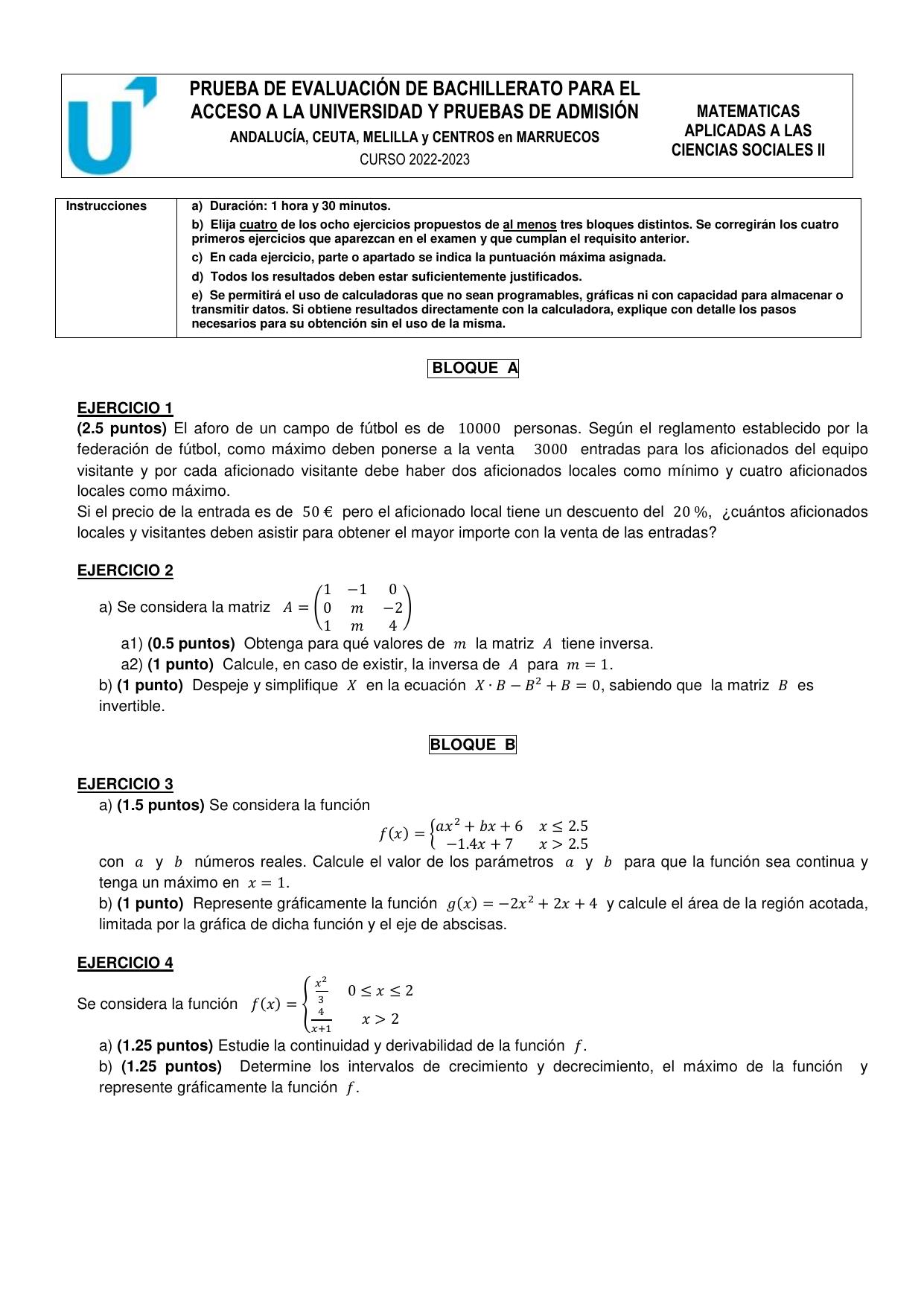
A=(1100m21m4)A = \begin{pmatrix} 1 & -1 & 0 \\ 0 & m & -2 \\ 1 & m & 4 \end{pmatrix}
a1) Obtenga para qué valores de mm la matriz AA tiene inversa.a2) Calcule, en caso de existir, la inversa de AA para m=1m = 1.b) Despeje y simplifique XX en la ecuación XBB2+B=0X \cdot B - B^2 + B = 0, sabiendo que la matriz BB es invertible.
MatricesInversa de una matrizEcuaciones matriciales
a1) Obtenga para qué valores de mm la matriz AA tiene inversa.

Una matriz tiene inversa si y solo si su determinante es distinto de cero. Calculamos el determinante de AA:

det(A)=1100m21m4\det(A) = \begin{vmatrix} 1 & -1 & 0 \\ 0 & m & -2 \\ 1 & m & 4 \end{vmatrix}
det(A)=1(m4(2)m)(1)(04(2)1)+0(0mm1)\det(A) = 1(m \cdot 4 - (-2) \cdot m) - (-1)(0 \cdot 4 - (-2) \cdot 1) + 0(0 \cdot m - m \cdot 1)
det(A)=1(4m+2m)+1(0+2)+0\det(A) = 1(4m + 2m) + 1(0 + 2) + 0
det(A)=6m+2\det(A) = 6m + 2

Para que la matriz AA tenga inversa, el determinante debe ser distinto de cero:

6m+206m + 2 \neq 0
6m26m \neq -2
m26m \neq -\frac{2}{6}
m13m \neq -\frac{1}{3}

La matriz AA tiene inversa para todos los valores de mRm \in \mathbb{R} tales que m13m \neq -\frac{1}{3}.

a2) Calcule, en caso de existir, la inversa de AA para m=1m = 1.

Dado que m=113m = 1 \neq -\frac{1}{3}, la inversa existe. Sustituimos m=1m = 1 en la matriz AA:

A=(110012114)A = \begin{pmatrix} 1 & -1 & 0 \\ 0 & 1 & -2 \\ 1 & 1 & 4 \end{pmatrix}

Calculamos el determinante para m=1m=1:

det(A)=6(1)+2=8\det(A) = 6(1) + 2 = 8

Ahora calculamos la matriz de adjuntos C=(Aij)C = (A_{ij}):

A11=1214=14(2)1=4+2=6A_{11} = \begin{vmatrix} 1 & -2 \\ 1 & 4 \end{vmatrix} = 1 \cdot 4 - (-2) \cdot 1 = 4 + 2 = 6
A12=0214=(04(2)1)=(0+2)=2A_{12} = -\begin{vmatrix} 0 & -2 \\ 1 & 4 \end{vmatrix} = -(0 \cdot 4 - (-2) \cdot 1) = -(0 + 2) = -2
A13=0111=0111=01=1A_{13} = \begin{vmatrix} 0 & 1 \\ 1 & 1 \end{vmatrix} = 0 \cdot 1 - 1 \cdot 1 = 0 - 1 = -1
A21=1014=((1)401)=(40)=4A_{21} = -\begin{vmatrix} -1 & 0 \\ 1 & 4 \end{vmatrix} = -((-1) \cdot 4 - 0 \cdot 1) = -(-4 - 0) = 4
A22=1014=1401=40=4A_{22} = \begin{vmatrix} 1 & 0 \\ 1 & 4 \end{vmatrix} = 1 \cdot 4 - 0 \cdot 1 = 4 - 0 = 4
A23=1111=(11(1)1)=(1+1)=2A_{23} = -\begin{vmatrix} 1 & -1 \\ 1 & 1 \end{vmatrix} = -(1 \cdot 1 - (-1) \cdot 1) = -(1 + 1) = -2
A31=1012=(1)(2)01=20=2A_{31} = \begin{vmatrix} -1 & 0 \\ 1 & -2 \end{vmatrix} = (-1) \cdot (-2) - 0 \cdot 1 = 2 - 0 = 2
A32=1002=(1(2)00)=(20)=2A_{32} = -\begin{vmatrix} 1 & 0 \\ 0 & -2 \end{vmatrix} = -(1 \cdot (-2) - 0 \cdot 0) = -(-2 - 0) = 2
A33=1101=11(1)0=10=1A_{33} = \begin{vmatrix} 1 & -1 \\ 0 & 1 \end{vmatrix} = 1 \cdot 1 - (-1) \cdot 0 = 1 - 0 = 1

La matriz de cofactores es:

C=(621442221)C = \begin{pmatrix} 6 & -2 & -1 \\ 4 & 4 & -2 \\ 2 & 2 & 1 \end{pmatrix}

La matriz adjunta es la traspuesta de la matriz de cofactores:

Adj(A)=CT=(642242121)Adj(A) = C^T = \begin{pmatrix} 6 & 4 & 2 \\ -2 & 4 & 2 \\ -1 & -2 & 1 \end{pmatrix}

Finalmente, la inversa de AA es A1=1det(A)Adj(A)A^{-1} = \frac{1}{\det(A)} \text{Adj}(A):

A1=18(642242121)A^{-1} = \frac{1}{8} \begin{pmatrix} 6 & 4 & 2 \\ -2 & 4 & 2 \\ -1 & -2 & 1 \end{pmatrix}
A1=(6/84/82/82/84/82/81/82/81/8)A^{-1} = \begin{pmatrix} 6/8 & 4/8 & 2/8 \\ -2/8 & 4/8 & 2/8 \\ -1/8 & -2/8 & 1/8 \end{pmatrix}
A1=(3/41/21/41/41/21/41/81/41/8)A^{-1} = \begin{pmatrix} 3/4 & 1/2 & 1/4 \\ -1/4 & 1/2 & 1/4 \\ -1/8 & -1/4 & 1/8 \end{pmatrix}
b) Despeje y simplifique XX en la ecuación XBB2+B=0X \cdot B - B^2 + B = 0, sabiendo que la matriz BB es invertible.

Partimos de la ecuación dada:

XBB2+B=0X \cdot B - B^2 + B = 0

Sumamos B2B^2 y restamos BB a ambos lados de la ecuación para aislar el término con XX:

XB=B2BX \cdot B = B^2 - B

Dado que la matriz BB es invertible, podemos multiplicar por su inversa B1B^{-1} por la derecha en ambos lados de la ecuación. Es crucial mantener el orden de la multiplicación, ya que la multiplicación de matrices no es conmutativa:

(XB)B1=(B2B)B1(X \cdot B) \cdot B^{-1} = (B^2 - B) \cdot B^{-1}

Aplicamos la propiedad asociativa X(BB1)X \cdot (B \cdot B^{-1}) a la izquierda y la propiedad distributiva B2B1BB1B^2 \cdot B^{-1} - B \cdot B^{-1} a la derecha:

X(BB1)=B2B1BB1X \cdot (B \cdot B^{-1}) = B^2 \cdot B^{-1} - B \cdot B^{-1}

Sabiendo que BB1=IB \cdot B^{-1} = I (matriz identidad):

XI=B2B1IX \cdot I = B^2 \cdot B^{-1} - I

Como XI=XX \cdot I = X y B2B1=B(BB1)=BI=BB^2 \cdot B^{-1} = B \cdot (B \cdot B^{-1}) = B \cdot I = B:

X=BIX = B - I

La expresión simplificada para XX es X=BIX = B - I, donde II es la matriz identidad del mismo orden que BB.

Ecuaciones matriciales
Problema
2023 · Ordinaria · Titular
2
Examen
BLOQUE A - EJERCICIO 2

Dadas las matrices:

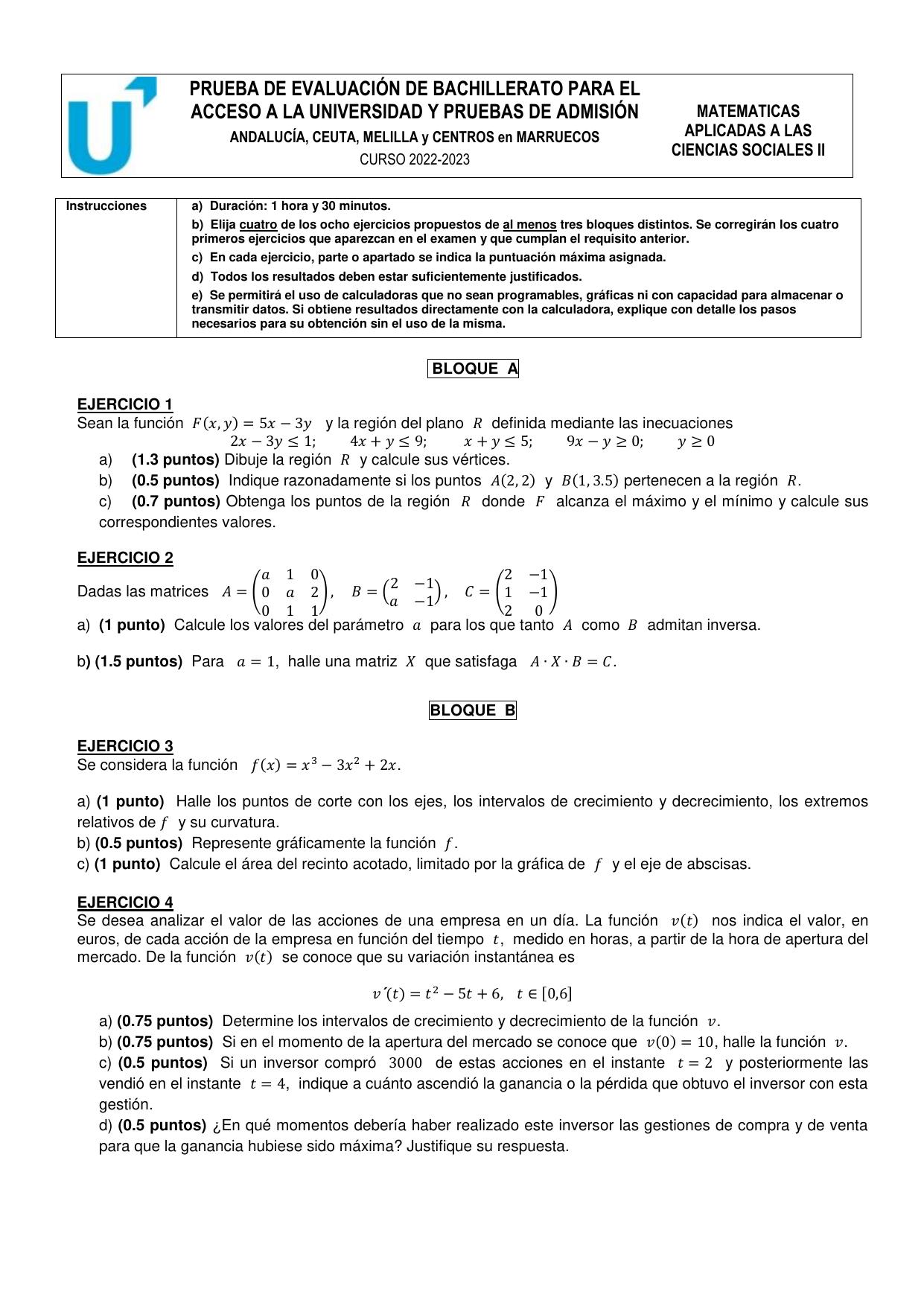
A=(a100a2011),B=(21a1),C=(211120)A = \begin{pmatrix} a & 1 & 0 \\ 0 & a & 2 \\ 0 & 1 & 1 \\ \end{pmatrix}, \quad B = \begin{pmatrix} 2 & -1 \\ a & -1 \\ \end{pmatrix}, \quad C = \begin{pmatrix} 2 & -1 \\ 1 & -1 \\ 2 & 0 \\ \end{pmatrix}
a) Calcule los valores del parámetro aa para los que tanto AA como BB admitan inversa.b) Para a=1a = 1, halle una matriz XX que satisfaga AXB=CA \cdot X \cdot B = C.
MatricesMatriz InversaEcuación Matricial
a) Calcule los valores del parámetro aa para los que tanto AA como BB admitan inversa.

Para que una matriz admita inversa, su determinante debe ser distinto de cero.Calculamos el determinante de la matriz A=(a100a2011)A = \begin{pmatrix} a & 1 & 0 \\ 0 & a & 2 \\ 0 & 1 & 1 \\ \end{pmatrix}:

det(A)=aa21110201+00a01\det(A) = a \begin{vmatrix} a & 2 \\ 1 & 1 \end{vmatrix} - 1 \begin{vmatrix} 0 & 2 \\ 0 & 1 \end{vmatrix} + 0 \begin{vmatrix} 0 & a \\ 0 & 1 \end{vmatrix}
det(A)=a(a121)1(00)+0=a(a2)\det(A) = a(a \cdot 1 - 2 \cdot 1) - 1(0 - 0) + 0 = a(a-2)

Para que AA tenga inversa, det(A)0\det(A) \neq 0, lo que implica:

a(a2)0    a0ya2a(a-2) \neq 0 \implies a \neq 0 \quad \text{y} \quad a \neq 2

Ahora calculamos el determinante de la matriz B=(21a1)B = \begin{pmatrix} 2 & -1 \\ a & -1 \\ \end{pmatrix}:

\det(B) = (2)(-1) - (-1)(a) = -2 + a

Para que BB tenga inversa, det(B)0\det(B) \neq 0, lo que implica:

2+a0    a2-2 + a \neq 0 \implies a \neq 2

Para que ambas matrices, AA y BB, admitan inversa, se deben cumplir todas las condiciones simultáneamente.

a0ya2a \neq 0 \quad \text{y} \quad a \neq 2
b) Para a=1a = 1, halle una matriz XX que satisfaga AXB=CA \cdot X \cdot B = C.

Sustituimos a=1a=1 en las matrices AA y BB:

A=(110012011),B=(2111),C=(211120)A = \begin{pmatrix} 1 & 1 & 0 \\ 0 & 1 & 2 \\ 0 & 1 & 1 \\ \end{pmatrix}, \quad B = \begin{pmatrix} 2 & -1 \\ 1 & -1 \\ \end{pmatrix}, \quad C = \begin{pmatrix} 2 & -1 \\ 1 & -1 \\ 2 & 0 \\ \end{pmatrix}

La ecuación a resolver es AXB=CA \cdot X \cdot B = C. Para despejar XX, multiplicamos por la inversa de AA por la izquierda y por la inversa de BB por la derecha:

A1(AXB)B1=A1CB1A^{-1} \cdot (A \cdot X \cdot B) \cdot B^{-1} = A^{-1} \cdot C \cdot B^{-1}
(A1A)X(BB1)=A1CB1(A^{-1} \cdot A) \cdot X \cdot (B \cdot B^{-1}) = A^{-1} \cdot C \cdot B^{-1}
IXI=A1CB1I \cdot X \cdot I = A^{-1} \cdot C \cdot B^{-1}
X=A1CB1X = A^{-1} \cdot C \cdot B^{-1}

Calculamos A1A^{-1} para a=1a=1:

A=(110012011)A = \begin{pmatrix} 1 & 1 & 0 \\ 0 & 1 & 2 \\ 0 & 1 & 1 \\ \end{pmatrix}

Ya hemos calculado det(A)=a(a2)\det(A) = a(a-2). Para a=1a=1, det(A)=1(12)=1\det(A) = 1(1-2) = -1.Calculamos la matriz de cofactores McofM_{cof}:

Mcof=(+(1)(0)+(0)(1)+(1)(1)+(2)(2)+(1))=(100111221)M_{cof} = \begin{pmatrix} +(-1) & -(0) & +(0) \\ -(1) & +(1) & -(-1) \\ +(2) & -(-2) & +(1) \\ \end{pmatrix} = \begin{pmatrix} -1 & 0 & 0 \\ -1 & 1 & 1 \\ 2 & 2 & 1 \\ \end{pmatrix}

La matriz adjunta es la traspuesta de la matriz de cofactores:

adj(A)=McofT=(112012011)\text{adj}(A) = M_{cof}^T = \begin{pmatrix} -1 & -1 & 2 \\ 0 & 1 & 2 \\ 0 & 1 & 1 \\ \end{pmatrix}

La matriz inversa A1A^{-1} es:

A1=1det(A)adj(A)=11(112012011)=(112012011)A^{-1} = \frac{1}{\det(A)} \text{adj}(A) = \frac{1}{-1} \begin{pmatrix} -1 & -1 & 2 \\ 0 & 1 & 2 \\ 0 & 1 & 1 \\ \end{pmatrix} = \begin{pmatrix} 1 & 1 & -2 \\ 0 & -1 & -2 \\ 0 & -1 & -1 \\ \end{pmatrix}

Revisando adjunta, M23=((1)(1)(0)(1))=1M_{23} = -((1)(1) - (0)(1)) = -1, entonces Mcof23=(1)=1M_{cof_{23}} = -(-1) = 1. M32=((1)(2)(0)(0))=2M_{32} = -((1)(2) - (0)(0)) = -2, Mcof32=(2)=2M_{cof_{32}} = -(-2) = 2. Así que adjunta es:

adj(A)=(112012011)\text{adj}(A) = \begin{pmatrix} -1 & -1 & 2 \\ 0 & 1 & -2 \\ 0 & -1 & 1 \\ \end{pmatrix}
A1=11(112012011)=(112012011)A^{-1} = \frac{1}{-1} \begin{pmatrix} -1 & -1 & 2 \\ 0 & 1 & -2 \\ 0 & -1 & 1 \\ \end{pmatrix} = \begin{pmatrix} 1 & 1 & -2 \\ 0 & -1 & 2 \\ 0 & 1 & -1 \\ \end{pmatrix}

Calculamos B1B^{-1} para a=1a=1:

B=(2111)B = \begin{pmatrix} 2 & -1 \\ 1 & -1 \\ \end{pmatrix}

Ya hemos calculado det(B)=2+a\det(B) = -2 + a. Para a=1a=1, det(B)=2+1=1\det(B) = -2 + 1 = -1.

B1=1det(B)adj(B)=11(1112)=(1112)B^{-1} = \frac{1}{\det(B)} \text{adj}(B) = \frac{1}{-1} \begin{pmatrix} -1 & 1 \\ -1 & 2 \\ \end{pmatrix} = \begin{pmatrix} 1 & -1 \\ 1 & -2 \\ \end{pmatrix}

Ahora calculamos el producto A1CA^{-1} \cdot C:

A1C=(112012011)(211120)A^{-1} \cdot C = \begin{pmatrix} 1 & 1 & -2 \\ 0 & -1 & 2 \\ 0 & 1 & -1 \\ \end{pmatrix} \cdot \begin{pmatrix} 2 & -1 \\ 1 & -1 \\ 2 & 0 \\ \end{pmatrix}
A1C=((1)(2)+(1)(1)+(2)(2)(1)(1)+(1)(1)+(2)(0)(0)(2)+(1)(1)+(2)(2)(0)(1)+(1)(1)+(2)(0)(0)(2)+(1)(1)+(1)(2)(0)(1)+(1)(1)+(1)(0))A^{-1} \cdot C = \begin{pmatrix} (1)(2)+(1)(1)+(-2)(2) & (1)(-1)+(1)(-1)+(-2)(0) \\ (0)(2)+(-1)(1)+(2)(2) & (0)(-1)+(-1)(-1)+(2)(0) \\ (0)(2)+(1)(1)+(-1)(2) & (0)(-1)+(1)(-1)+(-1)(0) \\ \end{pmatrix}
A1C=(2+1411+001+40+1+00+1201+0)=(123111)A^{-1} \cdot C = \begin{pmatrix} 2+1-4 & -1-1+0 \\ 0-1+4 & 0+1+0 \\ 0+1-2 & 0-1+0 \\ \end{pmatrix} = \begin{pmatrix} -1 & -2 \\ 3 & 1 \\ -1 & -1 \\ \end{pmatrix}

Finalmente, calculamos X=(A1C)B1X = (A^{-1} \cdot C) \cdot B^{-1}:

X=(123111)(1112)X = \begin{pmatrix} -1 & -2 \\ 3 & 1 \\ -1 & -1 \\ \end{pmatrix} \cdot \begin{pmatrix} 1 & -1 \\ 1 & -2 \\ \end{pmatrix}
X=((1)(1)+(2)(1)(1)(1)+(2)(2)(3)(1)+(1)(1)(3)(1)+(1)(2)(1)(1)+(1)(1)(1)(1)+(1)(2))X = \begin{pmatrix} (-1)(1)+(-2)(1) & (-1)(-1)+(-2)(-2) \\ (3)(1)+(1)(1) & (3)(-1)+(1)(-2) \\ (-1)(1)+(-1)(1) & (-1)(-1)+(-1)(-2) \\ \end{pmatrix}
X=(121+43+132111+2)X = \begin{pmatrix} -1-2 & 1+4 \\ 3+1 & -3-2 \\ -1-1 & 1+2 \\ \end{pmatrix}
X=(354523)X = \begin{pmatrix} -3 & 5 \\ 4 & -5 \\ -2 & 3 \\ \end{pmatrix}
Matrices y problemas con matrices
Problema
2023 · Extraordinaria · Reserva
1
Examen

Una conservera fabrica latas de pisto con tomate, cebolla y pimiento siguiendo dos recetas distintas. La matriz (500300200600100300)\begin{pmatrix} 500 & 300 & 200 \\ 600 & 100 & 300 \end{pmatrix} indica los gramos necesarios de cada producto para conseguir una lata de cada receta. Se dispone de dos proveedores, siendo la matriz de precios en euros por kilo de cada producto (0.50.40.60.40.50.7)\begin{pmatrix} 0.5 & 0.4 & 0.6 \\ 0.4 & 0.5 & 0.7 \end{pmatrix}. Los costes de producción de cada receta en euros por lata vienen dados por la matriz (0.110.09)(0.11 \quad 0.09). Los costes de transporte en euros por lata según cada proveedor vienen dados por la matriz (0.020.03)(0.02 \quad 0.03). La conservera quiere obtener un beneficio de 5 céntimos por lata. Una distribuidora compra 11000 latas de la primera receta, siendo 5000 del primer proveedor, y otras 11000 de la segunda receta, siendo 6000 del primer proveedor. ¿Cuánto debe cobrar la conservera por el pedido de esta distribuidora?

MatricesCostes de producciónOperaciones con matrices

Definimos las matrices dadas y realizamos las conversiones de unidades necesarias. La matriz de ingredientes está dada en gramos, por lo que la convertiremos a kilogramos para que sea compatible con la matriz de precios.

Mingredientes=(500300200600100300) (gramos por lata)M_{ingredientes} = \begin{pmatrix} 500 & 300 & 200 \\ 600 & 100 & 300 \end{pmatrix} \text{ (gramos por lata)}
Mingredientes=(0.50.30.20.60.10.3) (kilogramos por lata)M'_{ingredientes} = \begin{pmatrix} 0.5 & 0.3 & 0.2 \\ 0.6 & 0.1 & 0.3 \end{pmatrix} \text{ (kilogramos por lata)}
Mprecios=(0.50.40.60.40.50.7) (euros por kilogramo, por proveedor)M_{precios} = \begin{pmatrix} 0.5 & 0.4 & 0.6 \\ 0.4 & 0.5 & 0.7 \end{pmatrix} \text{ (euros por kilogramo, por proveedor)}
Mcostes_produccioˊn=(0.110.09) (euros por lata, por receta)M_{costes\_producción} = \begin{pmatrix} 0.11 & 0.09 \end{pmatrix} \text{ (euros por lata, por receta)}
Mcostes_transporte=(0.020.03) (euros por lata, por proveedor)M_{costes\_transporte} = \begin{pmatrix} 0.02 & 0.03 \end{pmatrix} \text{ (euros por lata, por proveedor)}

El beneficio deseado es de 0.050.05 euros por lata.

Paso 1: Cálculo del coste de ingredientes por lata

Para calcular el coste de los ingredientes por lata para cada receta y cada proveedor, multiplicamos la matriz de ingredientes en kilogramos (MingredientesM'_{ingredientes}) por la traspuesta de la matriz de precios (MpreciosTM_{precios}^T). Las filas de MingredientesM'_{ingredientes} representan las recetas y las columnas los ingredientes. Las filas de MpreciosM_{precios} representan los proveedores y las columnas los precios de los ingredientes. Para obtener el coste de ingredientes por lata (Receta, Proveedor), realizamos el siguiente producto matricial:

Cingredientes=MingredientesMpreciosTC_{ingredientes} = M'_{ingredientes} \cdot M_{precios}^T
Cingredientes=(0.50.30.20.60.10.3)(0.50.40.40.50.60.7)C_{ingredientes} = \begin{pmatrix} 0.5 & 0.3 & 0.2 \\ 0.6 & 0.1 & 0.3 \end{pmatrix} \cdot \begin{pmatrix} 0.5 & 0.4 \\ 0.4 & 0.5 \\ 0.6 & 0.7 \end{pmatrix}
Cingredientes=((0.50.5)+(0.30.4)+(0.20.6)(0.50.4)+(0.30.5)+(0.20.7)(0.60.5)+(0.10.4)+(0.30.6)(0.60.4)+(0.10.5)+(0.30.7))C_{ingredientes} = \begin{pmatrix} (0.5\cdot0.5) + (0.3\cdot0.4) + (0.2\cdot0.6) & (0.5\cdot0.4) + (0.3\cdot0.5) + (0.2\cdot0.7) \\ (0.6\cdot0.5) + (0.1\cdot0.4) + (0.3\cdot0.6) & (0.6\cdot0.4) + (0.1\cdot0.5) + (0.3\cdot0.7) \end{pmatrix}
Cingredientes=(0.25+0.12+0.120.20+0.15+0.140.30+0.04+0.180.24+0.05+0.21)C_{ingredientes} = \begin{pmatrix} 0.25 + 0.12 + 0.12 & 0.20 + 0.15 + 0.14 \\ 0.30 + 0.04 + 0.18 & 0.24 + 0.05 + 0.21 \end{pmatrix}
Cingredientes=(0.490.490.520.50) (euros por lata, por receta y proveedor)C_{ingredientes} = \begin{pmatrix} 0.49 & 0.49 \\ 0.52 & 0.50 \end{pmatrix} \text{ (euros por lata, por receta y proveedor)}
Paso 2: Cálculo del coste total por lata

El coste total por lata se obtiene sumando el coste de los ingredientes, el coste de producción (dependiente de la receta) y el coste de transporte (dependiente del proveedor). Los costes de producción se aplican por receta, y los de transporte por proveedor.

Ctotal(i,j)=Cingredientes(i,j)+Mcostes_produccioˊn(i)+Mcostes_transporte(j)C_{total}(i,j) = C_{ingredientes}(i,j) + M_{costes\_producción}(i) + M_{costes\_transporte}(j)
Ctotal(1,1)=0.49+0.11+0.02=0.62 (Receta 1, Proveedor 1)C_{total}(1,1) = 0.49 + 0.11 + 0.02 = 0.62 \text{ (Receta 1, Proveedor 1)}
Ctotal(1,2)=0.49+0.11+0.03=0.63 (Receta 1, Proveedor 2)C_{total}(1,2) = 0.49 + 0.11 + 0.03 = 0.63 \text{ (Receta 1, Proveedor 2)}
Ctotal(2,1)=0.52+0.09+0.02=0.63 (Receta 2, Proveedor 1)C_{total}(2,1) = 0.52 + 0.09 + 0.02 = 0.63 \text{ (Receta 2, Proveedor 1)}
Ctotal(2,2)=0.50+0.09+0.03=0.62 (Receta 2, Proveedor 2)C_{total}(2,2) = 0.50 + 0.09 + 0.03 = 0.62 \text{ (Receta 2, Proveedor 2)}
Ctotal=(0.620.630.630.62) (euros por lata)C_{total} = \begin{pmatrix} 0.62 & 0.63 \\ 0.63 & 0.62 \end{pmatrix} \text{ (euros por lata)}
Paso 3: Cálculo del precio de venta por lata

Para obtener el precio de venta por lata, sumamos el beneficio deseado (0.050.05 euros) al coste total por lata.

Pventa(i,j)=Ctotal(i,j)+0.05P_{venta}(i,j) = C_{total}(i,j) + 0.05
Pventa(1,1)=0.62+0.05=0.67P_{venta}(1,1) = 0.62 + 0.05 = 0.67
Pventa(1,2)=0.63+0.05=0.68P_{venta}(1,2) = 0.63 + 0.05 = 0.68
Pventa(2,1)=0.63+0.05=0.68P_{venta}(2,1) = 0.63 + 0.05 = 0.68
Pventa(2,2)=0.62+0.05=0.67P_{venta}(2,2) = 0.62 + 0.05 = 0.67
Pventa=(0.670.680.680.67) (euros por lata)P_{venta} = \begin{pmatrix} 0.67 & 0.68 \\ 0.68 & 0.67 \end{pmatrix} \text{ (euros por lata)}
Paso 4: Cálculo del importe total del pedido

La distribuidora compra: - 11000 latas de la primera receta, de las cuales 5000 son del primer proveedor y el resto (6000) del segundo proveedor. - 11000 latas de la segunda receta, de las cuales 6000 son del primer proveedor y el resto (5000) del segundo proveedor.

Importe total=(5000Pventa(1,1))+(6000Pventa(1,2))+(6000Pventa(2,1))+(5000Pventa(2,2))\text{Importe total} = (5000 \cdot P_{venta}(1,1)) + (6000 \cdot P_{venta}(1,2)) + (6000 \cdot P_{venta}(2,1)) + (5000 \cdot P_{venta}(2,2))
Importe total=(50000.67)+(60000.68)+(60000.68)+(50000.67)\text{Importe total} = (5000 \cdot 0.67) + (6000 \cdot 0.68) + (6000 \cdot 0.68) + (5000 \cdot 0.67)
Importe total=3350+4080+4080+3350\text{Importe total} = 3350 + 4080 + 4080 + 3350
Importe total=14860 euros\text{Importe total} = 14860 \text{ euros}

La conservera debe cobrar 1486014860 euros por el pedido de esta distribuidora.
Operaciones con matrices y sistemas matriciales
Problema
2023 · Extraordinaria · Titular
2
Examen

Se consideran las matrices

A=(576704031),B=(1292011047),C=(121)A = \begin{pmatrix} 5 & -7 & 6 \\ 7 & 0 & 4 \\ 0 & 3 & -1 \end{pmatrix}, \quad B = \begin{pmatrix} 1 & 2 & -9 \\ -2 & 0 & 11 \\ 0 & 4 & -7 \end{pmatrix}, \quad C = \begin{pmatrix} 1 \\ 2 \\ -1 \end{pmatrix}
a) Halle las dimensiones de las siguientes matrices CtAC,ACCtBC^tAC, ACC^tB.b) Calcule, en caso de existir, las inversas de las matrices AA y BB.c) Resuelva el siguiente sistema matricial
{2X+3Y=A3X+4Y=B\begin{cases} 2X + 3Y = A \\ -3X + 4Y = B \end{cases}
MatricesMatriz inversaEcuación matricial
a) Halle las dimensiones de las siguientes matrices CtAC,ACCtBC^tAC, ACC^tB.

Las dimensiones de las matrices dadas son:AA es de dimensión 3×33 \times 3 BB es de dimensión 3×33 \times 3 CC es de dimensión 3×13 \times 1 Por lo tanto, CtC^t es de dimensión 1×31 \times 3.Para CtACC^tAC:

(1×3)(3×3)(3×1)(1×3)(3×1)1×1(1 \times 3) \cdot (3 \times 3) \cdot (3 \times 1) \rightarrow (1 \times 3) \cdot (3 \times 1) \rightarrow 1 \times 1

La dimensión de CtACC^tAC es 1×11 \times 1.Para ACCtBACC^tB:

(3×3)(3×1)(1×3)(3×3)(3 \times 3) \cdot (3 \times 1) \cdot (1 \times 3) \cdot (3 \times 3)

Primero, calculemos las dimensiones de los productos intermedios:CCtC C^t: (3×1)(1×3)3×3(3 \times 1) \cdot (1 \times 3) \rightarrow 3 \times 3 Entonces, A(CCt)BA(CC^t)B: (3×3)(3×3)(3×3)(3×3)(3×3)3×3(3 \times 3) \cdot (3 \times 3) \cdot (3 \times 3) \rightarrow (3 \times 3) \cdot (3 \times 3) \rightarrow 3 \times 3 La dimensión de ACCtBACC^tB es 3×33 \times 3.

b) Calcule, en caso de existir, las inversas de las matrices AA y BB.

Cálculo de la inversa de AA:

A=(576704031)A = \begin{pmatrix} 5 & -7 & 6 \\ 7 & 0 & 4 \\ 0 & 3 & -1 \end{pmatrix}

Primero, calculamos el determinante de AA:

det(A)=5det(0431)(7)det(7401)+6det(7003)\det(A) = 5 \cdot \det\begin{pmatrix} 0 & 4 \\ 3 & -1 \end{pmatrix} - (-7) \cdot \det\begin{pmatrix} 7 & 4 \\ 0 & -1 \end{pmatrix} + 6 \cdot \det\begin{pmatrix} 7 & 0 \\ 0 & 3 \end{pmatrix}
det(A)=5(0(1)43)+7(7(1)40)+6(7300)\det(A) = 5(0 \cdot (-1) - 4 \cdot 3) + 7(7 \cdot (-1) - 4 \cdot 0) + 6(7 \cdot 3 - 0 \cdot 0)
det(A)=5(12)+7(7)+6(21)\det(A) = 5(-12) + 7(-7) + 6(21)
det(A)=6049+126=17\det(A) = -60 - 49 + 126 = 17

Dado que det(A)=170\det(A) = 17 \neq 0, la matriz AA tiene inversa.A continuación, calculamos la matriz de cofactores CijC_{ij}:

C11=12,C12=7,C13=21C_{11} = -12, \quad C_{12} = 7, \quad C_{13} = 21
C21=11,C22=5,C23=15C_{21} = 11, \quad C_{22} = -5, \quad C_{23} = -15
C31=28,C32=22,C33=49C_{31} = -28, \quad C_{32} = 22, \quad C_{33} = 49

La matriz adjunta Adj(A)Adj(A) es la traspuesta de la matriz de cofactores:

Adj(A)=(1211287522211549)Adj(A) = \begin{pmatrix} -12 & 11 & -28 \\ 7 & -5 & 22 \\ 21 & -15 & 49 \end{pmatrix}

Finalmente, la inversa de AA es:

A1=1det(A)Adj(A)=117(1211287522211549)A^{-1} = \frac{1}{\det(A)} Adj(A) = \frac{1}{17} \begin{pmatrix} -12 & 11 & -28 \\ 7 & -5 & 22 \\ 21 & -15 & 49 \end{pmatrix}

Cálculo de la inversa de BB:

B=(1292011047)B = \begin{pmatrix} 1 & 2 & -9 \\ -2 & 0 & 11 \\ 0 & 4 & -7 \end{pmatrix}

Calculamos el determinante de BB:

det(B)=1det(01147)2det(21107)+(9)det(2004)\det(B) = 1 \cdot \det\begin{pmatrix} 0 & 11 \\ 4 & -7 \end{pmatrix} - 2 \cdot \det\begin{pmatrix} -2 & 11 \\ 0 & -7 \end{pmatrix} + (-9) \cdot \det\begin{pmatrix} -2 & 0 \\ 0 & 4 \end{pmatrix}
det(B)=1(0(7)114)2((2)(7)110)9((2)400)\det(B) = 1(0 \cdot (-7) - 11 \cdot 4) - 2((-2) \cdot (-7) - 11 \cdot 0) - 9((-2) \cdot 4 - 0 \cdot 0)
det(B)=1(44)2(14)9(8)\det(B) = 1(-44) - 2(14) - 9(-8)
det(B)=4428+72\det(B) = -44 - 28 + 72
det(B)=0\det(B) = 0

Dado que det(B)=0\det(B) = 0, la matriz BB no tiene inversa.

c) Resuelva el siguiente sistema matricial {2X+3Y=A3X+4Y=B\begin{cases} 2X + 3Y = A \\ -3X + 4Y = B \end{cases}

Multiplicamos la primera ecuación por 3 y la segunda por 2 para eliminar XX:

{6X+9Y=3A6X+8Y=2B\begin{cases} 6X + 9Y = 3A \\ -6X + 8Y = 2B \end{cases}

Sumando ambas ecuaciones:

(6X+9Y)+(6X+8Y)=3A+2B(6X + 9Y) + (-6X + 8Y) = 3A + 2B
17Y=3A+2B17Y = 3A + 2B
Y=117(3A+2B)Y = \frac{1}{17}(3A + 2B)

Ahora, sustituimos YY en la primera ecuación para despejar XX:

2X=A3Y2X = A - 3Y
X=12(A3Y)X = \frac{1}{2}(A - 3Y)
X=12(A3(117(3A+2B)))X = \frac{1}{2}\left(A - 3\left(\frac{1}{17}(3A + 2B)\right)\right)
X=12(A917A617B)X = \frac{1}{2}\left(A - \frac{9}{17}A - \frac{6}{17}B\right)
X=12(17A9A176B17)X = \frac{1}{2}\left(\frac{17A - 9A}{17} - \frac{6B}{17}\right)
X=12(8A176B17)X = \frac{1}{2}\left(\frac{8A}{17} - \frac{6B}{17}\right)
X=4A173B17=117(4A3B)X = \frac{4A}{17} - \frac{3B}{17} = \frac{1}{17}(4A - 3B)

Calculamos 3A+2B3A + 2B:

3A=3(576704031)=(15211821012093)3A = 3 \begin{pmatrix} 5 & -7 & 6 \\ 7 & 0 & 4 \\ 0 & 3 & -1 \end{pmatrix} = \begin{pmatrix} 15 & -21 & 18 \\ 21 & 0 & 12 \\ 0 & 9 & -3 \end{pmatrix}
2B=2(1292011047)=(241840220814)2B = 2 \begin{pmatrix} 1 & 2 & -9 \\ -2 & 0 & 11 \\ 0 & 4 & -7 \end{pmatrix} = \begin{pmatrix} 2 & 4 & -18 \\ -4 & 0 & 22 \\ 0 & 8 & -14 \end{pmatrix}
3A+2B=(15+221+418182140+012+220+09+8314)=(171701703401717)3A + 2B = \begin{pmatrix} 15+2 & -21+4 & 18-18 \\ 21-4 & 0+0 & 12+22 \\ 0+0 & 9+8 & -3-14 \end{pmatrix} = \begin{pmatrix} 17 & -17 & 0 \\ 17 & 0 & 34 \\ 0 & 17 & -17 \end{pmatrix}

Por lo tanto, la matriz YY es:

Y=117(171701703401717)=(110102011)Y = \frac{1}{17} \begin{pmatrix} 17 & -17 & 0 \\ 17 & 0 & 34 \\ 0 & 17 & -17 \end{pmatrix} = \begin{pmatrix} 1 & -1 & 0 \\ 1 & 0 & 2 \\ 0 & 1 & -1 \end{pmatrix}

Calculamos 4A3B4A - 3B:

4A=4(576704031)=(202824280160124)4A = 4 \begin{pmatrix} 5 & -7 & 6 \\ 7 & 0 & 4 \\ 0 & 3 & -1 \end{pmatrix} = \begin{pmatrix} 20 & -28 & 24 \\ 28 & 0 & 16 \\ 0 & 12 & -4 \end{pmatrix}
3B=3(1292011047)=(3627603301221)3B = 3 \begin{pmatrix} 1 & 2 & -9 \\ -2 & 0 & 11 \\ 0 & 4 & -7 \end{pmatrix} = \begin{pmatrix} 3 & 6 & -27 \\ -6 & 0 & 33 \\ 0 & 12 & -21 \end{pmatrix}
4A3B=(20328624(27)28(6)0016330012124(21))=(173451340170017)4A - 3B = \begin{pmatrix} 20-3 & -28-6 & 24-(-27) \\ 28-(-6) & 0-0 & 16-33 \\ 0-0 & 12-12 & -4-(-21) \end{pmatrix} = \begin{pmatrix} 17 & -34 & 51 \\ 34 & 0 & -17 \\ 0 & 0 & 17 \end{pmatrix}

Por lo tanto, la matriz XX es:

X=117(173451340170017)=(123201001)X = \frac{1}{17} \begin{pmatrix} 17 & -34 & 51 \\ 34 & 0 & -17 \\ 0 & 0 & 17 \end{pmatrix} = \begin{pmatrix} 1 & -2 & 3 \\ 2 & 0 & -1 \\ 0 & 0 & 1 \end{pmatrix}
Operaciones con matrices y ecuaciones matriciales
Problema
2022 · Ordinaria · Reserva
1
Examen
BLOQUE A

Se consideran las matrices

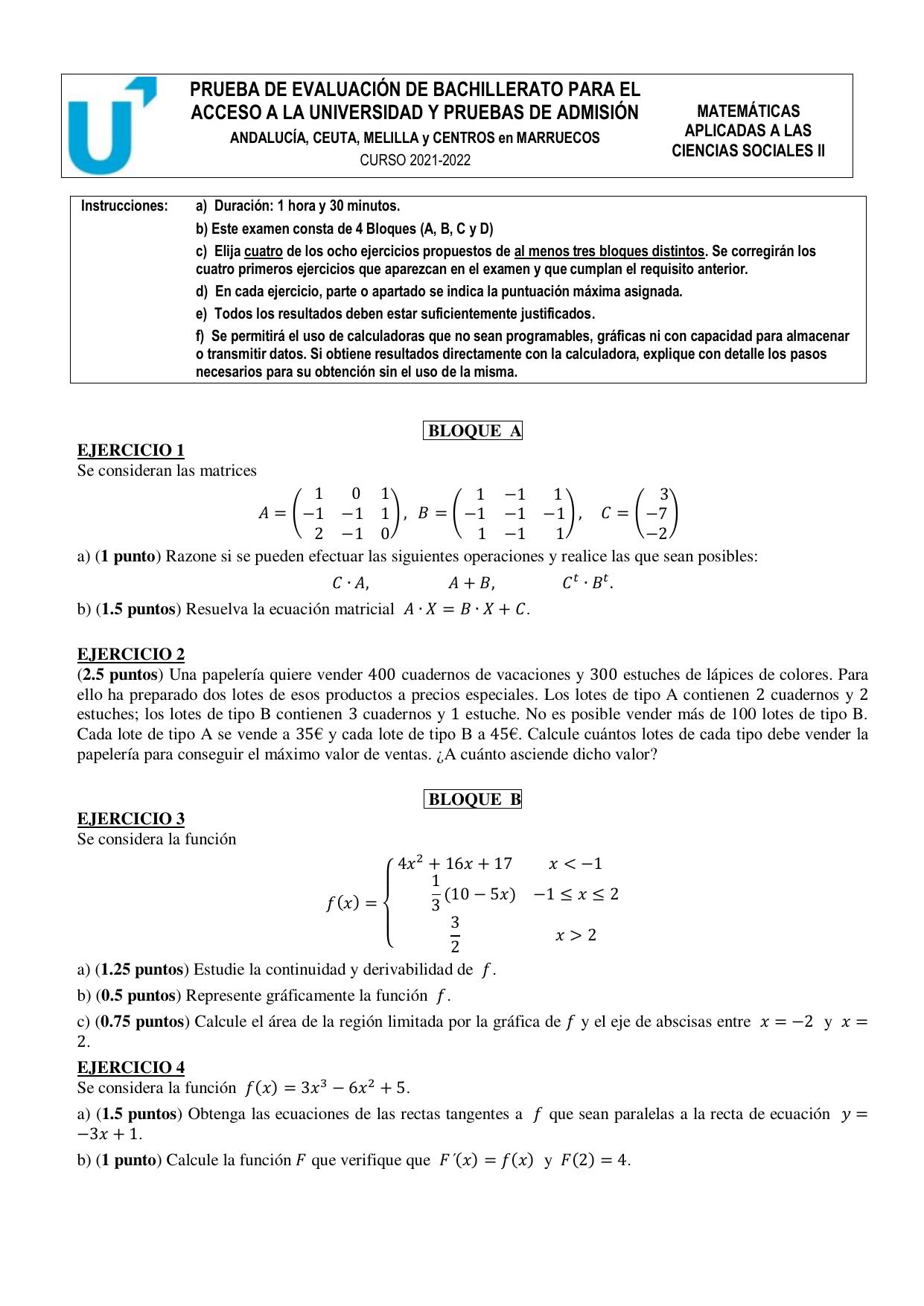
A=(101111210),B=(111111111),C=(372)A = \begin{pmatrix} 1 & 0 & 1 \\ -1 & -1 & 1 \\ 2 & -1 & 0 \end{pmatrix}, B = \begin{pmatrix} 1 & -1 & 1 \\ -1 & -1 & -1 \\ 1 & -1 & 1 \end{pmatrix}, C = \begin{pmatrix} 3 \\ -7 \\ -2 \end{pmatrix}
a) Razone si se pueden efectuar las siguientes operaciones y realice las que sean posibles: CA,A+B,CtBtC \cdot A, A + B, C^t \cdot B^t.b) Resuelva la ecuación matricial AX=BX+CA \cdot X = B \cdot X + C.
MatricesEcuación matricialInversa de una matriz
Resolución del ejercicio

Se tienen las matrices:

A=(101111210),B=(111111111),C=(372)A = \begin{pmatrix} 1 & 0 & 1 \\ -1 & -1 & 1 \\ 2 & -1 & 0 \end{pmatrix}, B = \begin{pmatrix} 1 & -1 & 1 \\ -1 & -1 & -1 \\ 1 & -1 & 1 \end{pmatrix}, C = \begin{pmatrix} 3 \\ -7 \\ -2 \end{pmatrix}

Las dimensiones de estas matrices son:

dim(A)=3×3dim(B)=3×3dim(C)=3×1\text{dim}(A) = 3 \times 3 \quad \text{dim}(B) = 3 \times 3 \quad \text{dim}(C) = 3 \times 1
a) Razone si se pueden efectuar las siguientes operaciones y realice las que sean posibles: CA,A+B,CtBtC \cdot A, A + B, C^t \cdot B^t.

Para la operación CAC \cdot A:

dim(C)=3×1dim(A)=3×3\text{dim}(C) = 3 \times 1 \quad \text{dim}(A) = 3 \times 3

El número de columnas de CC (1) no coincide con el número de filas de AA (3). Por lo tanto, la operación CAC \cdot A no se puede efectuar.Para la operación A+BA + B:

dim(A)=3×3dim(B)=3×3\text{dim}(A) = 3 \times 3 \quad \text{dim}(B) = 3 \times 3

Ambas matrices tienen las mismas dimensiones. Por lo tanto, la operación A+BA + B se puede efectuar. El resultado es:

A+B=(101111210)+(111111111)=(1+1011+11111112+1110+1)=(212220321)A + B = \begin{pmatrix} 1 & 0 & 1 \\ -1 & -1 & 1 \\ 2 & -1 & 0 \end{pmatrix} + \begin{pmatrix} 1 & -1 & 1 \\ -1 & -1 & -1 \\ 1 & -1 & 1 \end{pmatrix} = \begin{pmatrix} 1+1 & 0-1 & 1+1 \\ -1-1 & -1-1 & 1-1 \\ 2+1 & -1-1 & 0+1 \end{pmatrix} = \begin{pmatrix} 2 & -1 & 2 \\ -2 & -2 & 0 \\ 3 & -2 & 1 \end{pmatrix}

Para la operación CtBtC^t \cdot B^t:Primero, calculamos las matrices transpuestas:

Ct=(372)dim(Ct)=1×3C^t = \begin{pmatrix} 3 & -7 & -2 \end{pmatrix} \quad \text{dim}(C^t) = 1 \times 3
Bt=(111111111)t=(111111111)dim(Bt)=3×3B^t = \begin{pmatrix} 1 & -1 & 1 \\ -1 & -1 & -1 \\ 1 & -1 & 1 \end{pmatrix}^t = \begin{pmatrix} 1 & -1 & 1 \\ -1 & -1 & -1 \\ 1 & -1 & 1 \end{pmatrix} \quad \text{dim}(B^t) = 3 \times 3

El número de columnas de CtC^t (3) coincide con el número de filas de BtB^t (3). Por lo tanto, la operación CtBtC^t \cdot B^t se puede efectuar. El resultado es:

CtBt=(372)(111111111)C^t \cdot B^t = \begin{pmatrix} 3 & -7 & -2 \end{pmatrix} \cdot \begin{pmatrix} 1 & -1 & 1 \\ -1 & -1 & -1 \\ 1 & -1 & 1 \end{pmatrix}
=(3(1)+(7)(1)+(2)(1)3(1)+(7)(1)+(2)(1)3(1)+(7)(1)+(2)(1))= \begin{pmatrix} 3(1)+(-7)(-1)+(-2)(1) & 3(-1)+(-7)(-1)+(-2)(-1) & 3(1)+(-7)(-1)+(-2)(1) \end{pmatrix}
=(3+723+7+23+72)=(868)= \begin{pmatrix} 3+7-2 & -3+7+2 & 3+7-2 \end{pmatrix} = \begin{pmatrix} 8 & 6 & 8 \end{pmatrix}
b) Resuelva la ecuación matricial AX=BX+CA \cdot X = B \cdot X + C.

Reordenamos la ecuación para aislar XX:

AXBX=CA \cdot X - B \cdot X = C
(AB)X=C(A - B) \cdot X = C

Sea D=ABD = A - B. Calculamos DD:

D=(101111210)(111111111)=(110(1)111(1)1(1)1(1)211(1)01)=(010002101)D = \begin{pmatrix} 1 & 0 & 1 \\ -1 & -1 & 1 \\ 2 & -1 & 0 \end{pmatrix} - \begin{pmatrix} 1 & -1 & 1 \\ -1 & -1 & -1 \\ 1 & -1 & 1 \end{pmatrix} = \begin{pmatrix} 1-1 & 0-(-1) & 1-1 \\ -1-(-1) & -1-(-1) & 1-(-1) \\ 2-1 & -1-(-1) & 0-1 \end{pmatrix} = \begin{pmatrix} 0 & 1 & 0 \\ 0 & 0 & 2 \\ 1 & 0 & -1 \end{pmatrix}

Ahora, la ecuación es DX=CD \cdot X = C. Para resolverla, necesitamos la inversa de DD, D1D^{-1}. Primero, calculamos el determinante de DD para verificar si es invertible:

det(D)=0det(0201)1det(0211)+0det(0010)\det(D) = 0 \cdot \det\begin{pmatrix} 0 & 2 \\ 0 & -1 \end{pmatrix} - 1 \cdot \det\begin{pmatrix} 0 & 2 \\ 1 & -1 \end{pmatrix} + 0 \cdot \det\begin{pmatrix} 0 & 0 \\ 1 & 0 \end{pmatrix}
det(D)=01(02)+0=1(2)=2\det(D) = 0 - 1(0 - 2) + 0 = -1(-2) = 2

Dado que det(D)=20\det(D) = 2 \neq 0, la matriz DD es invertible.Calculamos la matriz de cofactores de DD:

C11=0C12=(2)=2C13=0C_{11} = 0 \quad C_{12} = -(-2) = 2 \quad C_{13} = 0
C21=(1)=1C22=0C23=(1)=1C_{21} = -(-1) = 1 \quad C_{22} = 0 \quad C_{23} = -(-1) = 1
C31=2C32=0=0C33=0C_{31} = 2 \quad C_{32} = -0 = 0 \quad C_{33} = 0
cof(D)=(020101200)\text{cof}(D) = \begin{pmatrix} 0 & 2 & 0 \\ 1 & 0 & 1 \\ 2 & 0 & 0 \end{pmatrix}

La matriz adjunta es la transpuesta de la matriz de cofactores:

adj(D)=(cof(D))t=(012200010)\text{adj}(D) = (\text{cof}(D))^t = \begin{pmatrix} 0 & 1 & 2 \\ 2 & 0 & 0 \\ 0 & 1 & 0 \end{pmatrix}

La matriz inversa D1D^{-1} es:

D1=1det(D)adj(D)=12(012200010)=(01/2110001/20)D^{-1} = \frac{1}{\det(D)} \text{adj}(D) = \frac{1}{2} \begin{pmatrix} 0 & 1 & 2 \\ 2 & 0 & 0 \\ 0 & 1 & 0 \end{pmatrix} = \begin{pmatrix} 0 & 1/2 & 1 \\ 1 & 0 & 0 \\ 0 & 1/2 & 0 \end{pmatrix}

Finalmente, resolvemos para X=D1CX = D^{-1} \cdot C:

X=(01/2110001/20)(372)X = \begin{pmatrix} 0 & 1/2 & 1 \\ 1 & 0 & 0 \\ 0 & 1/2 & 0 \end{pmatrix} \cdot \begin{pmatrix} 3 \\ -7 \\ -2 \end{pmatrix}
X=((0)(3)+(1/2)(7)+(1)(2)(1)(3)+(0)(7)+(0)(2)(0)(3)+(1/2)(7)+(0)(2))X = \begin{pmatrix} (0)(3) + (1/2)(-7) + (1)(-2) \\ (1)(3) + (0)(-7) + (0)(-2) \\ (0)(3) + (1/2)(-7) + (0)(-2) \end{pmatrix}
X=(07/223+0+007/2+0)=(11/237/2)X = \begin{pmatrix} 0 - 7/2 - 2 \\ 3 + 0 + 0 \\ 0 - 7/2 + 0 \end{pmatrix} = \begin{pmatrix} -11/2 \\ 3 \\ -7/2 \end{pmatrix}
Ecuaciones matriciales
Operacional
2022 · Ordinaria · Suplente
2
Examen

Se consideran las matrices

A=(762314504),B=(223534401),C=(121230)D=(a20111a)A = \begin{pmatrix} 7 & -6 & -2 \\ 3 & 1 & 4 \\ -5 & 0 & -4 \end{pmatrix} , B = \begin{pmatrix} 2 & 2 & 3 \\ 5 & 3 & 4 \\ -4 & 0 & 1 \end{pmatrix} , C = \begin{pmatrix} 1 & 2 & -1 \\ -2 & -3 & 0 \end{pmatrix} D = \begin{pmatrix} a^2 & 0 & -1 \\ 1 & -1 & a \end{pmatrix}
a) Resuelva la siguiente ecuación matricial AtXA=3I3A^t - X \cdot A = 3I_3.b) ¿Existe algún valor del parámetro aa para el que se verifique CtD=BC^t \cdot D = B? En caso afirmativo, calcule dicho valor.
MatricesEcuación matricialParámetros
a) Resuelva la siguiente ecuación matricial AtXA=3I3A^t - X \cdot A = 3I_3.

Primero, despejamos la matriz XX de la ecuación:

AtXA=3I3A^t - X \cdot A = 3I_3
XA=At3I3X \cdot A = A^t - 3I_3

Para aislar XX, multiplicamos por la inversa de AA, A1A^{-1}, por la derecha (si existe):

X=(At3I3)A1X = (A^t - 3I_3) \cdot A^{-1}

Calculamos AtA^t y 3I33I_3:

At=(735610244)A^t = \begin{pmatrix} 7 & 3 & -5 \\ -6 & 1 & 0 \\ -2 & 4 & -4 \end{pmatrix}
3I3=3(100010001)=(300030003)3I_3 = 3 \begin{pmatrix} 1 & 0 & 0 \\ 0 & 1 & 0 \\ 0 & 0 & 1 \end{pmatrix} = \begin{pmatrix} 3 & 0 & 0 \\ 0 & 3 & 0 \\ 0 & 0 & 3 \end{pmatrix}

Ahora calculamos la expresión (At3I3)(A^t - 3I_3):

At3I3=(735610244)(300030003)=(435620247)A^t - 3I_3 = \begin{pmatrix} 7 & 3 & -5 \\ -6 & 1 & 0 \\ -2 & 4 & -4 \end{pmatrix} - \begin{pmatrix} 3 & 0 & 0 \\ 0 & 3 & 0 \\ 0 & 0 & 3 \end{pmatrix} = \begin{pmatrix} 4 & 3 & -5 \\ -6 & -2 & 0 \\ -2 & 4 & -7 \end{pmatrix}

A continuación, calculamos la inversa de AA, A1A^{-1}. Primero, el determinante de AA:

A=(762314504)A = \begin{pmatrix} 7 & -6 & -2 \\ 3 & 1 & 4 \\ -5 & 0 & -4 \end{pmatrix}
det(A)=7(1(4)40)(6)(3(4)4(5))+(2)(301(5))\det(A) = 7(1 \cdot (-4) - 4 \cdot 0) - (-6)(3 \cdot (-4) - 4 \cdot (-5)) + (-2)(3 \cdot 0 - 1 \cdot (-5))
det(A)=7(4)+6(12+20)2(5)=28+6(8)10=28+4810=10\det(A) = 7(-4) + 6(-12 + 20) - 2(5) = -28 + 6(8) - 10 = -28 + 48 - 10 = 10

Como det(A)=100\det(A) = 10 \neq 0, la inversa A1A^{-1} existe. Calculamos la matriz de cofactores de AA:

C11=4C12=8C13=5C_{11} = -4 \quad C_{12} = -8 \quad C_{13} = 5
C21=24C22=38C23=30C_{21} = -24 \quad C_{22} = -38 \quad C_{23} = 30
C31=22C32=34C33=25C_{31} = -22 \quad C_{32} = -34 \quad C_{33} = 25
Adj(A)=(424228383453025)Adj(A) = \begin{pmatrix} -4 & -24 & -22 \\ -8 & -38 & -34 \\ 5 & 30 & 25 \end{pmatrix}

La inversa de AA es:

A1=110(424228383453025)A^{-1} = \frac{1}{10} \begin{pmatrix} -4 & -24 & -22 \\ -8 & -38 & -34 \\ 5 & 30 & 25 \end{pmatrix}

Finalmente, calculamos X=(At3I3)A1X = (A^t - 3I_3)A^{-1}:

X=(435620247)110(424228383453025)X = \begin{pmatrix} 4 & 3 & -5 \\ -6 & -2 & 0 \\ -2 & 4 & -7 \end{pmatrix} \cdot \frac{1}{10} \begin{pmatrix} -4 & -24 & -22 \\ -8 & -38 & -34 \\ 5 & 30 & 25 \end{pmatrix}
X=110(653603154022020059314267)X = \frac{1}{10} \begin{pmatrix} -65 & -360 & -315 \\ 40 & 220 & 200 \\ -59 & -314 & -267 \end{pmatrix}
X=(6.53631.5422205.931.426.7)X = \begin{pmatrix} -6.5 & -36 & -31.5 \\ 4 & 22 & 20 \\ -5.9 & -31.4 & -26.7 \end{pmatrix}
b) ¿Existe algún valor del parámetro aa para el que se verifique CtD=BC^t \cdot D = B? En caso afirmativo, calcule dicho valor.

Dadas las matrices:

C = \begin{pmatrix} 1 & 2 & -1 \\ -2 & -3 & 0 \end{pmatrix}$, $D = \begin{pmatrix} a^2 & 0 & -1 \\ 1 & -1 & a \end{pmatrix}$, $B = \begin{pmatrix} 2 & 2 & 3 \\ 5 & 3 & 4 \\ -4 & 0 & 1 \end{pmatrix}

Primero, calculamos la traspuesta de CC, CtC^t:

Ct=(122310)C^t = \begin{pmatrix} 1 & -2 \\ 2 & -3 \\ -1 & 0 \end{pmatrix}

Ahora realizamos el producto matricial CtDC^t \cdot D:

CtD=(122310)(a20111a)C^t \cdot D = \begin{pmatrix} 1 & -2 \\ 2 & -3 \\ -1 & 0 \end{pmatrix} \cdot \begin{pmatrix} a^2 & 0 & -1 \\ 1 & -1 & a \end{pmatrix}
CtD=(1a2+(2)110+(2)(1)1(1)+(2)a2a2+(3)120+(3)(1)2(1)+(3)a(1)a2+01(1)0+0(1)(1)(1)+0a)C^t \cdot D = \begin{pmatrix} 1 \cdot a^2 + (-2) \cdot 1 & 1 \cdot 0 + (-2) \cdot (-1) & 1 \cdot (-1) + (-2) \cdot a \\ 2 \cdot a^2 + (-3) \cdot 1 & 2 \cdot 0 + (-3) \cdot (-1) & 2 \cdot (-1) + (-3) \cdot a \\ (-1) \cdot a^2 + 0 \cdot 1 & (-1) \cdot 0 + 0 \cdot (-1) & (-1) \cdot (-1) + 0 \cdot a \end{pmatrix}
CtD=(a22212a2a23323aa201)C^t \cdot D = \begin{pmatrix} a^2 - 2 & 2 & -1 - 2a \\ 2a^2 - 3 & 3 & -2 - 3a \\ -a^2 & 0 & 1 \end{pmatrix}

Para que se verifique CtD=BC^t \cdot D = B, igualamos las matrices elemento a elemento:

(a22212a2a23323aa201)=(223534401)\begin{pmatrix} a^2 - 2 & 2 & -1 - 2a \\ 2a^2 - 3 & 3 & -2 - 3a \\ -a^2 & 0 & 1 \end{pmatrix} = \begin{pmatrix} 2 & 2 & 3 \\ 5 & 3 & 4 \\ -4 & 0 & 1 \end{pmatrix}

De la comparación obtenemos las siguientes ecuaciones para aa:

a22=2    a2=4    a=±2a^2 - 2 = 2 \implies a^2 = 4 \implies a = \pm 2
12a=3    2a=4    a=2-1 - 2a = 3 \implies -2a = 4 \implies a = -2
2a23=5    2a2=8    a2=4    a=±22a^2 - 3 = 5 \implies 2a^2 = 8 \implies a^2 = 4 \implies a = \pm 2
23a=4    3a=6    a=2-2 - 3a = 4 \implies -3a = 6 \implies a = -2
a2=4    a2=4    a=±2-a^2 = -4 \implies a^2 = 4 \implies a = \pm 2

Para que la igualdad CtD=BC^t \cdot D = B se cumpla, aa debe satisfacer todas las ecuaciones simultáneamente. Las ecuaciones 12a=3-1 - 2a = 3 y 23a=4-2 - 3a = 4 implican que a=2a = -2. Verificamos si este valor es consistente con las otras ecuaciones (a2=4a^2 = 4):

(2)2=4(-2)^2 = 4

Esto es consistente. Si hubiéramos tomado a=2a = 2, no se cumplirían las ecuaciones 12a=3-1 - 2a = 3 (ya que 12(2)=53-1 - 2(2) = -5 \neq 3) ni 23a=4-2 - 3a = 4 (ya que 23(2)=84-2 - 3(2) = -8 \neq 4). Por lo tanto, el único valor de aa para el que se verifica la igualdad es:
a=2a = -2
Cálculo matricial y ecuaciones
Problema
2022 · Ordinaria · Titular
2
Examen

Se consideran las matrices

A = \begin{pmatrix} a & 1 & 0 \\ 0 & a & 1 \\ 3 & 4 & 1 \end{pmatrix} , B = (2 & -1 & 0), C = (1 & 3 & -1)

donde aa es un número real.

a) Halle los valores del parámetro aa para que la matriz AA tenga inversa.b) Para a=2a = 2, calcule la matriz inversa de AA.c) Para a=2a = 2, resuelva la ecuación matricial XA+I3=BtCX \cdot A + I_3 = B^t \cdot C.
MatricesDeterminantesEcuaciones matriciales
a) Halle los valores del parámetro aa para que la matriz AA tenga inversa.

Una matriz tiene inversa si y solo si su determinante es distinto de cero. Calculamos el determinante de AA:

det(A)=det(a100a1341)\det(A) = \det \begin{pmatrix} a & 1 & 0 \\ 0 & a & 1 \\ 3 & 4 & 1 \end{pmatrix}
det(A)=a(a114)1(0113)+0(04a3)\det(A) = a(a \cdot 1 - 1 \cdot 4) - 1(0 \cdot 1 - 1 \cdot 3) + 0(0 \cdot 4 - a \cdot 3)
det(A)=a(a4)1(3)+0\det(A) = a(a - 4) - 1(-3) + 0
det(A)=a24a+3\det(A) = a^2 - 4a + 3

Para que AA no tenga inversa, el determinante debe ser cero:

a24a+3=0a^2 - 4a + 3 = 0

Resolvemos la ecuación cuadrática:

(a1)(a3)=0(a - 1)(a - 3) = 0

Los valores de aa para los cuales la matriz AA no tiene inversa son a=1a = 1 y a=3a = 3. Por lo tanto, la matriz AA tiene inversa para todos los valores de aRa \in \mathbb{R} excepto a=1a = 1 y a=3a = 3.

a1ya3a \neq 1 \quad \text{y} \quad a \neq 3
b) Para a=2a = 2, calcule la matriz inversa de AA.

Sustituimos a=2a = 2 en la matriz AA:

A=(210021341)A = \begin{pmatrix} 2 & 1 & 0 \\ 0 & 2 & 1 \\ 3 & 4 & 1 \end{pmatrix}

Calculamos el determinante para a=2a = 2:

det(A)=(2)24(2)+3=48+3=1\det(A) = (2)^2 - 4(2) + 3 = 4 - 8 + 3 = -1

Ahora calculamos la matriz de cofactores CC:

C11=det(2141)=24=2C_{11} = \det \begin{pmatrix} 2 & 1 \\ 4 & 1 \end{pmatrix} = 2 - 4 = -2
C12=det(0131)=(03)=3C_{12} = -\det \begin{pmatrix} 0 & 1 \\ 3 & 1 \end{pmatrix} = -(0 - 3) = 3
C13=det(0234)=06=6C_{13} = \det \begin{pmatrix} 0 & 2 \\ 3 & 4 \end{pmatrix} = 0 - 6 = -6
C21=det(1041)=(10)=1C_{21} = -\det \begin{pmatrix} 1 & 0 \\ 4 & 1 \end{pmatrix} = -(1 - 0) = -1
C22=det(2031)=20=2C_{22} = \det \begin{pmatrix} 2 & 0 \\ 3 & 1 \end{pmatrix} = 2 - 0 = 2
C23=det(2134)=(83)=5C_{23} = -\det \begin{pmatrix} 2 & 1 \\ 3 & 4 \end{pmatrix} = -(8 - 3) = -5
C31=det(1021)=10=1C_{31} = \det \begin{pmatrix} 1 & 0 \\ 2 & 1 \end{pmatrix} = 1 - 0 = 1
C32=det(2001)=(20)=2C_{32} = -\det \begin{pmatrix} 2 & 0 \\ 0 & 1 \end{pmatrix} = -(2 - 0) = -2
C33=det(2102)=40=4C_{33} = \det \begin{pmatrix} 2 & 1 \\ 0 & 2 \end{pmatrix} = 4 - 0 = 4

La matriz de cofactores es:

C=(236125124)C = \begin{pmatrix} -2 & 3 & -6 \\ -1 & 2 & -5 \\ 1 & -2 & 4 \end{pmatrix}

La matriz adjunta es la traspuesta de la matriz de cofactores:

Adj(A)=Ct=(211322654)\text{Adj}(A) = C^t = \begin{pmatrix} -2 & -1 & 1 \\ 3 & 2 & -2 \\ -6 & -5 & 4 \end{pmatrix}

Finalmente, la matriz inversa es A1=1det(A)Adj(A)A^{-1} = \frac{1}{\det(A)} \text{Adj}(A):

A1=11(211322654)=(211322654)A^{-1} = \frac{1}{-1} \begin{pmatrix} -2 & -1 & 1 \\ 3 & 2 & -2 \\ -6 & -5 & 4 \end{pmatrix} = \begin{pmatrix} 2 & 1 & -1 \\ -3 & -2 & 2 \\ 6 & 5 & -4 \end{pmatrix}
c) Para a=2a = 2, resuelva la ecuación matricial XA+I3=BtCX \cdot A + I_3 = B^t \cdot C.

Primero, despejamos XX de la ecuación:

XA=BtCI3X \cdot A = B^t \cdot C - I_3

Multiplicamos por A1A^{-1} por la derecha:

X=(BtCI3)A1X = (B^t \cdot C - I_3) \cdot A^{-1}

Calculamos BtCB^t \cdot C:

Bt=(210)B^t = \begin{pmatrix} 2 \\ -1 \\ 0 \end{pmatrix}
BtC=(210)(131)=(262131000)B^t \cdot C = \begin{pmatrix} 2 \\ -1 \\ 0 \end{pmatrix} \begin{pmatrix} 1 & 3 & -1 \end{pmatrix} = \begin{pmatrix} 2 & 6 & -2 \\ -1 & -3 & 1 \\ 0 & 0 & 0 \end{pmatrix}

Ahora, calculamos BtCI3B^t \cdot C - I_3:

BtCI3=(262131000)(100010001)=(162141001)B^t \cdot C - I_3 = \begin{pmatrix} 2 & 6 & -2 \\ -1 & -3 & 1 \\ 0 & 0 & 0 \end{pmatrix} - \begin{pmatrix} 1 & 0 & 0 \\ 0 & 1 & 0 \\ 0 & 0 & 1 \end{pmatrix} = \begin{pmatrix} 1 & 6 & -2 \\ -1 & -4 & 1 \\ 0 & 0 & -1 \end{pmatrix}

Finalmente, calculamos X=(BtCI3)A1X = (B^t \cdot C - I_3) \cdot A^{-1}:

X=(162141001)(211322654)X = \begin{pmatrix} 1 & 6 & -2 \\ -1 & -4 & 1 \\ 0 & 0 & -1 \end{pmatrix} \begin{pmatrix} 2 & 1 & -1 \\ -3 & -2 & 2 \\ 6 & 5 & -4 \end{pmatrix}
X=(1(2)+6(3)+(2)(6)1(1)+6(2)+(2)(5)1(1)+6(2)+(2)(4)(1)(2)+(4)(3)+1(6)(1)(1)+(4)(2)+1(5)(1)(1)+(4)(2)+1(4)0(2)+0(3)+(1)(6)0(1)+0(2)+(1)(5)0(1)+0(2)+(1)(4))X = \begin{pmatrix} 1(2)+6(-3)+(-2)(6) & 1(1)+6(-2)+(-2)(5) & 1(-1)+6(2)+(-2)(-4) \\ (-1)(2)+(-4)(-3)+1(6) & (-1)(1)+(-4)(-2)+1(5) & (-1)(-1)+(-4)(2)+1(-4) \\ 0(2)+0(-3)+(-1)(6) & 0(1)+0(-2)+(-1)(5) & 0(-1)+0(2)+(-1)(-4) \end{pmatrix}
X=(21812112101+12+82+12+61+8+51840+060+050+0+4)X = \begin{pmatrix} 2 - 18 - 12 & 1 - 12 - 10 & -1 + 12 + 8 \\ -2 + 12 + 6 & -1 + 8 + 5 & 1 - 8 - 4 \\ 0 + 0 - 6 & 0 + 0 - 5 & 0 + 0 + 4 \end{pmatrix}
X=(282119161211654)X = \begin{pmatrix} -28 & -21 & 19 \\ 16 & 12 & -11 \\ -6 & -5 & 4 \end{pmatrix}
Matrices con parámetros, potencias de matrices y ecuaciones matriciales
Problema
2022 · Extraordinaria · Reserva
1
Examen

Considere la matriz

A=(23a11aa+113a)A = \begin{pmatrix} 2 & -3 & -a - 1 \\ -1 & a & a + 1 \\ 1 & -3 & -a \end{pmatrix}

donde aa es un número real. Determine de manera justificada:

a) Los valores de aa para los que la matriz AA tiene inversa.b) Las matrices A2A^2, A3A^3 y A2022A^{2022} para a=4a = 4.c) La matriz XX que verifica que XA=I3X \cdot A = I_3 para a=3a = 3.
Inversa de una matrizPotencia de una matrizEcuación matricial
a) Los valores de aa para los que la matriz AA tiene inversa.

Una matriz tiene inversa si y solo si su determinante es distinto de cero. Calculamos el determinante de AA.

det(A)=23a11aa+113a\det(A) = \begin{vmatrix} 2 & -3 & -a - 1 \\ -1 & a & a + 1 \\ 1 & -3 & -a \end{vmatrix}
\\det(A) = 2(a(-a) - (a+1)(-3)) - (-3)((-1)(-a) - (a+1)(1)) + (-a-1)((-1)(-3) - a(1))
\\det(A) = 2(-a^2 + 3a + 3) + 3(a - a - 1) + (-a-1)(3-a)
\\det(A) = -2a^2 + 6a + 6 + 3(-1) + (-3a + a^2 - 3 + a)
det(A)=2a2+6a+63+a22a3\det(A) = -2a^2 + 6a + 6 - 3 + a^2 - 2a - 3
det(A)=a2+4a\det(A) = -a^2 + 4a

Para que la matriz AA tenga inversa, el determinante debe ser no nulo:

a2+4a0-a^2 + 4a \neq 0
a(a4)0-a(a - 4) \neq 0

Esto implica que a0a \neq 0 y a4a \neq 4.La matriz AA tiene inversa para todos los valores de aRa \in \mathbb{R} excepto a=0a = 0 y a=4a = 4.

b) Las matrices A2A^2, A3A^3 y A2022A^{2022} para a=4a = 4.

Sustituimos a=4a = 4 en la matriz AA:

A=(2341144+1134)=(235145134)A = \begin{pmatrix} 2 & -3 & -4 - 1 \\ -1 & 4 & 4 + 1 \\ 1 & -3 & -4 \end{pmatrix} = \begin{pmatrix} 2 & -3 & -5 \\ -1 & 4 & 5 \\ 1 & -3 & -4 \end{pmatrix}

Calculamos A2=AAA^2 = A \cdot A:

A2=(235145134)(235145134)A^2 = \begin{pmatrix} 2 & -3 & -5 \\ -1 & 4 & 5 \\ 1 & -3 & -4 \end{pmatrix} \begin{pmatrix} 2 & -3 & -5 \\ -1 & 4 & 5 \\ 1 & -3 & -4 \end{pmatrix}
A2=(2(2)3(1)5(1)2(3)3(4)5(3)2(5)3(5)5(4)1(2)+4(1)+5(1)1(3)+4(4)+5(3)1(5)+4(5)+5(4)1(2)3(1)4(1)1(3)3(4)4(3)1(5)3(5)4(4))A^2 = \begin{pmatrix} 2(2)-3(-1)-5(1) & 2(-3)-3(4)-5(-3) & 2(-5)-3(5)-5(-4) \\ -1(2)+4(-1)+5(1) & -1(-3)+4(4)+5(-3) & -1(-5)+4(5)+5(-4) \\ 1(2)-3(-1)-4(1) & 1(-3)-3(4)-4(-3) & 1(-5)-3(5)-4(-4) \end{pmatrix}
A2=(4+35612+151015+2024+53+16155+20202+34312+12515+16)A^2 = \begin{pmatrix} 4+3-5 & -6-12+15 & -10-15+20 \\ -2-4+5 & 3+16-15 & 5+20-20 \\ 2+3-4 & -3-12+12 & -5-15+16 \end{pmatrix}
A2=(235145134)A^2 = \begin{pmatrix} 2 & -3 & -5 \\ -1 & 4 & 5 \\ 1 & -3 & -4 \end{pmatrix}

Observamos que A2=AA^2 = A.Por lo tanto, A3=AA2=AA=A2=AA^3 = A \cdot A^2 = A \cdot A = A^2 = A.En general, para cualquier entero positivo nn, An=AA^n = A. Así, A2022=AA^{2022} = A.

A2=(235145134)A^2 = \begin{pmatrix} 2 & -3 & -5 \\ -1 & 4 & 5 \\ 1 & -3 & -4 \end{pmatrix}
A3=(235145134)A^3 = \begin{pmatrix} 2 & -3 & -5 \\ -1 & 4 & 5 \\ 1 & -3 & -4 \end{pmatrix}
A2022=(235145134)A^{2022} = \begin{pmatrix} 2 & -3 & -5 \\ -1 & 4 & 5 \\ 1 & -3 & -4 \end{pmatrix}
c) La matriz XX que verifica que XA=I3X \cdot A = I_3 para a=3a = 3.

La ecuación XA=I3X \cdot A = I_3 implica que X=A1X = A^{-1}. Debemos calcular la inversa de AA para a=3a = 3.Sustituimos a=3a = 3 en la matriz AA:

A=(2331133+1133)=(234134133)A = \begin{pmatrix} 2 & -3 & -3 - 1 \\ -1 & 3 & 3 + 1 \\ 1 & -3 & -3 \end{pmatrix} = \begin{pmatrix} 2 & -3 & -4 \\ -1 & 3 & 4 \\ 1 & -3 & -3 \end{pmatrix}

Calculamos el determinante de AA para a=3a=3 usando la expresión de la parte a):

det(A)=a2+4a=(3)2+4(3)=9+12=3\det(A) = -a^2 + 4a = -(3)^2 + 4(3) = -9 + 12 = 3

Como det(A)=30\det(A) = 3 \neq 0, la inversa existe. Calculamos la matriz de cofactores de AA:

C11=3433=9(12)=3C_{11} = \begin{vmatrix} 3 & 4 \\ -3 & -3 \end{vmatrix} = -9 - (-12) = 3
C12=1413=(34)=1C_{12} = -\begin{vmatrix} -1 & 4 \\ 1 & -3 \end{vmatrix} = - (3 - 4) = 1
C13=1313=33=0C_{13} = \begin{vmatrix} -1 & 3 \\ 1 & -3 \end{vmatrix} = 3 - 3 = 0
C21=3433=(912)=3C_{21} = -\begin{vmatrix} -3 & -4 \\ -3 & -3 \end{vmatrix} = - (9 - 12) = 3
C22=2413=6(4)=2C_{22} = \begin{vmatrix} 2 & -4 \\ 1 & -3 \end{vmatrix} = -6 - (-4) = -2
C23=2313=(6(3))=3C_{23} = -\begin{vmatrix} 2 & -3 \\ 1 & -3 \end{vmatrix} = - (-6 - (-3)) = 3
C31=3434=12(12)=0C_{31} = \begin{vmatrix} -3 & -4 \\ 3 & 4 \end{vmatrix} = -12 - (-12) = 0
C32=2414=(84)=4C_{32} = -\begin{vmatrix} 2 & -4 \\ -1 & 4 \end{vmatrix} = - (8 - 4) = -4
C33=2313=63=3C_{33} = \begin{vmatrix} 2 & -3 \\ -1 & 3 \end{vmatrix} = 6 - 3 = 3

La matriz de cofactores CC es:

C=(310323043)C = \begin{pmatrix} 3 & 1 & 0 \\ 3 & -2 & 3 \\ 0 & -4 & 3 \end{pmatrix}

La matriz adjunta es la traspuesta de la matriz de cofactores:

adj(A)=CT=(330124033)\text{adj}(A) = C^T = \begin{pmatrix} 3 & 3 & 0 \\ 1 & -2 & -4 \\ 0 & 3 & 3 \end{pmatrix}

Finalmente, la inversa A1A^{-1} es:

X=A1=1det(A)adj(A)=13(330124033)X = A^{-1} = \frac{1}{\det(A)} \text{adj}(A) = \frac{1}{3} \begin{pmatrix} 3 & 3 & 0 \\ 1 & -2 & -4 \\ 0 & 3 & 3 \end{pmatrix}
X=(1101/32/34/3011)X = \begin{pmatrix} 1 & 1 & 0 \\ 1/3 & -2/3 & -4/3 \\ 0 & 1 & 1 \end{pmatrix}
Inversa de una matriz
Problema
2022 · Extraordinaria · Suplente
2
Examen

Se consideran las matrices A=(a208a000a)A = \begin{pmatrix} a & 2 & 0 \\ 8 & a & 0 \\ 0 & 0 & a \end{pmatrix} y B=(1210)B = \begin{pmatrix} 1 \\ -2 \\ 10 \end{pmatrix}, donde aa es un número real.

a) Determine los valores de aa para que la matriz AA sea no invertible.b) Para a=5a = 5, calcule la inversa de la matriz AA.c) Para a=5a = 5, resuelva la ecuación matricial AX=BA \cdot X = B.
Matriz invertibleEcuación matricialDeterminante
a) Determine los valores de aa para que la matriz AA sea no invertible.

Una matriz es no invertible (o singular) si su determinante es igual a cero. Calculamos el determinante de la matriz AA:

det(A)=a208a000a\det(A) = \begin{vmatrix} a & 2 & 0 \\ 8 & a & 0 \\ 0 & 0 & a \end{vmatrix}
det(A)=aa00a2800a+08a00\det(A) = a \cdot \begin{vmatrix} a & 0 \\ 0 & a \end{vmatrix} - 2 \cdot \begin{vmatrix} 8 & 0 \\ 0 & a \end{vmatrix} + 0 \cdot \begin{vmatrix} 8 & a \\ 0 & 0 \end{vmatrix}
det(A)=a(aa00)2(8a00)+0\det(A) = a(a \cdot a - 0 \cdot 0) - 2(8 \cdot a - 0 \cdot 0) + 0
\det(A) = a(a^2) - 2(8a) = a^3 - 16a

Ahora, igualamos el determinante a cero para encontrar los valores de aa:

a316a=0a^3 - 16a = 0
a(a216)=0a(a^2 - 16) = 0
a(a4)(a+4)=0a(a - 4)(a + 4) = 0

Los valores de aa para los cuales la matriz AA no es invertible son a=0a = 0, a=4a = 4 y a=4a = -4.

b) Para a=5a = 5, calcule la inversa de la matriz AA.

Para a=5a = 5, la matriz AA es:

A=(520850005)A = \begin{pmatrix} 5 & 2 & 0 \\ 8 & 5 & 0 \\ 0 & 0 & 5 \end{pmatrix}

El determinante para a=5a=5 es:

det(A)=5316(5)=12580=45\det(A) = 5^3 - 16(5) = 125 - 80 = 45

Calculamos la matriz de cofactores CC:

C11=5005=25C12=8005=40C13=8500=0C_{11} = \begin{vmatrix} 5 & 0 \\ 0 & 5 \end{vmatrix} = 25 \quad C_{12} = -\begin{vmatrix} 8 & 0 \\ 0 & 5 \end{vmatrix} = -40 \quad C_{13} = \begin{vmatrix} 8 & 5 \\ 0 & 0 \end{vmatrix} = 0
C21=2005=10C22=5005=25C23=5200=0C_{21} = -\begin{vmatrix} 2 & 0 \\ 0 & 5 \end{vmatrix} = -10 \quad C_{22} = \begin{vmatrix} 5 & 0 \\ 0 & 5 \end{vmatrix} = 25 \quad C_{23} = -\begin{vmatrix} 5 & 2 \\ 0 & 0 \end{vmatrix} = 0
C31=2050=0C32=5080=0C33=5285=2516=9C_{31} = \begin{vmatrix} 2 & 0 \\ 5 & 0 \end{vmatrix} = 0 \quad C_{32} = -\begin{vmatrix} 5 & 0 \\ 8 & 0 \end{vmatrix} = 0 \quad C_{33} = \begin{vmatrix} 5 & 2 \\ 8 & 5 \end{vmatrix} = 25 - 16 = 9

La matriz de cofactores es:

C=(2540010250009)C = \begin{pmatrix} 25 & -40 & 0 \\ -10 & 25 & 0 \\ 0 & 0 & 9 \end{pmatrix}

La matriz adjunta es la traspuesta de la matriz de cofactores:

adj(A)=CT=(2510040250009)\text{adj}(A) = C^T = \begin{pmatrix} 25 & -10 & 0 \\ -40 & 25 & 0 \\ 0 & 0 & 9 \end{pmatrix}

Finalmente, la matriz inversa A1A^{-1} se calcula como 1det(A)adj(A)\frac{1}{\det(A)} \cdot \text{adj}(A):

A1=145(2510040250009)A^{-1} = \frac{1}{45} \begin{pmatrix} 25 & -10 & 0 \\ -40 & 25 & 0 \\ 0 & 0 & 9 \end{pmatrix}
A1=(25/4510/450/4540/4525/450/450/450/459/45)=(5/92/908/95/90001/5)A^{-1} = \begin{pmatrix} 25/45 & -10/45 & 0/45 \\ -40/45 & 25/45 & 0/45 \\ 0/45 & 0/45 & 9/45 \end{pmatrix} = \begin{pmatrix} 5/9 & -2/9 & 0 \\ -8/9 & 5/9 & 0 \\ 0 & 0 & 1/5 \end{pmatrix}
c) Para a=5a = 5, resuelva la ecuación matricial AX=BA \cdot X = B.

Para resolver la ecuación AX=BA \cdot X = B, podemos multiplicar por la izquierda por la matriz inversa A1A^{-1} (calculada en el apartado anterior, ya que a=5a=5):

A1AX=A1BA^{-1} \cdot A \cdot X = A^{-1} \cdot B
IX=A1BI \cdot X = A^{-1} \cdot B
X=A1BX = A^{-1} \cdot B

Sustituimos A1A^{-1} y BB:

X=(5/92/908/95/90001/5)(1210)X = \begin{pmatrix} 5/9 & -2/9 & 0 \\ -8/9 & 5/9 & 0 \\ 0 & 0 & 1/5 \end{pmatrix} \begin{pmatrix} 1 \\ -2 \\ 10 \end{pmatrix}
X=((5/9)(1)+(2/9)(2)+(0)(10)(8/9)(1)+(5/9)(2)+(0)(10)(0)(1)+(0)(2)+(1/5)(10))X = \begin{pmatrix} (5/9)(1) + (-2/9)(-2) + (0)(10) \\ (-8/9)(1) + (5/9)(-2) + (0)(10) \\ (0)(1) + (0)(-2) + (1/5)(10) \end{pmatrix}
X=(5/9+4/9+08/910/9+00+0+10/5)X = \begin{pmatrix} 5/9 + 4/9 + 0 \\ -8/9 - 10/9 + 0 \\ 0 + 0 + 10/5 \end{pmatrix}
X=(9/918/92)=(122)X = \begin{pmatrix} 9/9 \\ -18/9 \\ 2 \end{pmatrix} = \begin{pmatrix} 1 \\ -2 \\ 2 \end{pmatrix}
Operaciones con matrices y ecuaciones matriciales
Problema
2022 · Extraordinaria · Titular
1
Examen
EJERCICIO 1

Se consideran las matrices

A=(112201011),B=(213102),C=(121123)A = \begin{pmatrix} 1 & 1 & 2 \\ -2 & 0 & 1 \\ 0 & -1 & -1 \end{pmatrix}, \quad B = \begin{pmatrix} -2 & 1 \\ 3 & 1 \\ 0 & 2 \end{pmatrix}, \quad C = \begin{pmatrix} 1 & 2 \\ -1 & -1 \\ -2 & 3 \end{pmatrix}
a) Determine la matriz XX que verifica AX+B=A2CA \cdot X + B = A^2 \cdot C.b) Determine las dimensiones de dos matrices PP y QQ sabiendo que APt+C=C(QB)A \cdot P^t + C = C \cdot (Q \cdot B).
MatricesEcuación matricialDimensión de matrices
a) Determine la matriz XX que verifica AX+B=A2CA \cdot X + B = A^2 \cdot C.

La ecuación matricial es AX+B=A2CA \cdot X + B = A^2 \cdot C. Despejamos XX:

AX=A2CBA \cdot X = A^2 \cdot C - B

Primero, calculamos el determinante de AA para verificar si es invertible:

A=112201011=1(0(1))1((2)(1)0(1))+2((2)(1)0(0))|A| = \begin{vmatrix} 1 & 1 & 2 \\ -2 & 0 & 1 \\ 0 & -1 & -1 \end{vmatrix} = 1(0 - (-1)) - 1((-2)(-1) - 0(1)) + 2((-2)(-1) - 0(0))
A=1(1)1(2)+2(2)=12+4=3|A| = 1(1) - 1(2) + 2(2) = 1 - 2 + 4 = 3

Como A=30|A| = 3 \neq 0, la matriz AA es invertible, por lo que podemos multiplicar por A1A^{-1} por la izquierda:

X=A1(A2CB)X = A^{-1} (A^2 \cdot C - B)

Calculamos A2A^2:

A2=AA=(112201011)(112201011)=(12+01+022+122+0+02+014+010+2+00+0+101+1)=(111235210)A^2 = A \cdot A = \begin{pmatrix} 1 & 1 & 2 \\ -2 & 0 & 1 \\ 0 & -1 & -1 \end{pmatrix} \begin{pmatrix} 1 & 1 & 2 \\ -2 & 0 & 1 \\ 0 & -1 & -1 \end{pmatrix} = \begin{pmatrix} 1-2+0 & 1+0-2 & 2+1-2 \\ -2+0+0 & -2+0-1 & -4+0-1 \\ 0+2+0 & 0+0+1 & 0-1+1 \end{pmatrix} = \begin{pmatrix} -1 & -1 & 1 \\ -2 & -3 & -5 \\ 2 & 1 & 0 \end{pmatrix}

Calculamos A2CA^2 \cdot C:

A2C=(111235210)(121123)=(1+122+1+32+3+104+31521+041+0)=(22111613)A^2 \cdot C = \begin{pmatrix} -1 & -1 & 1 \\ -2 & -3 & -5 \\ 2 & 1 & 0 \end{pmatrix} \begin{pmatrix} 1 & 2 \\ -1 & -1 \\ -2 & 3 \end{pmatrix} = \begin{pmatrix} -1+1-2 & -2+1+3 \\ -2+3+10 & -4+3-15 \\ 2-1+0 & 4-1+0 \end{pmatrix} = \begin{pmatrix} -2 & 2 \\ 11 & -16 \\ 1 & 3 \end{pmatrix}

Calculamos A2CBA^2 \cdot C - B:

A2CB=(22111613)(213102)=(2(2)211131611032)=(0181711)A^2 \cdot C - B = \begin{pmatrix} -2 & 2 \\ 11 & -16 \\ 1 & 3 \end{pmatrix} - \begin{pmatrix} -2 & 1 \\ 3 & 1 \\ 0 & 2 \end{pmatrix} = \begin{pmatrix} -2-(-2) & 2-1 \\ 11-3 & -16-1 \\ 1-0 & 3-2 \end{pmatrix} = \begin{pmatrix} 0 & 1 \\ 8 & -17 \\ 1 & 1 \end{pmatrix}

Calculamos la inversa de AA, A1=1AAdj(A)tA^{-1} = \frac{1}{|A|} \text{Adj}(A)^t:La matriz de cofactores es:

Cof(A) = \begin{pmatrix} \begin{vmatrix} 0 & 1 \\ -1 & -1 \end{pmatrix} & -\begin{vmatrix} -2 & 1 \\ 0 & -1 \end{pmatrix} & \begin{vmatrix} -2 & 0 \\ 0 & -1 \end{pmatrix} \\ -\begin{vmatrix} 1 & 2 \\ -1 & -1 \end{pmatrix} & \begin{vmatrix} 1 & 2 \\ 0 & -1 \end{pmatrix} & -\begin{vmatrix} 1 & 1 \\ 0 & -1 \end{pmatrix} \\ \begin{vmatrix} 1 & 2 \\ 0 & 1 \end{pmatrix} & -\begin{vmatrix} 1 & 2 \\ -2 & 1 \end{pmatrix} & \begin{vmatrix} 1 & 1 \\ -2 & 0 \end{pmatrix} \end{pmatrix} = \begin{pmatrix} 1 & -2 & 2 \\ -1 & -1 & 1 \\ 1 & -5 & 2 \end{pmatrix}

La adjunta es la traspuesta de la matriz de cofactores:

Adj(A)=(111215212)\text{Adj}(A) = \begin{pmatrix} 1 & -1 & 1 \\ -2 & -1 & -5 \\ 2 & 1 & 2 \end{pmatrix}
A1=13(111215212)A^{-1} = \frac{1}{3} \begin{pmatrix} 1 & -1 & 1 \\ -2 & -1 & -5 \\ 2 & 1 & 2 \end{pmatrix}

Finalmente, calculamos XX:

X=A1(A2CB)=13(111215212)(0181711)X = A^{-1} (A^2 \cdot C - B) = \frac{1}{3} \begin{pmatrix} 1 & -1 & 1 \\ -2 & -1 & -5 \\ 2 & 1 & 2 \end{pmatrix} \begin{pmatrix} 0 & 1 \\ 8 & -17 \\ 1 & 1 \end{pmatrix}
X=13((1)(0)+(1)(8)+(1)(1)(1)(1)+(1)(17)+(1)(1)(2)(0)+(1)(8)+(5)(1)(2)(1)+(1)(17)+(5)(1)(2)(0)+(1)(8)+(2)(1)(2)(1)+(1)(17)+(2)(1))X = \frac{1}{3} \begin{pmatrix} (1)(0)+(-1)(8)+(1)(1) & (1)(1)+(-1)(-17)+(1)(1) \\ (-2)(0)+(-1)(8)+(-5)(1) & (-2)(1)+(-1)(-17)+(-5)(1) \\ (2)(0)+(1)(8)+(2)(1) & (2)(1)+(1)(-17)+(2)(1) \end{pmatrix}
X=13(71913101013)=(7/319/313/310/310/313/3)X = \frac{1}{3} \begin{pmatrix} -7 & 19 \\ -13 & 10 \\ 10 & -13 \end{pmatrix} = \begin{pmatrix} -7/3 & 19/3 \\ -13/3 & 10/3 \\ 10/3 & -13/3 \end{pmatrix}
b) Determine las dimensiones de dos matrices PP y QQ sabiendo que APt+C=C(QB)A \cdot P^t + C = C \cdot (Q \cdot B).

Dadas las dimensiones de las matrices:

A3×3,B3×2,C3×2A_{3 \times 3}, \quad B_{3 \times 2}, \quad C_{3 \times 2}

Sea PP una matriz de dimensión m×nm \times n. Entonces PtP^t tendrá dimensión n×mn \times m.Para que el producto APtA \cdot P^t sea posible, el número de columnas de AA debe ser igual al número de filas de PtP^t.

A3×3Pn×mt    n=3A_{3 \times 3} \cdot P^t_{n \times m} \implies n=3

La matriz resultante APtA \cdot P^t tendrá dimensión 3×m3 \times m.Para que la suma APt+CA \cdot P^t + C sea posible, APtA \cdot P^t y CC deben tener las mismas dimensiones.

(APt)3×m=C3×2    m=2(A \cdot P^t)_{3 \times m} = C_{3 \times 2} \implies m=2

Por lo tanto, PtP^t tiene dimensión 3×23 \times 2, lo que significa que PP tiene dimensión 2×32 \times 3.Ahora, consideremos el lado derecho de la ecuación: C(QB)C \cdot (Q \cdot B).Sea QQ una matriz de dimensión r×sr \times s.Para que el producto QBQ \cdot B sea posible, el número de columnas de QQ debe ser igual al número de filas de BB.

Qr×sB3×2    s=3Q_{r \times s} \cdot B_{3 \times 2} \implies s=3

La matriz resultante QBQ \cdot B tendrá dimensión r×2r \times 2.Para que el producto C(QB)C \cdot (Q \cdot B) sea posible, el número de columnas de CC debe ser igual al número de filas de QBQ \cdot B.

C3×2(QB)r×2    r=2C_{3 \times 2} \cdot (Q \cdot B)_{r \times 2} \implies r=2

La matriz resultante C(QB)C \cdot (Q \cdot B) tendrá dimensión 3×23 \times 2.Ambos lados de la ecuación tienen la misma dimensión (3×23 \times 2), lo cual es consistente.Resumiendo las dimensiones encontradas:
La matriz P tiene dimensioˊ2×3.\text{La matriz } P \text{ tiene dimensión } 2 \times 3.
La matriz Q tiene dimensioˊ2×3.\text{La matriz } Q \text{ tiene dimensión } 2 \times 3.
Ecuaciones matriciales
Problema
2021 · Ordinaria · Reserva
2
Examen

Se considera la ecuación matricial (10I3A)X=B(10 I_3 - A) \cdot X = B, donde A=(210420225)A = \begin{pmatrix} 2 & 1 & 0 \\ 4 & 2 & 0 \\ 2 & 2 & 5 \end{pmatrix} y BB es una matriz con tres filas y una columna.

a) Razone qué dimensión ha de tener la matriz XX.b) ¿Tiene solución la ecuación matricial anterior para cualquier matriz BB de orden 3×13 \times 1? ¿Por qué?c) Resuelva dicha ecuación matricial si B=(5203)tB = (5 \quad 20 \quad -3)^t.
Ecuación matricialDimensión de matrizMatriz inversa

Primero, vamos a calcular la matriz C=10I3AC = 10I_3 - A.

C=10(100010001)(210420225)=(100001000010)(210420225)=(810480225)C = 10 \begin{pmatrix} 1 & 0 & 0 \\ 0 & 1 & 0 \\ 0 & 0 & 1 \end{pmatrix} - \begin{pmatrix} 2 & 1 & 0 \\ 4 & 2 & 0 \\ 2 & 2 & 5 \end{pmatrix} = \begin{pmatrix} 10 & 0 & 0 \\ 0 & 10 & 0 \\ 0 & 0 & 10 \end{pmatrix} - \begin{pmatrix} 2 & 1 & 0 \\ 4 & 2 & 0 \\ 2 & 2 & 5 \end{pmatrix} = \begin{pmatrix} 8 & -1 & 0 \\ -4 & 8 & 0 \\ -2 & -2 & 5 \end{pmatrix}
a) Razone qué dimensión ha de tener la matriz XX. La ecuación matricial es CX=BC \cdot X = B. La matriz CC es de dimensión 3×33 \times 3. La matriz BB es de dimensión 3×13 \times 1. Para que el producto matricial CXC \cdot X esté definido, el número de columnas de CC debe ser igual al número de filas de XX. Además, la matriz resultante CXC \cdot X debe tener la misma dimensión que BB. Por lo tanto, si C3×3C_{3 \times 3} y Xm×nX_{m \times n}, el producto CXC \cdot X será de dimensión 3×n3 \times n. Como CXC \cdot X debe ser 3×13 \times 1, entonces n=1n=1. Y para que el producto CXC \cdot X sea válido, mm debe ser igual al número de columnas de CC, es decir, m=3m=3. Por lo tanto, la matriz XX debe tener dimensión 3×13 \times 1.b) ¿Tiene solución la ecuación matricial anterior para cualquier matriz BB de orden 3×13 \times 1? ¿Por qué? La ecuación matricial CX=BC \cdot X = B tiene solución para cualquier matriz BB si y solo si la matriz CC es invertible. Una matriz es invertible si su determinante es distinto de cero. Calculamos el determinante de CC:
det(C)=det(810480225)\det(C) = \det\begin{pmatrix} 8 & -1 & 0 \\ -4 & 8 & 0 \\ -2 & -2 & 5 \end{pmatrix}

Desarrollamos el determinante por la tercera columna, ya que tiene dos ceros:

det(C)=0C13+0C23+5C33=58148\det(C) = 0 \cdot C_{13} + 0 \cdot C_{23} + 5 \cdot C_{33} = 5 \cdot \begin{vmatrix} 8 & -1 \\ -4 & 8 \end{vmatrix}
det(C)=5(88(1)(4))=5(644)=560=300\det(C) = 5 \cdot (8 \cdot 8 - (-1) \cdot (-4)) = 5 \cdot (64 - 4) = 5 \cdot 60 = 300

Dado que det(C)=3000\det(C) = 300 \neq 0, la matriz CC es invertible. Por lo tanto, la ecuación matricial CX=BC \cdot X = B tiene una solución única X=C1BX = C^{-1} \cdot B para cualquier matriz BB de orden 3×13 \times 1.

c) Resuelva dicha ecuación matricial si B=(5203)tB = (5 \quad 20 \quad -3)^t. La matriz BB es B=(5203)B = \begin{pmatrix} 5 \\ 20 \\ -3 \end{pmatrix}. La ecuación es CX=BC \cdot X = B, donde X=(xyz)X = \begin{pmatrix} x \\ y \\ z \end{pmatrix}. Podemos escribir esto como un sistema de ecuaciones lineales:
(810480225)(xyz)=(5203)\begin{pmatrix} 8 & -1 & 0 \\ -4 & 8 & 0 \\ -2 & -2 & 5 \end{pmatrix} \begin{pmatrix} x \\ y \\ z \end{pmatrix} = \begin{pmatrix} 5 \\ 20 \\ -3 \end{pmatrix}

Esto nos da el siguiente sistema de ecuaciones:

{8xy=5(1)4x+8y=20(2)2x2y+5z=3(3)\begin{cases} 8x - y = 5 & (1) \\ -4x + 8y = 20 & (2) \\ -2x - 2y + 5z = -3 & (3) \end{cases}

De la ecuación (1), despejamos yy: y=8x5y = 8x - 5. Sustituimos esta expresión de yy en la ecuación (2):

4x+8(8x5)=20-4x + 8(8x - 5) = 20
4x+64x40=20-4x + 64x - 40 = 20
60x=6060x = 60
x=1x = 1

Ahora, sustituimos el valor de xx en la expresión de yy:

y=8(1)5=85=3y = 8(1) - 5 = 8 - 5 = 3

Finalmente, sustituimos los valores de xx e yy en la ecuación (3) para encontrar zz:

2(1)2(3)+5z=3-2(1) - 2(3) + 5z = -3
26+5z=3-2 - 6 + 5z = -3
8+5z=3-8 + 5z = -3
5z=55z = 5
z=1z = 1

Por lo tanto, la matriz XX es:

X=(131)X = \begin{pmatrix} 1 \\ 3 \\ 1 \end{pmatrix}