AndalucíaAndalucía
MadridMadrid
CataluñaCataluña
GaliciaGalicia
MurciaMurcia
ValenciaValencia
En construcciónAñadimos comunidades, materias, años y soluciones de forma progresiva y constante.
Cálculo matricial y ecuaciones
Problema
2022 · Ordinaria · Titular
2
Examen

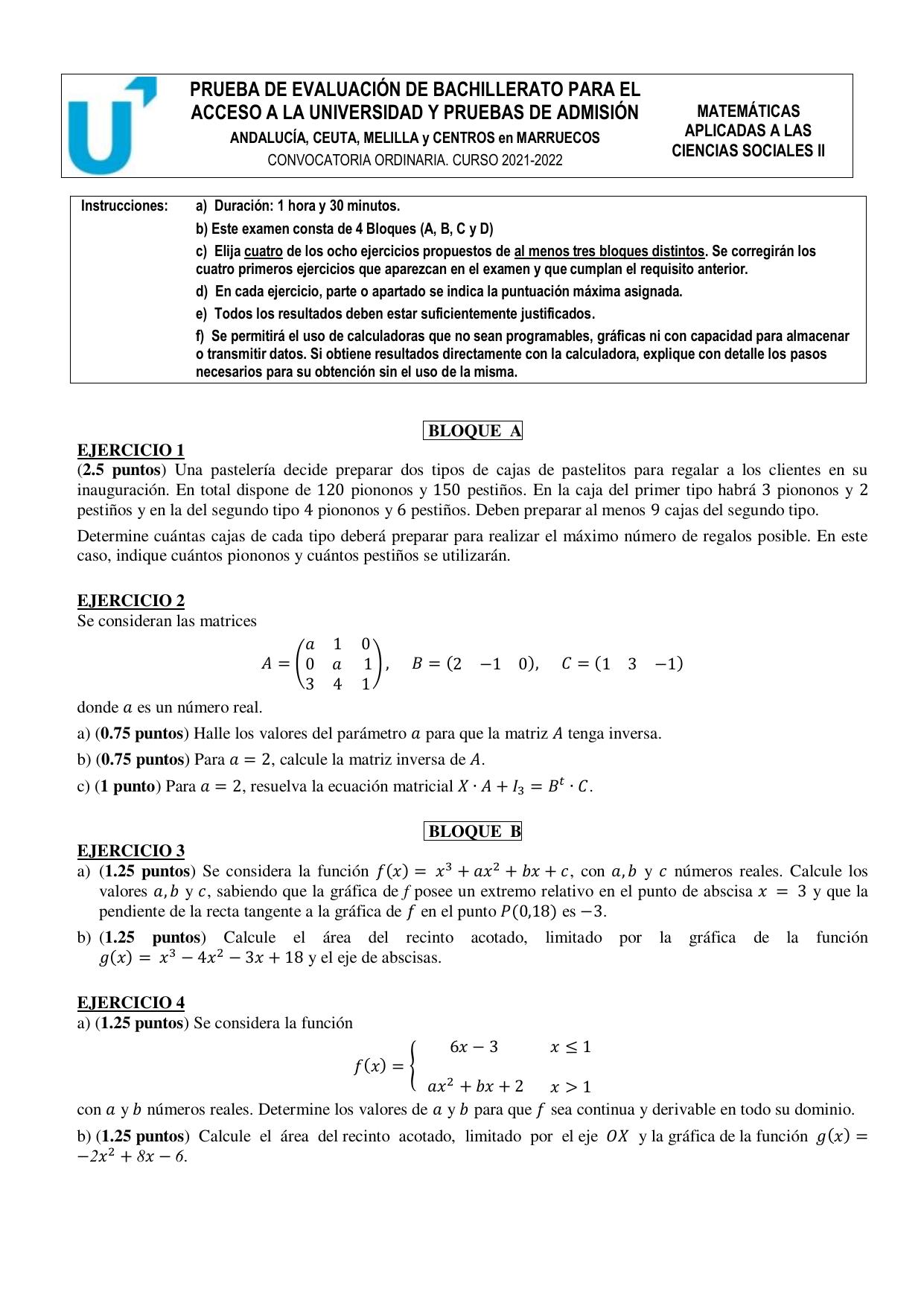
Se consideran las matrices

A = \begin{pmatrix} a & 1 & 0 \\ 0 & a & 1 \\ 3 & 4 & 1 \end{pmatrix} , B = (2 & -1 & 0), C = (1 & 3 & -1)

donde aa es un número real.

a) Halle los valores del parámetro aa para que la matriz AA tenga inversa.b) Para a=2a = 2, calcule la matriz inversa de AA.c) Para a=2a = 2, resuelva la ecuación matricial XA+I3=BtCX \cdot A + I_3 = B^t \cdot C.
MatricesDeterminantesEcuaciones matriciales
a) Halle los valores del parámetro aa para que la matriz AA tenga inversa.

Una matriz tiene inversa si y solo si su determinante es distinto de cero. Calculamos el determinante de AA:

det(A)=det(a100a1341)\det(A) = \det \begin{pmatrix} a & 1 & 0 \\ 0 & a & 1 \\ 3 & 4 & 1 \end{pmatrix}
det(A)=a(a114)1(0113)+0(04a3)\det(A) = a(a \cdot 1 - 1 \cdot 4) - 1(0 \cdot 1 - 1 \cdot 3) + 0(0 \cdot 4 - a \cdot 3)
det(A)=a(a4)1(3)+0\det(A) = a(a - 4) - 1(-3) + 0
det(A)=a24a+3\det(A) = a^2 - 4a + 3

Para que AA no tenga inversa, el determinante debe ser cero:

a24a+3=0a^2 - 4a + 3 = 0

Resolvemos la ecuación cuadrática:

(a1)(a3)=0(a - 1)(a - 3) = 0

Los valores de aa para los cuales la matriz AA no tiene inversa son a=1a = 1 y a=3a = 3. Por lo tanto, la matriz AA tiene inversa para todos los valores de aRa \in \mathbb{R} excepto a=1a = 1 y a=3a = 3.

a1ya3a \neq 1 \quad \text{y} \quad a \neq 3
b) Para a=2a = 2, calcule la matriz inversa de AA.

Sustituimos a=2a = 2 en la matriz AA:

A=(210021341)A = \begin{pmatrix} 2 & 1 & 0 \\ 0 & 2 & 1 \\ 3 & 4 & 1 \end{pmatrix}

Calculamos el determinante para a=2a = 2:

det(A)=(2)24(2)+3=48+3=1\det(A) = (2)^2 - 4(2) + 3 = 4 - 8 + 3 = -1

Ahora calculamos la matriz de cofactores CC:

C11=det(2141)=24=2C_{11} = \det \begin{pmatrix} 2 & 1 \\ 4 & 1 \end{pmatrix} = 2 - 4 = -2
C12=det(0131)=(03)=3C_{12} = -\det \begin{pmatrix} 0 & 1 \\ 3 & 1 \end{pmatrix} = -(0 - 3) = 3
C13=det(0234)=06=6C_{13} = \det \begin{pmatrix} 0 & 2 \\ 3 & 4 \end{pmatrix} = 0 - 6 = -6
C21=det(1041)=(10)=1C_{21} = -\det \begin{pmatrix} 1 & 0 \\ 4 & 1 \end{pmatrix} = -(1 - 0) = -1
C22=det(2031)=20=2C_{22} = \det \begin{pmatrix} 2 & 0 \\ 3 & 1 \end{pmatrix} = 2 - 0 = 2
C23=det(2134)=(83)=5C_{23} = -\det \begin{pmatrix} 2 & 1 \\ 3 & 4 \end{pmatrix} = -(8 - 3) = -5
C31=det(1021)=10=1C_{31} = \det \begin{pmatrix} 1 & 0 \\ 2 & 1 \end{pmatrix} = 1 - 0 = 1
C32=det(2001)=(20)=2C_{32} = -\det \begin{pmatrix} 2 & 0 \\ 0 & 1 \end{pmatrix} = -(2 - 0) = -2
C33=det(2102)=40=4C_{33} = \det \begin{pmatrix} 2 & 1 \\ 0 & 2 \end{pmatrix} = 4 - 0 = 4

La matriz de cofactores es:

C=(236125124)C = \begin{pmatrix} -2 & 3 & -6 \\ -1 & 2 & -5 \\ 1 & -2 & 4 \end{pmatrix}

La matriz adjunta es la traspuesta de la matriz de cofactores:

Adj(A)=Ct=(211322654)\text{Adj}(A) = C^t = \begin{pmatrix} -2 & -1 & 1 \\ 3 & 2 & -2 \\ -6 & -5 & 4 \end{pmatrix}

Finalmente, la matriz inversa es A1=1det(A)Adj(A)A^{-1} = \frac{1}{\det(A)} \text{Adj}(A):

A1=11(211322654)=(211322654)A^{-1} = \frac{1}{-1} \begin{pmatrix} -2 & -1 & 1 \\ 3 & 2 & -2 \\ -6 & -5 & 4 \end{pmatrix} = \begin{pmatrix} 2 & 1 & -1 \\ -3 & -2 & 2 \\ 6 & 5 & -4 \end{pmatrix}
c) Para a=2a = 2, resuelva la ecuación matricial XA+I3=BtCX \cdot A + I_3 = B^t \cdot C.

Primero, despejamos XX de la ecuación:

XA=BtCI3X \cdot A = B^t \cdot C - I_3

Multiplicamos por A1A^{-1} por la derecha:

X=(BtCI3)A1X = (B^t \cdot C - I_3) \cdot A^{-1}

Calculamos BtCB^t \cdot C:

Bt=(210)B^t = \begin{pmatrix} 2 \\ -1 \\ 0 \end{pmatrix}
BtC=(210)(131)=(262131000)B^t \cdot C = \begin{pmatrix} 2 \\ -1 \\ 0 \end{pmatrix} \begin{pmatrix} 1 & 3 & -1 \end{pmatrix} = \begin{pmatrix} 2 & 6 & -2 \\ -1 & -3 & 1 \\ 0 & 0 & 0 \end{pmatrix}

Ahora, calculamos BtCI3B^t \cdot C - I_3:

BtCI3=(262131000)(100010001)=(162141001)B^t \cdot C - I_3 = \begin{pmatrix} 2 & 6 & -2 \\ -1 & -3 & 1 \\ 0 & 0 & 0 \end{pmatrix} - \begin{pmatrix} 1 & 0 & 0 \\ 0 & 1 & 0 \\ 0 & 0 & 1 \end{pmatrix} = \begin{pmatrix} 1 & 6 & -2 \\ -1 & -4 & 1 \\ 0 & 0 & -1 \end{pmatrix}

Finalmente, calculamos X=(BtCI3)A1X = (B^t \cdot C - I_3) \cdot A^{-1}:

X=(162141001)(211322654)X = \begin{pmatrix} 1 & 6 & -2 \\ -1 & -4 & 1 \\ 0 & 0 & -1 \end{pmatrix} \begin{pmatrix} 2 & 1 & -1 \\ -3 & -2 & 2 \\ 6 & 5 & -4 \end{pmatrix}
X=(1(2)+6(3)+(2)(6)1(1)+6(2)+(2)(5)1(1)+6(2)+(2)(4)(1)(2)+(4)(3)+1(6)(1)(1)+(4)(2)+1(5)(1)(1)+(4)(2)+1(4)0(2)+0(3)+(1)(6)0(1)+0(2)+(1)(5)0(1)+0(2)+(1)(4))X = \begin{pmatrix} 1(2)+6(-3)+(-2)(6) & 1(1)+6(-2)+(-2)(5) & 1(-1)+6(2)+(-2)(-4) \\ (-1)(2)+(-4)(-3)+1(6) & (-1)(1)+(-4)(-2)+1(5) & (-1)(-1)+(-4)(2)+1(-4) \\ 0(2)+0(-3)+(-1)(6) & 0(1)+0(-2)+(-1)(5) & 0(-1)+0(2)+(-1)(-4) \end{pmatrix}
X=(21812112101+12+82+12+61+8+51840+060+050+0+4)X = \begin{pmatrix} 2 - 18 - 12 & 1 - 12 - 10 & -1 + 12 + 8 \\ -2 + 12 + 6 & -1 + 8 + 5 & 1 - 8 - 4 \\ 0 + 0 - 6 & 0 + 0 - 5 & 0 + 0 + 4 \end{pmatrix}
X=(282119161211654)X = \begin{pmatrix} -28 & -21 & 19 \\ 16 & 12 & -11 \\ -6 & -5 & 4 \end{pmatrix}