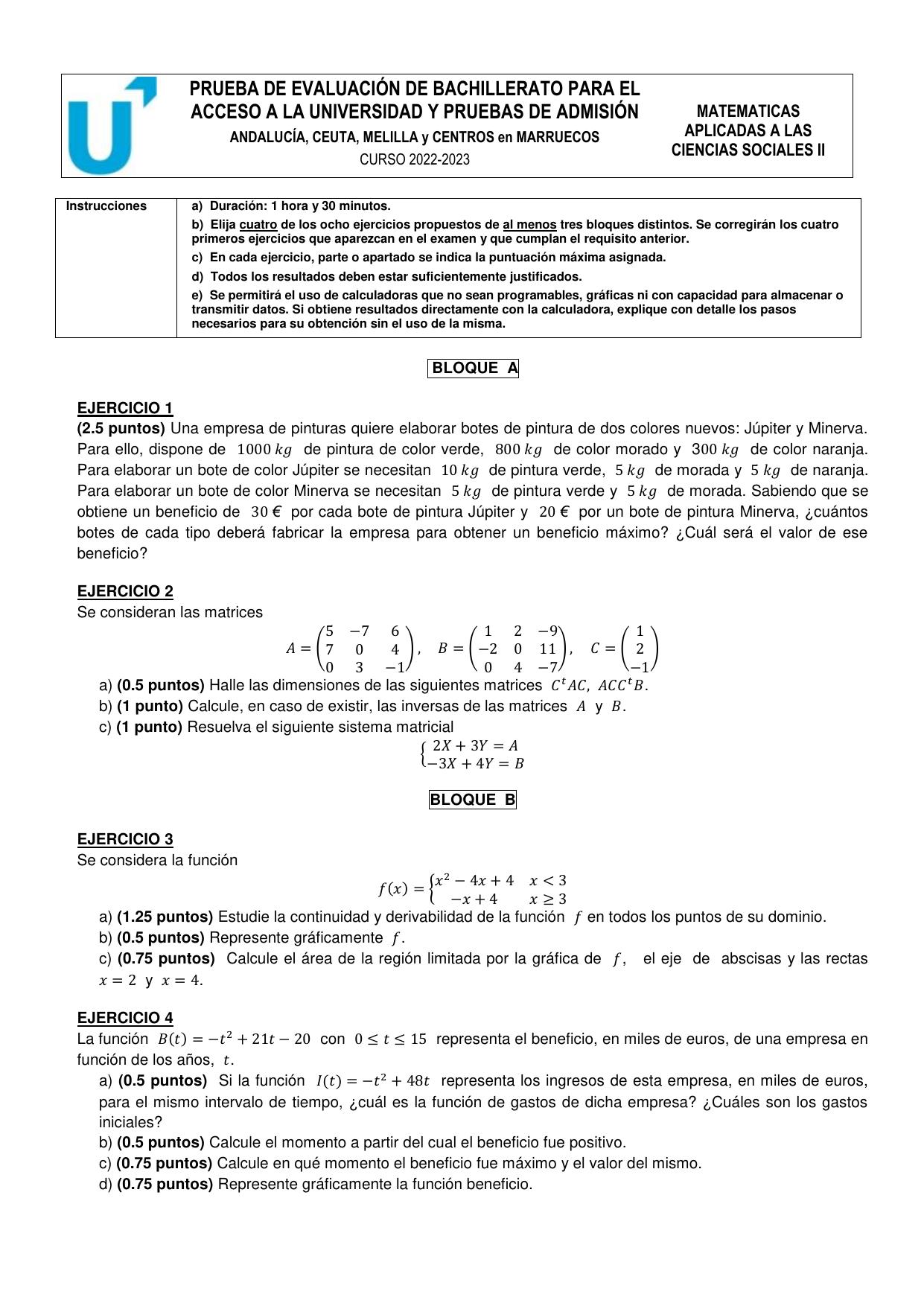
a) Halle las dimensiones de las siguientes matrices C t A C , A C C t B C^tAC, ACC^tB C t A C , A C C t B . Las dimensiones de las matrices dadas son: A A A es de dimensión 3 × 3 3 \times 3 3 × 3 B B B es de dimensión 3 × 3 3 \times 3 3 × 3 C C C es de dimensión 3 × 1 3 \times 1 3 × 1 Por lo tanto, C t C^t C t es de dimensión 1 × 3 1 \times 3 1 × 3 . Para C t A C C^tAC C t A C :
( 1 × 3 ) ⋅ ( 3 × 3 ) ⋅ ( 3 × 1 ) → ( 1 × 3 ) ⋅ ( 3 × 1 ) → 1 × 1 (1 \times 3) \cdot (3 \times 3) \cdot (3 \times 1) \rightarrow (1 \times 3) \cdot (3 \times 1) \rightarrow 1 \times 1 ( 1 × 3 ) ⋅ ( 3 × 3 ) ⋅ ( 3 × 1 ) → ( 1 × 3 ) ⋅ ( 3 × 1 ) → 1 × 1 La dimensión de C t A C C^tAC C t A C es 1 × 1 1 \times 1 1 × 1 . Para A C C t B ACC^tB A C C t B :
( 3 × 3 ) ⋅ ( 3 × 1 ) ⋅ ( 1 × 3 ) ⋅ ( 3 × 3 ) (3 \times 3) \cdot (3 \times 1) \cdot (1 \times 3) \cdot (3 \times 3) ( 3 × 3 ) ⋅ ( 3 × 1 ) ⋅ ( 1 × 3 ) ⋅ ( 3 × 3 ) Primero, calculemos las dimensiones de los productos intermedios: C C t C C^t C C t : ( 3 × 1 ) ⋅ ( 1 × 3 ) → 3 × 3 (3 \times 1) \cdot (1 \times 3) \rightarrow 3 \times 3 ( 3 × 1 ) ⋅ ( 1 × 3 ) → 3 × 3 Entonces, A ( C C t ) B A(CC^t)B A ( C C t ) B : ( 3 × 3 ) ⋅ ( 3 × 3 ) ⋅ ( 3 × 3 ) → ( 3 × 3 ) ⋅ ( 3 × 3 ) → 3 × 3 (3 \times 3) \cdot (3 \times 3) \cdot (3 \times 3) \rightarrow (3 \times 3) \cdot (3 \times 3) \rightarrow 3 \times 3 ( 3 × 3 ) ⋅ ( 3 × 3 ) ⋅ ( 3 × 3 ) → ( 3 × 3 ) ⋅ ( 3 × 3 ) → 3 × 3 La dimensión de A C C t B ACC^tB A C C t B es 3 × 3 3 \times 3 3 × 3 .
b) Calcule, en caso de existir, las inversas de las matrices A A A y B B B . Cálculo de la inversa de A A A :
A = ( 5 − 7 6 7 0 4 0 3 − 1 ) A = \begin{pmatrix} 5 & -7 & 6 \\ 7 & 0 & 4 \\ 0 & 3 & -1 \end{pmatrix} A = 5 7 0 − 7 0 3 6 4 − 1 Primero, calculamos el determinante de A A A :
det ( A ) = 5 ⋅ det ( 0 4 3 − 1 ) − ( − 7 ) ⋅ det ( 7 4 0 − 1 ) + 6 ⋅ det ( 7 0 0 3 ) \det(A) = 5 \cdot \det\begin{pmatrix} 0 & 4 \\ 3 & -1 \end{pmatrix} - (-7) \cdot \det\begin{pmatrix} 7 & 4 \\ 0 & -1 \end{pmatrix} + 6 \cdot \det\begin{pmatrix} 7 & 0 \\ 0 & 3 \end{pmatrix} det ( A ) = 5 ⋅ det ( 0 3 4 − 1 ) − ( − 7 ) ⋅ det ( 7 0 4 − 1 ) + 6 ⋅ det ( 7 0 0 3 ) det ( A ) = 5 ( 0 ⋅ ( − 1 ) − 4 ⋅ 3 ) + 7 ( 7 ⋅ ( − 1 ) − 4 ⋅ 0 ) + 6 ( 7 ⋅ 3 − 0 ⋅ 0 ) \det(A) = 5(0 \cdot (-1) - 4 \cdot 3) + 7(7 \cdot (-1) - 4 \cdot 0) + 6(7 \cdot 3 - 0 \cdot 0) det ( A ) = 5 ( 0 ⋅ ( − 1 ) − 4 ⋅ 3 ) + 7 ( 7 ⋅ ( − 1 ) − 4 ⋅ 0 ) + 6 ( 7 ⋅ 3 − 0 ⋅ 0 ) det ( A ) = 5 ( − 12 ) + 7 ( − 7 ) + 6 ( 21 ) \det(A) = 5(-12) + 7(-7) + 6(21) det ( A ) = 5 ( − 12 ) + 7 ( − 7 ) + 6 ( 21 ) det ( A ) = − 60 − 49 + 126 = 17 \det(A) = -60 - 49 + 126 = 17 det ( A ) = − 60 − 49 + 126 = 17 Dado que det ( A ) = 17 ≠ 0 \det(A) = 17 \neq 0 det ( A ) = 17 = 0 , la matriz A A A tiene inversa. A continuación, calculamos la matriz de cofactores C i j C_{ij} C ij :
C 11 = − 12 , C 12 = 7 , C 13 = 21 C_{11} = -12, \quad C_{12} = 7, \quad C_{13} = 21 C 11 = − 12 , C 12 = 7 , C 13 = 21 C 21 = 11 , C 22 = − 5 , C 23 = − 15 C_{21} = 11, \quad C_{22} = -5, \quad C_{23} = -15 C 21 = 11 , C 22 = − 5 , C 23 = − 15 C 31 = − 28 , C 32 = 22 , C 33 = 49 C_{31} = -28, \quad C_{32} = 22, \quad C_{33} = 49 C 31 = − 28 , C 32 = 22 , C 33 = 49 La matriz adjunta A d j ( A ) Adj(A) A d j ( A ) es la traspuesta de la matriz de cofactores:
A d j ( A ) = ( − 12 11 − 28 7 − 5 22 21 − 15 49 ) Adj(A) = \begin{pmatrix} -12 & 11 & -28 \\ 7 & -5 & 22 \\ 21 & -15 & 49 \end{pmatrix} A d j ( A ) = − 12 7 21 11 − 5 − 15 − 28 22 49 Finalmente, la inversa de A A A es:
A − 1 = 1 det ( A ) A d j ( A ) = 1 17 ( − 12 11 − 28 7 − 5 22 21 − 15 49 ) A^{-1} = \frac{1}{\det(A)} Adj(A) = \frac{1}{17} \begin{pmatrix} -12 & 11 & -28 \\ 7 & -5 & 22 \\ 21 & -15 & 49 \end{pmatrix} A − 1 = det ( A ) 1 A d j ( A ) = 17 1 − 12 7 21 11 − 5 − 15 − 28 22 49 Cálculo de la inversa de B B B :
B = ( 1 2 − 9 − 2 0 11 0 4 − 7 ) B = \begin{pmatrix} 1 & 2 & -9 \\ -2 & 0 & 11 \\ 0 & 4 & -7 \end{pmatrix} B = 1 − 2 0 2 0 4 − 9 11 − 7 Calculamos el determinante de B B B :
det ( B ) = 1 ⋅ det ( 0 11 4 − 7 ) − 2 ⋅ det ( − 2 11 0 − 7 ) + ( − 9 ) ⋅ det ( − 2 0 0 4 ) \det(B) = 1 \cdot \det\begin{pmatrix} 0 & 11 \\ 4 & -7 \end{pmatrix} - 2 \cdot \det\begin{pmatrix} -2 & 11 \\ 0 & -7 \end{pmatrix} + (-9) \cdot \det\begin{pmatrix} -2 & 0 \\ 0 & 4 \end{pmatrix} det ( B ) = 1 ⋅ det ( 0 4 11 − 7 ) − 2 ⋅ det ( − 2 0 11 − 7 ) + ( − 9 ) ⋅ det ( − 2 0 0 4 ) det ( B ) = 1 ( 0 ⋅ ( − 7 ) − 11 ⋅ 4 ) − 2 ( ( − 2 ) ⋅ ( − 7 ) − 11 ⋅ 0 ) − 9 ( ( − 2 ) ⋅ 4 − 0 ⋅ 0 ) \det(B) = 1(0 \cdot (-7) - 11 \cdot 4) - 2((-2) \cdot (-7) - 11 \cdot 0) - 9((-2) \cdot 4 - 0 \cdot 0) det ( B ) = 1 ( 0 ⋅ ( − 7 ) − 11 ⋅ 4 ) − 2 (( − 2 ) ⋅ ( − 7 ) − 11 ⋅ 0 ) − 9 (( − 2 ) ⋅ 4 − 0 ⋅ 0 ) det ( B ) = 1 ( − 44 ) − 2 ( 14 ) − 9 ( − 8 ) \det(B) = 1(-44) - 2(14) - 9(-8) det ( B ) = 1 ( − 44 ) − 2 ( 14 ) − 9 ( − 8 ) det ( B ) = − 44 − 28 + 72 \det(B) = -44 - 28 + 72 det ( B ) = − 44 − 28 + 72 det ( B ) = 0 \det(B) = 0 det ( B ) = 0 Dado que det ( B ) = 0 \det(B) = 0 det ( B ) = 0 , la matriz B B B no tiene inversa.
c) Resuelva el siguiente sistema matricial { 2 X + 3 Y = A − 3 X + 4 Y = B \begin{cases} 2X + 3Y = A \\ -3X + 4Y = B \end{cases} { 2 X + 3 Y = A − 3 X + 4 Y = B Multiplicamos la primera ecuación por 3 y la segunda por 2 para eliminar X X X :
{ 6 X + 9 Y = 3 A − 6 X + 8 Y = 2 B \begin{cases} 6X + 9Y = 3A \\ -6X + 8Y = 2B \end{cases} { 6 X + 9 Y = 3 A − 6 X + 8 Y = 2 B Sumando ambas ecuaciones:
( 6 X + 9 Y ) + ( − 6 X + 8 Y ) = 3 A + 2 B (6X + 9Y) + (-6X + 8Y) = 3A + 2B ( 6 X + 9 Y ) + ( − 6 X + 8 Y ) = 3 A + 2 B 17 Y = 3 A + 2 B 17Y = 3A + 2B 17 Y = 3 A + 2 B Y = 1 17 ( 3 A + 2 B ) Y = \frac{1}{17}(3A + 2B) Y = 17 1 ( 3 A + 2 B ) Ahora, sustituimos Y Y Y en la primera ecuación para despejar X X X :
2 X = A − 3 Y 2X = A - 3Y 2 X = A − 3 Y X = 1 2 ( A − 3 Y ) X = \frac{1}{2}(A - 3Y) X = 2 1 ( A − 3 Y ) X = 1 2 ( A − 3 ( 1 17 ( 3 A + 2 B ) ) ) X = \frac{1}{2}\left(A - 3\left(\frac{1}{17}(3A + 2B)\right)\right) X = 2 1 ( A − 3 ( 17 1 ( 3 A + 2 B ) ) ) X = 1 2 ( A − 9 17 A − 6 17 B ) X = \frac{1}{2}\left(A - \frac{9}{17}A - \frac{6}{17}B\right) X = 2 1 ( A − 17 9 A − 17 6 B ) X = 1 2 ( 17 A − 9 A 17 − 6 B 17 ) X = \frac{1}{2}\left(\frac{17A - 9A}{17} - \frac{6B}{17}\right) X = 2 1 ( 17 17 A − 9 A − 17 6 B ) X = 1 2 ( 8 A 17 − 6 B 17 ) X = \frac{1}{2}\left(\frac{8A}{17} - \frac{6B}{17}\right) X = 2 1 ( 17 8 A − 17 6 B ) X = 4 A 17 − 3 B 17 = 1 17 ( 4 A − 3 B ) X = \frac{4A}{17} - \frac{3B}{17} = \frac{1}{17}(4A - 3B) X = 17 4 A − 17 3 B = 17 1 ( 4 A − 3 B ) Calculamos 3 A + 2 B 3A + 2B 3 A + 2 B :
3 A = 3 ( 5 − 7 6 7 0 4 0 3 − 1 ) = ( 15 − 21 18 21 0 12 0 9 − 3 ) 3A = 3 \begin{pmatrix} 5 & -7 & 6 \\ 7 & 0 & 4 \\ 0 & 3 & -1 \end{pmatrix} = \begin{pmatrix} 15 & -21 & 18 \\ 21 & 0 & 12 \\ 0 & 9 & -3 \end{pmatrix} 3 A = 3 5 7 0 − 7 0 3 6 4 − 1 = 15 21 0 − 21 0 9 18 12 − 3 2 B = 2 ( 1 2 − 9 − 2 0 11 0 4 − 7 ) = ( 2 4 − 18 − 4 0 22 0 8 − 14 ) 2B = 2 \begin{pmatrix} 1 & 2 & -9 \\ -2 & 0 & 11 \\ 0 & 4 & -7 \end{pmatrix} = \begin{pmatrix} 2 & 4 & -18 \\ -4 & 0 & 22 \\ 0 & 8 & -14 \end{pmatrix} 2 B = 2 1 − 2 0 2 0 4 − 9 11 − 7 = 2 − 4 0 4 0 8 − 18 22 − 14 3 A + 2 B = ( 15 + 2 − 21 + 4 18 − 18 21 − 4 0 + 0 12 + 22 0 + 0 9 + 8 − 3 − 14 ) = ( 17 − 17 0 17 0 34 0 17 − 17 ) 3A + 2B = \begin{pmatrix} 15+2 & -21+4 & 18-18 \\ 21-4 & 0+0 & 12+22 \\ 0+0 & 9+8 & -3-14 \end{pmatrix} = \begin{pmatrix} 17 & -17 & 0 \\ 17 & 0 & 34 \\ 0 & 17 & -17 \end{pmatrix} 3 A + 2 B = 15 + 2 21 − 4 0 + 0 − 21 + 4 0 + 0 9 + 8 18 − 18 12 + 22 − 3 − 14 = 17 17 0 − 17 0 17 0 34 − 17 Por lo tanto, la matriz Y Y Y es:
Y = 1 17 ( 17 − 17 0 17 0 34 0 17 − 17 ) = ( 1 − 1 0 1 0 2 0 1 − 1 ) Y = \frac{1}{17} \begin{pmatrix} 17 & -17 & 0 \\ 17 & 0 & 34 \\ 0 & 17 & -17 \end{pmatrix} = \begin{pmatrix} 1 & -1 & 0 \\ 1 & 0 & 2 \\ 0 & 1 & -1 \end{pmatrix} Y = 17 1 17 17 0 − 17 0 17 0 34 − 17 = 1 1 0 − 1 0 1 0 2 − 1 Calculamos 4 A − 3 B 4A - 3B 4 A − 3 B :
4 A = 4 ( 5 − 7 6 7 0 4 0 3 − 1 ) = ( 20 − 28 24 28 0 16 0 12 − 4 ) 4A = 4 \begin{pmatrix} 5 & -7 & 6 \\ 7 & 0 & 4 \\ 0 & 3 & -1 \end{pmatrix} = \begin{pmatrix} 20 & -28 & 24 \\ 28 & 0 & 16 \\ 0 & 12 & -4 \end{pmatrix} 4 A = 4 5 7 0 − 7 0 3 6 4 − 1 = 20 28 0 − 28 0 12 24 16 − 4 3 B = 3 ( 1 2 − 9 − 2 0 11 0 4 − 7 ) = ( 3 6 − 27 − 6 0 33 0 12 − 21 ) 3B = 3 \begin{pmatrix} 1 & 2 & -9 \\ -2 & 0 & 11 \\ 0 & 4 & -7 \end{pmatrix} = \begin{pmatrix} 3 & 6 & -27 \\ -6 & 0 & 33 \\ 0 & 12 & -21 \end{pmatrix} 3 B = 3 1 − 2 0 2 0 4 − 9 11 − 7 = 3 − 6 0 6 0 12 − 27 33 − 21 4 A − 3 B = ( 20 − 3 − 28 − 6 24 − ( − 27 ) 28 − ( − 6 ) 0 − 0 16 − 33 0 − 0 12 − 12 − 4 − ( − 21 ) ) = ( 17 − 34 51 34 0 − 17 0 0 17 ) 4A - 3B = \begin{pmatrix} 20-3 & -28-6 & 24-(-27) \\ 28-(-6) & 0-0 & 16-33 \\ 0-0 & 12-12 & -4-(-21) \end{pmatrix} = \begin{pmatrix} 17 & -34 & 51 \\ 34 & 0 & -17 \\ 0 & 0 & 17 \end{pmatrix} 4 A − 3 B = 20 − 3 28 − ( − 6 ) 0 − 0 − 28 − 6 0 − 0 12 − 12 24 − ( − 27 ) 16 − 33 − 4 − ( − 21 ) = 17 34 0 − 34 0 0 51 − 17 17 Por lo tanto, la matriz X X X es:
X = 1 17 ( 17 − 34 51 34 0 − 17 0 0 17 ) = ( 1 − 2 3 2 0 − 1 0 0 1 ) X = \frac{1}{17} \begin{pmatrix} 17 & -34 & 51 \\ 34 & 0 & -17 \\ 0 & 0 & 17 \end{pmatrix} = \begin{pmatrix} 1 & -2 & 3 \\ 2 & 0 & -1 \\ 0 & 0 & 1 \end{pmatrix} X = 17 1 17 34 0 − 34 0 0 51 − 17 17 = 1 2 0 − 2 0 0 3 − 1 1