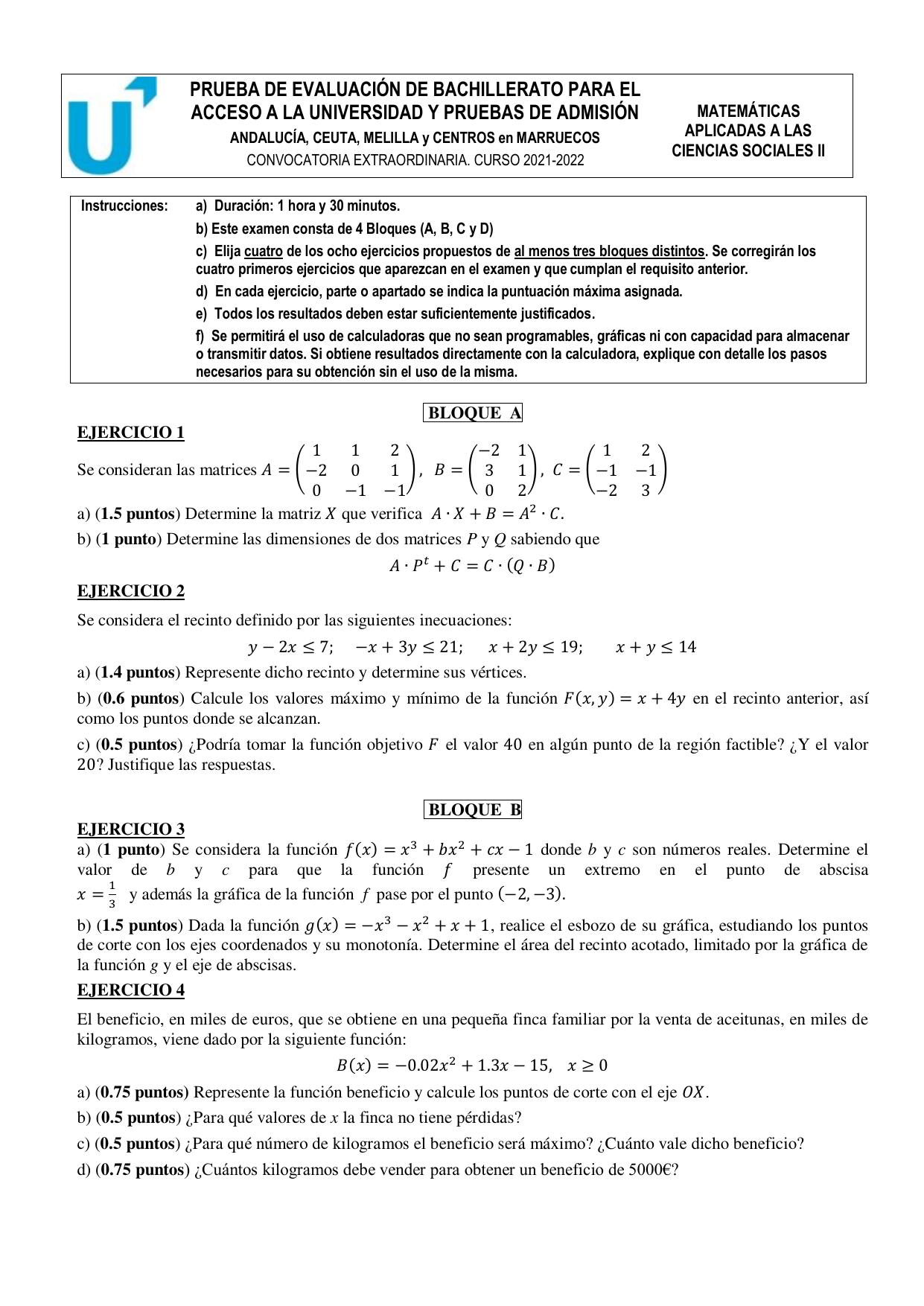
a) Determine la matriz X X X que verifica A ⋅ X + B = A 2 ⋅ C A \cdot X + B = A^2 \cdot C A ⋅ X + B = A 2 ⋅ C . La ecuación matricial es A ⋅ X + B = A 2 ⋅ C A \cdot X + B = A^2 \cdot C A ⋅ X + B = A 2 ⋅ C . Despejamos X X X :
A ⋅ X = A 2 ⋅ C − B A \cdot X = A^2 \cdot C - B A ⋅ X = A 2 ⋅ C − B Primero, calculamos el determinante de A A A para verificar si es invertible:
∣ A ∣ = ∣ 1 1 2 − 2 0 1 0 − 1 − 1 ∣ = 1 ( 0 − ( − 1 ) ) − 1 ( ( − 2 ) ( − 1 ) − 0 ( 1 ) ) + 2 ( ( − 2 ) ( − 1 ) − 0 ( 0 ) ) |A| = \begin{vmatrix} 1 & 1 & 2 \\ -2 & 0 & 1 \\ 0 & -1 & -1 \end{vmatrix} = 1(0 - (-1)) - 1((-2)(-1) - 0(1)) + 2((-2)(-1) - 0(0)) ∣ A ∣ = 1 − 2 0 1 0 − 1 2 1 − 1 = 1 ( 0 − ( − 1 )) − 1 (( − 2 ) ( − 1 ) − 0 ( 1 )) + 2 (( − 2 ) ( − 1 ) − 0 ( 0 )) ∣ A ∣ = 1 ( 1 ) − 1 ( 2 ) + 2 ( 2 ) = 1 − 2 + 4 = 3 |A| = 1(1) - 1(2) + 2(2) = 1 - 2 + 4 = 3 ∣ A ∣ = 1 ( 1 ) − 1 ( 2 ) + 2 ( 2 ) = 1 − 2 + 4 = 3 Como ∣ A ∣ = 3 ≠ 0 |A| = 3 \neq 0 ∣ A ∣ = 3 = 0 , la matriz A A A es invertible, por lo que podemos multiplicar por A − 1 A^{-1} A − 1 por la izquierda:
X = A − 1 ( A 2 ⋅ C − B ) X = A^{-1} (A^2 \cdot C - B) X = A − 1 ( A 2 ⋅ C − B ) Calculamos A 2 A^2 A 2 :
A 2 = A ⋅ A = ( 1 1 2 − 2 0 1 0 − 1 − 1 ) ( 1 1 2 − 2 0 1 0 − 1 − 1 ) = ( 1 − 2 + 0 1 + 0 − 2 2 + 1 − 2 − 2 + 0 + 0 − 2 + 0 − 1 − 4 + 0 − 1 0 + 2 + 0 0 + 0 + 1 0 − 1 + 1 ) = ( − 1 − 1 1 − 2 − 3 − 5 2 1 0 ) A^2 = A \cdot A = \begin{pmatrix} 1 & 1 & 2 \\ -2 & 0 & 1 \\ 0 & -1 & -1 \end{pmatrix} \begin{pmatrix} 1 & 1 & 2 \\ -2 & 0 & 1 \\ 0 & -1 & -1 \end{pmatrix} = \begin{pmatrix} 1-2+0 & 1+0-2 & 2+1-2 \\ -2+0+0 & -2+0-1 & -4+0-1 \\ 0+2+0 & 0+0+1 & 0-1+1 \end{pmatrix} = \begin{pmatrix} -1 & -1 & 1 \\ -2 & -3 & -5 \\ 2 & 1 & 0 \end{pmatrix} A 2 = A ⋅ A = 1 − 2 0 1 0 − 1 2 1 − 1 1 − 2 0 1 0 − 1 2 1 − 1 = 1 − 2 + 0 − 2 + 0 + 0 0 + 2 + 0 1 + 0 − 2 − 2 + 0 − 1 0 + 0 + 1 2 + 1 − 2 − 4 + 0 − 1 0 − 1 + 1 = − 1 − 2 2 − 1 − 3 1 1 − 5 0 Calculamos A 2 ⋅ C A^2 \cdot C A 2 ⋅ C :
A 2 ⋅ C = ( − 1 − 1 1 − 2 − 3 − 5 2 1 0 ) ( 1 2 − 1 − 1 − 2 3 ) = ( − 1 + 1 − 2 − 2 + 1 + 3 − 2 + 3 + 10 − 4 + 3 − 15 2 − 1 + 0 4 − 1 + 0 ) = ( − 2 2 11 − 16 1 3 ) A^2 \cdot C = \begin{pmatrix} -1 & -1 & 1 \\ -2 & -3 & -5 \\ 2 & 1 & 0 \end{pmatrix} \begin{pmatrix} 1 & 2 \\ -1 & -1 \\ -2 & 3 \end{pmatrix} = \begin{pmatrix} -1+1-2 & -2+1+3 \\ -2+3+10 & -4+3-15 \\ 2-1+0 & 4-1+0 \end{pmatrix} = \begin{pmatrix} -2 & 2 \\ 11 & -16 \\ 1 & 3 \end{pmatrix} A 2 ⋅ C = − 1 − 2 2 − 1 − 3 1 1 − 5 0 1 − 1 − 2 2 − 1 3 = − 1 + 1 − 2 − 2 + 3 + 10 2 − 1 + 0 − 2 + 1 + 3 − 4 + 3 − 15 4 − 1 + 0 = − 2 11 1 2 − 16 3 Calculamos A 2 ⋅ C − B A^2 \cdot C - B A 2 ⋅ C − B :
A 2 ⋅ C − B = ( − 2 2 11 − 16 1 3 ) − ( − 2 1 3 1 0 2 ) = ( − 2 − ( − 2 ) 2 − 1 11 − 3 − 16 − 1 1 − 0 3 − 2 ) = ( 0 1 8 − 17 1 1 ) A^2 \cdot C - B = \begin{pmatrix} -2 & 2 \\ 11 & -16 \\ 1 & 3 \end{pmatrix} - \begin{pmatrix} -2 & 1 \\ 3 & 1 \\ 0 & 2 \end{pmatrix} = \begin{pmatrix} -2-(-2) & 2-1 \\ 11-3 & -16-1 \\ 1-0 & 3-2 \end{pmatrix} = \begin{pmatrix} 0 & 1 \\ 8 & -17 \\ 1 & 1 \end{pmatrix} A 2 ⋅ C − B = − 2 11 1 2 − 16 3 − − 2 3 0 1 1 2 = − 2 − ( − 2 ) 11 − 3 1 − 0 2 − 1 − 16 − 1 3 − 2 = 0 8 1 1 − 17 1 Calculamos la inversa de A A A , A − 1 = 1 ∣ A ∣ Adj ( A ) t A^{-1} = \frac{1}{|A|} \text{Adj}(A)^t A − 1 = ∣ A ∣ 1 Adj ( A ) t : La matriz de cofactores es:
Cof(A) = \begin{pmatrix} \begin{vmatrix} 0 & 1 \\ -1 & -1 \end{pmatrix} & -\begin{vmatrix} -2 & 1 \\ 0 & -1 \end{pmatrix} & \begin{vmatrix} -2 & 0 \\ 0 & -1 \end{pmatrix} \\ -\begin{vmatrix} 1 & 2 \\ -1 & -1 \end{pmatrix} & \begin{vmatrix} 1 & 2 \\ 0 & -1 \end{pmatrix} & -\begin{vmatrix} 1 & 1 \\ 0 & -1 \end{pmatrix} \\ \begin{vmatrix} 1 & 2 \\ 0 & 1 \end{pmatrix} & -\begin{vmatrix} 1 & 2 \\ -2 & 1 \end{pmatrix} & \begin{vmatrix} 1 & 1 \\ -2 & 0 \end{pmatrix} \end{pmatrix} = \begin{pmatrix} 1 & -2 & 2 \\ -1 & -1 & 1 \\ 1 & -5 & 2 \end{pmatrix}
La adjunta es la traspuesta de la matriz de cofactores:
Adj ( A ) = ( 1 − 1 1 − 2 − 1 − 5 2 1 2 ) \text{Adj}(A) = \begin{pmatrix} 1 & -1 & 1 \\ -2 & -1 & -5 \\ 2 & 1 & 2 \end{pmatrix} Adj ( A ) = 1 − 2 2 − 1 − 1 1 1 − 5 2 A − 1 = 1 3 ( 1 − 1 1 − 2 − 1 − 5 2 1 2 ) A^{-1} = \frac{1}{3} \begin{pmatrix} 1 & -1 & 1 \\ -2 & -1 & -5 \\ 2 & 1 & 2 \end{pmatrix} A − 1 = 3 1 1 − 2 2 − 1 − 1 1 1 − 5 2 Finalmente, calculamos X X X :
X = A − 1 ( A 2 ⋅ C − B ) = 1 3 ( 1 − 1 1 − 2 − 1 − 5 2 1 2 ) ( 0 1 8 − 17 1 1 ) X = A^{-1} (A^2 \cdot C - B) = \frac{1}{3} \begin{pmatrix} 1 & -1 & 1 \\ -2 & -1 & -5 \\ 2 & 1 & 2 \end{pmatrix} \begin{pmatrix} 0 & 1 \\ 8 & -17 \\ 1 & 1 \end{pmatrix} X = A − 1 ( A 2 ⋅ C − B ) = 3 1 1 − 2 2 − 1 − 1 1 1 − 5 2 0 8 1 1 − 17 1 X = 1 3 ( ( 1 ) ( 0 ) + ( − 1 ) ( 8 ) + ( 1 ) ( 1 ) ( 1 ) ( 1 ) + ( − 1 ) ( − 17 ) + ( 1 ) ( 1 ) ( − 2 ) ( 0 ) + ( − 1 ) ( 8 ) + ( − 5 ) ( 1 ) ( − 2 ) ( 1 ) + ( − 1 ) ( − 17 ) + ( − 5 ) ( 1 ) ( 2 ) ( 0 ) + ( 1 ) ( 8 ) + ( 2 ) ( 1 ) ( 2 ) ( 1 ) + ( 1 ) ( − 17 ) + ( 2 ) ( 1 ) ) X = \frac{1}{3} \begin{pmatrix} (1)(0)+(-1)(8)+(1)(1) & (1)(1)+(-1)(-17)+(1)(1) \\ (-2)(0)+(-1)(8)+(-5)(1) & (-2)(1)+(-1)(-17)+(-5)(1) \\ (2)(0)+(1)(8)+(2)(1) & (2)(1)+(1)(-17)+(2)(1) \end{pmatrix} X = 3 1 ( 1 ) ( 0 ) + ( − 1 ) ( 8 ) + ( 1 ) ( 1 ) ( − 2 ) ( 0 ) + ( − 1 ) ( 8 ) + ( − 5 ) ( 1 ) ( 2 ) ( 0 ) + ( 1 ) ( 8 ) + ( 2 ) ( 1 ) ( 1 ) ( 1 ) + ( − 1 ) ( − 17 ) + ( 1 ) ( 1 ) ( − 2 ) ( 1 ) + ( − 1 ) ( − 17 ) + ( − 5 ) ( 1 ) ( 2 ) ( 1 ) + ( 1 ) ( − 17 ) + ( 2 ) ( 1 ) X = 1 3 ( − 7 19 − 13 10 10 − 13 ) = ( − 7 / 3 19 / 3 − 13 / 3 10 / 3 10 / 3 − 13 / 3 ) X = \frac{1}{3} \begin{pmatrix} -7 & 19 \\ -13 & 10 \\ 10 & -13 \end{pmatrix} = \begin{pmatrix} -7/3 & 19/3 \\ -13/3 & 10/3 \\ 10/3 & -13/3 \end{pmatrix} X = 3 1 − 7 − 13 10 19 10 − 13 = − 7/3 − 13/3 10/3 19/3 10/3 − 13/3 b) Determine las dimensiones de dos matrices P P P y Q Q Q sabiendo que A ⋅ P t + C = C ⋅ ( Q ⋅ B ) A \cdot P^t + C = C \cdot (Q \cdot B) A ⋅ P t + C = C ⋅ ( Q ⋅ B ) . Dadas las dimensiones de las matrices:
A 3 × 3 , B 3 × 2 , C 3 × 2 A_{3 \times 3}, \quad B_{3 \times 2}, \quad C_{3 \times 2} A 3 × 3 , B 3 × 2 , C 3 × 2 Sea P P P una matriz de dimensión m × n m \times n m × n . Entonces P t P^t P t tendrá dimensión n × m n \times m n × m . Para que el producto A ⋅ P t A \cdot P^t A ⋅ P t sea posible, el número de columnas de A A A debe ser igual al número de filas de P t P^t P t .
A 3 × 3 ⋅ P n × m t ⟹ n = 3 A_{3 \times 3} \cdot P^t_{n \times m} \implies n=3 A 3 × 3 ⋅ P n × m t ⟹ n = 3 La matriz resultante A ⋅ P t A \cdot P^t A ⋅ P t tendrá dimensión 3 × m 3 \times m 3 × m . Para que la suma A ⋅ P t + C A \cdot P^t + C A ⋅ P t + C sea posible, A ⋅ P t A \cdot P^t A ⋅ P t y C C C deben tener las mismas dimensiones.
( A ⋅ P t ) 3 × m = C 3 × 2 ⟹ m = 2 (A \cdot P^t)_{3 \times m} = C_{3 \times 2} \implies m=2 ( A ⋅ P t ) 3 × m = C 3 × 2 ⟹ m = 2 Por lo tanto, P t P^t P t tiene dimensión 3 × 2 3 \times 2 3 × 2 , lo que significa que P P P tiene dimensión 2 × 3 2 \times 3 2 × 3 . Ahora, consideremos el lado derecho de la ecuación: C ⋅ ( Q ⋅ B ) C \cdot (Q \cdot B) C ⋅ ( Q ⋅ B ) . Sea Q Q Q una matriz de dimensión r × s r \times s r × s . Para que el producto Q ⋅ B Q \cdot B Q ⋅ B sea posible, el número de columnas de Q Q Q debe ser igual al número de filas de B B B .
Q r × s ⋅ B 3 × 2 ⟹ s = 3 Q_{r \times s} \cdot B_{3 \times 2} \implies s=3 Q r × s ⋅ B 3 × 2 ⟹ s = 3 La matriz resultante Q ⋅ B Q \cdot B Q ⋅ B tendrá dimensión r × 2 r \times 2 r × 2 . Para que el producto C ⋅ ( Q ⋅ B ) C \cdot (Q \cdot B) C ⋅ ( Q ⋅ B ) sea posible, el número de columnas de C C C debe ser igual al número de filas de Q ⋅ B Q \cdot B Q ⋅ B .
C 3 × 2 ⋅ ( Q ⋅ B ) r × 2 ⟹ r = 2 C_{3 \times 2} \cdot (Q \cdot B)_{r \times 2} \implies r=2 C 3 × 2 ⋅ ( Q ⋅ B ) r × 2 ⟹ r = 2 La matriz resultante C ⋅ ( Q ⋅ B ) C \cdot (Q \cdot B) C ⋅ ( Q ⋅ B ) tendrá dimensión 3 × 2 3 \times 2 3 × 2 . Ambos lados de la ecuación tienen la misma dimensión ( 3 × 2 3 \times 2 3 × 2 ), lo cual es consistente. Resumiendo las dimensiones encontradas:
La matriz P tiene dimensi o ˊ n 2 × 3. \text{La matriz } P \text{ tiene dimensión } 2 \times 3. La matriz P tiene dimensi o ˊ n 2 × 3. La matriz Q tiene dimensi o ˊ n 2 × 3. \text{La matriz } Q \text{ tiene dimensión } 2 \times 3. La matriz Q tiene dimensi o ˊ n 2 × 3.