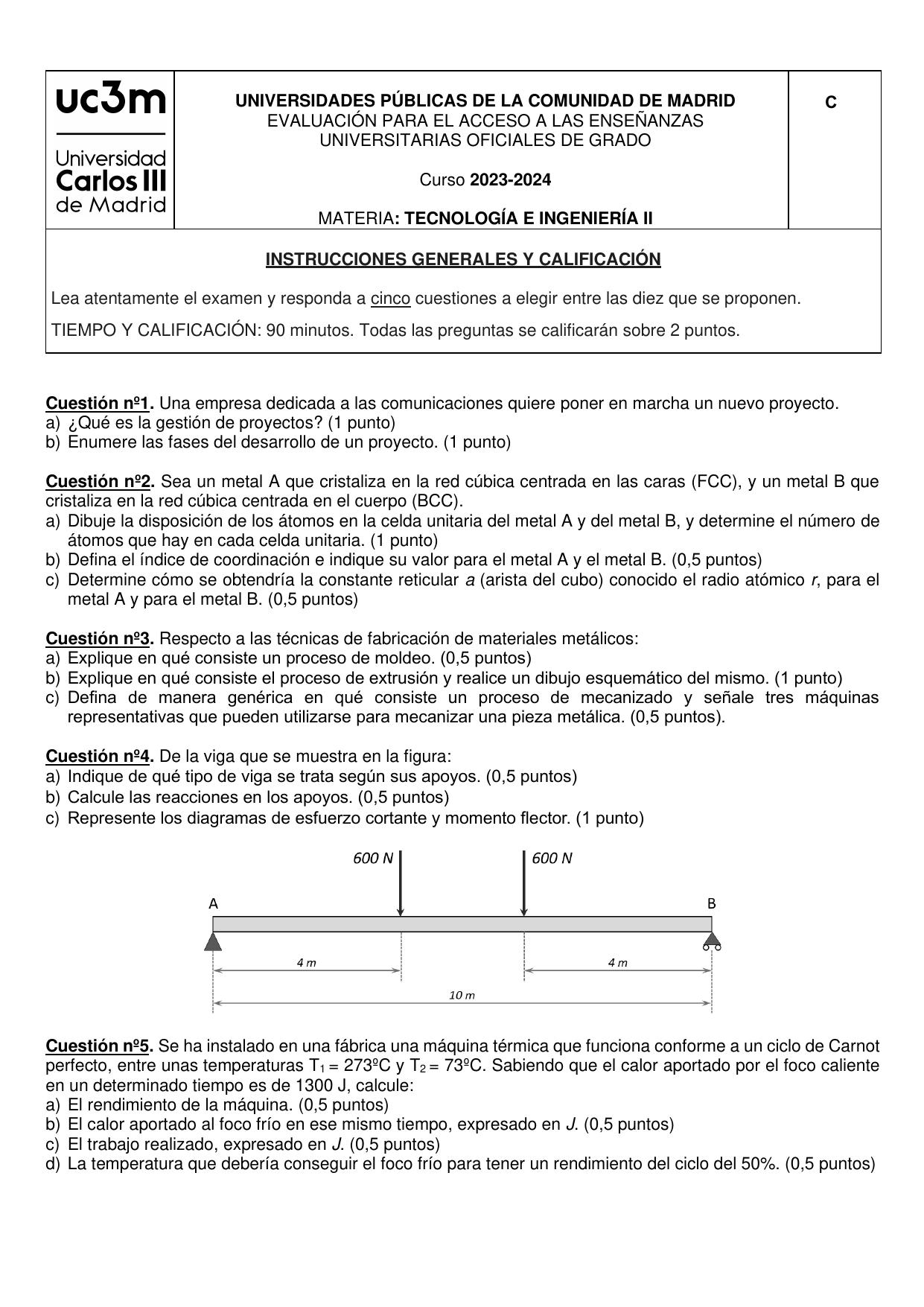
a)La viga es una viga simplemente apoyada, también conocida como viga biarticulada o viga isostática con un apoyo fijo (articulación) en un extremo y un apoyo móvil (rodillo) en el otro.
b)Cálculo de las reacciones en los apoyos:Definimos los apoyos: el apoyo A es una articulación fija (reacciones RAx y RAy) y el apoyo B es un rodillo (reacción RBy).Datos:
F_1 = 600\, \text{N}$ a $x_1 = 4\, \text{m}
F_2 = 600\, \text{N}$ a $x_2 = 6\, \text{m}$ (o $4\, \text{m}$ desde B)
L=10m Fórmulas (Ecuaciones de equilibrio):
Sustitución:1. Equilibrio de fuerzas horizontales:
RAx=0 2. Equilibrio de momentos respecto al punto A (sentido antihorario positivo):
∑MA=0 (−F1⋅x1)+(−F2⋅x2)+(RBy⋅L)=0 (−600N⋅4m)+(−600N⋅6m)+(RBy⋅10m)=0 −2400N⋅m−3600N⋅m+10RBy=0 10RBy=6000N⋅m RBy=10m6000N⋅m 3. Equilibrio de fuerzas verticales (sentido hacia arriba positivo):
RAy+RBy−F1−F2=0 RAy+600N−600N−600N=0 RAy−600N=0 RAy=600N Resultado:
RAx=0N RAy=600N RBy=600N Diagramas de esfuerzo cortante y momento flector:Se definen las funciones de esfuerzo cortante V(x) y momento flector M(x) por tramos, tomando el origen de coordenadas en el punto A.Tramo 1: 0≤x<4m Fórmulas:
V(x)=RAy M(x)=RAy⋅x Sustitución:
V(x)=600N M(x)=600xN⋅m Resultado:
V(0) = 600\, \text{N}$, $M(0) = 0\, \text{N}\cdot\text{m}
V(4^-) = 600\, \text{N}$, $M(4) = 2400\, \text{N}\cdot\text{m}
Tramo 2: 4m≤x<6m Fórmulas:
V(x)=RAy−F1 M(x)=RAy⋅x−F1⋅(x−x1) Sustitución:
V(x)=600N−600N=0N M(x)=600x−600(x−4)=600x−600x+2400=2400N⋅m Resultado:
V(4^+) = 0\, \text{N}$, $M(4) = 2400\, \text{N}\cdot\text{m}
V(6^-) = 0\, \text{N}$, $M(6) = 2400\, \text{N}\cdot\text{m}
Tramo 3: 6m≤x≤10m Fórmulas:
V(x)=RAy−F1−F2 M(x)=RAy⋅x−F1⋅(x−x1)−F2⋅(x−x2) Sustitución:
V(x)=600N−600N−600N=−600N M(x)=600x−600(x−4)−600(x−6) M(x)=600x−600x+2400−600x+3600 M(x)=−600x+6000N⋅m Resultado:
V(6^+) = -600\, \text{N}$, $M(6) = -600(6) + 6000 = -3600 + 6000 = 2400\, \text{N}\cdot\text{m}
V(10) = -600\, \text{N}$, $M(10) = -600(10) + 6000 = -6000 + 6000 = 0\, \text{N}\cdot\text{m}
Descripción de los diagramas:Diagrama de Esfuerzo Cortante V(x):Desde x=0 hasta x=4m, el esfuerzo cortante es constante e igual a 600N.En x=4m, hay un salto debido a la carga de 600N, reduciendo el cortante de 600N a 0N.Desde x=4m hasta x=6m, el esfuerzo cortante es constante e igual a 0N.En x=6m, hay otro salto debido a la carga de 600N, reduciendo el cortante de 0N a −600N.Desde x=6m hasta x=10m, el esfuerzo cortante es constante e igual a −600N.En x=10m, la reacción RBy de 600N cierra el diagrama a 0N.Diagrama de Momento Flector M(x):Desde x=0 hasta x=4m, el momento flector aumenta linealmente de 0N⋅m a 2400N⋅m.Desde x=4m hasta x=6m, el momento flector es constante e igual a 2400N⋅m (ya que el esfuerzo cortante es cero en este tramo).Desde x=6m hasta x=10m, el momento flector disminuye linealmente de 2400N⋅m a 0N⋅m.