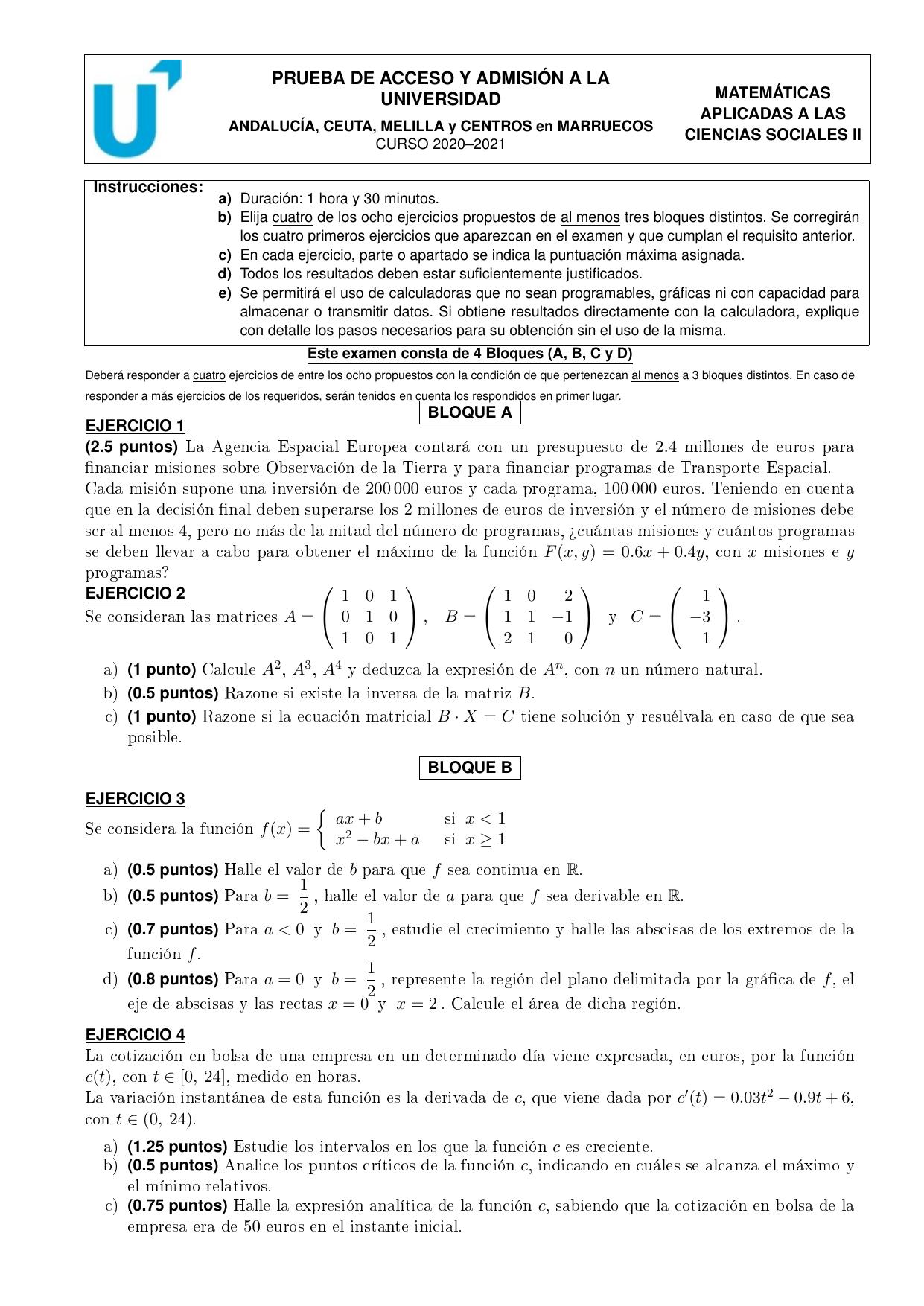
a) Calcule A 2 , A 3 , A 4 A^2, A^3, A^4 A 2 , A 3 , A 4 y deduzca la expresión de A n A^n A n , con n n n un número natural. Dada la matriz A = ( 1 0 1 0 1 0 1 0 1 ) A = \begin{pmatrix} 1 & 0 & 1 \\ 0 & 1 & 0 \\ 1 & 0 & 1 \end{pmatrix} A = 1 0 1 0 1 0 1 0 1 , Calculamos A 2 A^2 A 2 :
A 2 = A ⋅ A = ( 1 0 1 0 1 0 1 0 1 ) ( 1 0 1 0 1 0 1 0 1 ) = ( 1 ⋅ 1 + 0 ⋅ 0 + 1 ⋅ 1 1 ⋅ 0 + 0 ⋅ 1 + 1 ⋅ 0 1 ⋅ 1 + 0 ⋅ 0 + 1 ⋅ 1 0 ⋅ 1 + 1 ⋅ 0 + 0 ⋅ 1 0 ⋅ 0 + 1 ⋅ 1 + 0 ⋅ 0 0 ⋅ 1 + 1 ⋅ 0 + 0 ⋅ 1 1 ⋅ 1 + 0 ⋅ 0 + 1 ⋅ 1 1 ⋅ 0 + 0 ⋅ 1 + 1 ⋅ 0 1 ⋅ 1 + 0 ⋅ 0 + 1 ⋅ 1 ) = ( 2 0 2 0 1 0 2 0 2 ) A^2 = A \cdot A = \begin{pmatrix} 1 & 0 & 1 \\ 0 & 1 & 0 \\ 1 & 0 & 1 \end{pmatrix} \begin{pmatrix} 1 & 0 & 1 \\ 0 & 1 & 0 \\ 1 & 0 & 1 \end{pmatrix} = \begin{pmatrix} 1 \cdot 1 + 0 \cdot 0 + 1 \cdot 1 & 1 \cdot 0 + 0 \cdot 1 + 1 \cdot 0 & 1 \cdot 1 + 0 \cdot 0 + 1 \cdot 1 \\ 0 \cdot 1 + 1 \cdot 0 + 0 \cdot 1 & 0 \cdot 0 + 1 \cdot 1 + 0 \cdot 0 & 0 \cdot 1 + 1 \cdot 0 + 0 \cdot 1 \\ 1 \cdot 1 + 0 \cdot 0 + 1 \cdot 1 & 1 \cdot 0 + 0 \cdot 1 + 1 \cdot 0 & 1 \cdot 1 + 0 \cdot 0 + 1 \cdot 1 \end{pmatrix} = \begin{pmatrix} 2 & 0 & 2 \\ 0 & 1 & 0 \\ 2 & 0 & 2 \end{pmatrix} A 2 = A ⋅ A = 1 0 1 0 1 0 1 0 1 1 0 1 0 1 0 1 0 1 = 1 ⋅ 1 + 0 ⋅ 0 + 1 ⋅ 1 0 ⋅ 1 + 1 ⋅ 0 + 0 ⋅ 1 1 ⋅ 1 + 0 ⋅ 0 + 1 ⋅ 1 1 ⋅ 0 + 0 ⋅ 1 + 1 ⋅ 0 0 ⋅ 0 + 1 ⋅ 1 + 0 ⋅ 0 1 ⋅ 0 + 0 ⋅ 1 + 1 ⋅ 0 1 ⋅ 1 + 0 ⋅ 0 + 1 ⋅ 1 0 ⋅ 1 + 1 ⋅ 0 + 0 ⋅ 1 1 ⋅ 1 + 0 ⋅ 0 + 1 ⋅ 1 = 2 0 2 0 1 0 2 0 2 Calculamos A 3 A^3 A 3 :
A 3 = A 2 ⋅ A = ( 2 0 2 0 1 0 2 0 2 ) ( 1 0 1 0 1 0 1 0 1 ) = ( 2 ⋅ 1 + 0 ⋅ 0 + 2 ⋅ 1 2 ⋅ 0 + 0 ⋅ 1 + 2 ⋅ 0 2 ⋅ 1 + 0 ⋅ 0 + 2 ⋅ 1 0 ⋅ 1 + 1 ⋅ 0 + 0 ⋅ 1 0 ⋅ 0 + 1 ⋅ 1 + 0 ⋅ 0 0 ⋅ 1 + 1 ⋅ 0 + 0 ⋅ 1 2 ⋅ 1 + 0 ⋅ 0 + 2 ⋅ 1 2 ⋅ 0 + 0 ⋅ 1 + 2 ⋅ 0 2 ⋅ 1 + 0 ⋅ 0 + 2 ⋅ 1 ) = ( 4 0 4 0 1 0 4 0 4 ) A^3 = A^2 \cdot A = \begin{pmatrix} 2 & 0 & 2 \\ 0 & 1 & 0 \\ 2 & 0 & 2 \end{pmatrix} \begin{pmatrix} 1 & 0 & 1 \\ 0 & 1 & 0 \\ 1 & 0 & 1 \end{pmatrix} = \begin{pmatrix} 2 \cdot 1 + 0 \cdot 0 + 2 \cdot 1 & 2 \cdot 0 + 0 \cdot 1 + 2 \cdot 0 & 2 \cdot 1 + 0 \cdot 0 + 2 \cdot 1 \\ 0 \cdot 1 + 1 \cdot 0 + 0 \cdot 1 & 0 \cdot 0 + 1 \cdot 1 + 0 \cdot 0 & 0 \cdot 1 + 1 \cdot 0 + 0 \cdot 1 \\ 2 \cdot 1 + 0 \cdot 0 + 2 \cdot 1 & 2 \cdot 0 + 0 \cdot 1 + 2 \cdot 0 & 2 \cdot 1 + 0 \cdot 0 + 2 \cdot 1 \end{pmatrix} = \begin{pmatrix} 4 & 0 & 4 \\ 0 & 1 & 0 \\ 4 & 0 & 4 \end{pmatrix} A 3 = A 2 ⋅ A = 2 0 2 0 1 0 2 0 2 1 0 1 0 1 0 1 0 1 = 2 ⋅ 1 + 0 ⋅ 0 + 2 ⋅ 1 0 ⋅ 1 + 1 ⋅ 0 + 0 ⋅ 1 2 ⋅ 1 + 0 ⋅ 0 + 2 ⋅ 1 2 ⋅ 0 + 0 ⋅ 1 + 2 ⋅ 0 0 ⋅ 0 + 1 ⋅ 1 + 0 ⋅ 0 2 ⋅ 0 + 0 ⋅ 1 + 2 ⋅ 0 2 ⋅ 1 + 0 ⋅ 0 + 2 ⋅ 1 0 ⋅ 1 + 1 ⋅ 0 + 0 ⋅ 1 2 ⋅ 1 + 0 ⋅ 0 + 2 ⋅ 1 = 4 0 4 0 1 0 4 0 4 Calculamos A 4 A^4 A 4 :
A 4 = A 3 ⋅ A = ( 4 0 4 0 1 0 4 0 4 ) ( 1 0 1 0 1 0 1 0 1 ) = ( 4 ⋅ 1 + 0 ⋅ 0 + 4 ⋅ 1 4 ⋅ 0 + 0 ⋅ 1 + 4 ⋅ 0 4 ⋅ 1 + 0 ⋅ 0 + 4 ⋅ 1 0 ⋅ 1 + 1 ⋅ 0 + 0 ⋅ 1 0 ⋅ 0 + 1 ⋅ 1 + 0 ⋅ 0 0 ⋅ 1 + 1 ⋅ 0 + 0 ⋅ 1 4 ⋅ 1 + 0 ⋅ 0 + 4 ⋅ 1 4 ⋅ 0 + 0 ⋅ 1 + 4 ⋅ 0 4 ⋅ 1 + 0 ⋅ 0 + 4 ⋅ 1 ) = ( 8 0 8 0 1 0 8 0 8 ) A^4 = A^3 \cdot A = \begin{pmatrix} 4 & 0 & 4 \\ 0 & 1 & 0 \\ 4 & 0 & 4 \end{pmatrix} \begin{pmatrix} 1 & 0 & 1 \\ 0 & 1 & 0 \\ 1 & 0 & 1 \end{pmatrix} = \begin{pmatrix} 4 \cdot 1 + 0 \cdot 0 + 4 \cdot 1 & 4 \cdot 0 + 0 \cdot 1 + 4 \cdot 0 & 4 \cdot 1 + 0 \cdot 0 + 4 \cdot 1 \\ 0 \cdot 1 + 1 \cdot 0 + 0 \cdot 1 & 0 \cdot 0 + 1 \cdot 1 + 0 \cdot 0 & 0 \cdot 1 + 1 \cdot 0 + 0 \cdot 1 \\ 4 \cdot 1 + 0 \cdot 0 + 4 \cdot 1 & 4 \cdot 0 + 0 \cdot 1 + 4 \cdot 0 & 4 \cdot 1 + 0 \cdot 0 + 4 \cdot 1 \end{pmatrix} = \begin{pmatrix} 8 & 0 & 8 \\ 0 & 1 & 0 \\ 8 & 0 & 8 \end{pmatrix} A 4 = A 3 ⋅ A = 4 0 4 0 1 0 4 0 4 1 0 1 0 1 0 1 0 1 = 4 ⋅ 1 + 0 ⋅ 0 + 4 ⋅ 1 0 ⋅ 1 + 1 ⋅ 0 + 0 ⋅ 1 4 ⋅ 1 + 0 ⋅ 0 + 4 ⋅ 1 4 ⋅ 0 + 0 ⋅ 1 + 4 ⋅ 0 0 ⋅ 0 + 1 ⋅ 1 + 0 ⋅ 0 4 ⋅ 0 + 0 ⋅ 1 + 4 ⋅ 0 4 ⋅ 1 + 0 ⋅ 0 + 4 ⋅ 1 0 ⋅ 1 + 1 ⋅ 0 + 0 ⋅ 1 4 ⋅ 1 + 0 ⋅ 0 + 4 ⋅ 1 = 8 0 8 0 1 0 8 0 8 Observando el patrón de las potencias de A A A :
A 1 = ( 1 0 1 0 1 0 1 0 1 ) = ( 2 0 0 2 0 0 1 0 2 0 0 2 0 ) A^1 = \begin{pmatrix} 1 & 0 & 1 \\ 0 & 1 & 0 \\ 1 & 0 & 1 \end{pmatrix} = \begin{pmatrix} 2^0 & 0 & 2^0 \\ 0 & 1 & 0 \\ 2^0 & 0 & 2^0 \end{pmatrix} A 1 = 1 0 1 0 1 0 1 0 1 = 2 0 0 2 0 0 1 0 2 0 0 2 0 A 2 = ( 2 0 2 0 1 0 2 0 2 ) = ( 2 1 0 2 1 0 1 0 2 1 0 2 1 ) A^2 = \begin{pmatrix} 2 & 0 & 2 \\ 0 & 1 & 0 \\ 2 & 0 & 2 \end{pmatrix} = \begin{pmatrix} 2^1 & 0 & 2^1 \\ 0 & 1 & 0 \\ 2^1 & 0 & 2^1 \end{pmatrix} A 2 = 2 0 2 0 1 0 2 0 2 = 2 1 0 2 1 0 1 0 2 1 0 2 1 A 3 = ( 4 0 4 0 1 0 4 0 4 ) = ( 2 2 0 2 2 0 1 0 2 2 0 2 2 ) A^3 = \begin{pmatrix} 4 & 0 & 4 \\ 0 & 1 & 0 \\ 4 & 0 & 4 \end{pmatrix} = \begin{pmatrix} 2^2 & 0 & 2^2 \\ 0 & 1 & 0 \\ 2^2 & 0 & 2^2 \end{pmatrix} A 3 = 4 0 4 0 1 0 4 0 4 = 2 2 0 2 2 0 1 0 2 2 0 2 2 A 4 = ( 8 0 8 0 1 0 8 0 8 ) = ( 2 3 0 2 3 0 1 0 2 3 0 2 3 ) A^4 = \begin{pmatrix} 8 & 0 & 8 \\ 0 & 1 & 0 \\ 8 & 0 & 8 \end{pmatrix} = \begin{pmatrix} 2^3 & 0 & 2^3 \\ 0 & 1 & 0 \\ 2^3 & 0 & 2^3 \end{pmatrix} A 4 = 8 0 8 0 1 0 8 0 8 = 2 3 0 2 3 0 1 0 2 3 0 2 3 Se deduce que la expresión de A n A^n A n para n n n un número natural es:
A n = ( 2 n − 1 0 2 n − 1 0 1 0 2 n − 1 0 2 n − 1 ) A^n = \begin{pmatrix} 2^{n-1} & 0 & 2^{n-1} \\ 0 & 1 & 0 \\ 2^{n-1} & 0 & 2^{n-1} \end{pmatrix} A n = 2 n − 1 0 2 n − 1 0 1 0 2 n − 1 0 2 n − 1 b) Razone si existe la inversa de la matriz B B B . La matriz B = ( 1 0 2 1 1 − 1 2 1 0 ) B = \begin{pmatrix} 1 & 0 & 2 \\ 1 & 1 & -1 \\ 2 & 1 & 0 \end{pmatrix} B = 1 1 2 0 1 1 2 − 1 0 tiene inversa si y solo si su determinante es distinto de cero. Calculamos el determinante de B B B :
det ( B ) = ∣ 1 0 2 1 1 − 1 2 1 0 ∣ = 1 ⋅ ( 1 ⋅ 0 − ( − 1 ) ⋅ 1 ) − 0 ⋅ ( 1 ⋅ 0 − ( − 1 ) ⋅ 2 ) + 2 ⋅ ( 1 ⋅ 1 − 1 ⋅ 2 ) \det(B) = \begin{vmatrix} 1 & 0 & 2 \\ 1 & 1 & -1 \\ 2 & 1 & 0 \end{vmatrix} = 1 \cdot (1 \cdot 0 - (-1) \cdot 1) - 0 \cdot (1 \cdot 0 - (-1) \cdot 2) + 2 \cdot (1 \cdot 1 - 1 \cdot 2) det ( B ) = 1 1 2 0 1 1 2 − 1 0 = 1 ⋅ ( 1 ⋅ 0 − ( − 1 ) ⋅ 1 ) − 0 ⋅ ( 1 ⋅ 0 − ( − 1 ) ⋅ 2 ) + 2 ⋅ ( 1 ⋅ 1 − 1 ⋅ 2 ) det ( B ) = 1 ⋅ ( 0 + 1 ) − 0 + 2 ⋅ ( 1 − 2 ) \det(B) = 1 \cdot (0 + 1) - 0 + 2 \cdot (1 - 2) det ( B ) = 1 ⋅ ( 0 + 1 ) − 0 + 2 ⋅ ( 1 − 2 ) det ( B ) = 1 ⋅ 1 + 2 ⋅ ( − 1 ) \det(B) = 1 \cdot 1 + 2 \cdot (-1) det ( B ) = 1 ⋅ 1 + 2 ⋅ ( − 1 ) det ( B ) = 1 − 2 = − 1 \det(B) = 1 - 2 = -1 det ( B ) = 1 − 2 = − 1 Dado que det ( B ) = − 1 ≠ 0 \det(B) = -1 \neq 0 det ( B ) = − 1 = 0 , la inversa de la matriz B B B existe.
c) Razone si la ecuación matricial B ⋅ X = C B \cdot X = C B ⋅ X = C tiene solución y resuélvala en caso de que sea posible. Dado que la inversa de la matriz B B B existe (como se demostró en el apartado b), la ecuación matricial B ⋅ X = C B \cdot X = C B ⋅ X = C tiene una única solución. Para encontrar X X X , multiplicamos por B − 1 B^{-1} B − 1 por la izquierda en ambos lados de la ecuación:
B − 1 ⋅ B ⋅ X = B − 1 ⋅ C ⇒ I ⋅ X = B − 1 ⋅ C ⇒ X = B − 1 ⋅ C B^{-1} \cdot B \cdot X = B^{-1} \cdot C \Rightarrow I \cdot X = B^{-1} \cdot C \Rightarrow X = B^{-1} \cdot C B − 1 ⋅ B ⋅ X = B − 1 ⋅ C ⇒ I ⋅ X = B − 1 ⋅ C ⇒ X = B − 1 ⋅ C Primero calculamos la matriz inversa B − 1 B^{-1} B − 1 . Matriz de cofactores de B B B :
Cof(B) = \begin{pmatrix} +\begin{vmatrix} 1 & -1 \\ 1 & 0 \end{pmatrix} & -\begin{vmatrix} 1 & -1 \\ 2 & 0 \end{pmatrix} & +\begin{vmatrix} 1 & 1 \\ 2 & 1 \end{pmatrix} \\ -\begin{vmatrix} 0 & 2 \\ 1 & 0 \end{pmatrix} & +\begin{vmatrix} 1 & 2 \\ 2 & 0 \end{pmatrix} & -\begin{vmatrix} 1 & 0 \\ 2 & 1 \end{pmatrix} \\ +\begin{vmatrix} 0 & 2 \\ 1 & -1 \end{pmatrix} & -\begin{vmatrix} 1 & 2 \\ 1 & -1 \end{pmatrix} & +\begin{vmatrix} 1 & 0 \\ 1 & 1 \end{pmatrix} \end{pmatrix} = \begin{pmatrix} 1 & -2 & -1 \\ 2 & -4 & -1 \\ -2 & 3 & 1 \end{pmatrix}
Matriz adjunta de B B B , A d j ( B ) = ( C o f ( B ) ) T Adj(B) = (Cof(B))^T A d j ( B ) = ( C o f ( B ) ) T :
A d j ( B ) = ( 1 2 − 2 − 2 − 4 3 − 1 − 1 1 ) Adj(B) = \begin{pmatrix} 1 & 2 & -2 \\ -2 & -4 & 3 \\ -1 & -1 & 1 \end{pmatrix} A d j ( B ) = 1 − 2 − 1 2 − 4 − 1 − 2 3 1 Matriz inversa B − 1 = 1 det ( B ) A d j ( B ) B^{-1} = \frac{1}{\det(B)} Adj(B) B − 1 = d e t ( B ) 1 A d j ( B ) :
B − 1 = 1 − 1 ( 1 2 − 2 − 2 − 4 3 − 1 − 1 1 ) = ( − 1 − 2 2 2 4 − 3 1 1 − 1 ) B^{-1} = \frac{1}{-1} \begin{pmatrix} 1 & 2 & -2 \\ -2 & -4 & 3 \\ -1 & -1 & 1 \end{pmatrix} = \begin{pmatrix} -1 & -2 & 2 \\ 2 & 4 & -3 \\ 1 & 1 & -1 \end{pmatrix} B − 1 = − 1 1 1 − 2 − 1 2 − 4 − 1 − 2 3 1 = − 1 2 1 − 2 4 1 2 − 3 − 1 Ahora calculamos X = B − 1 C X = B^{-1}C X = B − 1 C con C = ( 1 − 3 1 ) C = \begin{pmatrix} 1 \\ -3 \\ 1 \end{pmatrix} C = 1 − 3 1 :
X = ( − 1 − 2 2 2 4 − 3 1 1 − 1 ) ( 1 − 3 1 ) = ( ( − 1 ) ( 1 ) + ( − 2 ) ( − 3 ) + ( 2 ) ( 1 ) ( 2 ) ( 1 ) + ( 4 ) ( − 3 ) + ( − 3 ) ( 1 ) ( 1 ) ( 1 ) + ( 1 ) ( − 3 ) + ( − 1 ) ( 1 ) ) X = \begin{pmatrix} -1 & -2 & 2 \\ 2 & 4 & -3 \\ 1 & 1 & -1 \end{pmatrix} \begin{pmatrix} 1 \\ -3 \\ 1 \end{pmatrix} = \begin{pmatrix} (-1)(1) + (-2)(-3) + (2)(1) \\ (2)(1) + (4)(-3) + (-3)(1) \\ (1)(1) + (1)(-3) + (-1)(1) \end{pmatrix} X = − 1 2 1 − 2 4 1 2 − 3 − 1 1 − 3 1 = ( − 1 ) ( 1 ) + ( − 2 ) ( − 3 ) + ( 2 ) ( 1 ) ( 2 ) ( 1 ) + ( 4 ) ( − 3 ) + ( − 3 ) ( 1 ) ( 1 ) ( 1 ) + ( 1 ) ( − 3 ) + ( − 1 ) ( 1 ) X = ( − 1 + 6 + 2 2 − 12 − 3 1 − 3 − 1 ) = ( 7 − 13 − 3 ) X = \begin{pmatrix} -1 + 6 + 2 \\ 2 - 12 - 3 \\ 1 - 3 - 1 \end{pmatrix} = \begin{pmatrix} 7 \\ -13 \\ -3 \end{pmatrix} X = − 1 + 6 + 2 2 − 12 − 3 1 − 3 − 1 = 7 − 13 − 3