🔍
Escribe al menos 2 caracteres...
AndalucíaAndalucía
MadridMadrid
CataluñaCataluña
GaliciaGalicia
MurciaMurcia
ValenciaValencia
En construcciónAñadimos comunidades, materias, años y soluciones de forma progresiva y constante.
Operaciones con matrices
Problema
2021 · Ordinaria · Suplente
1
Examen

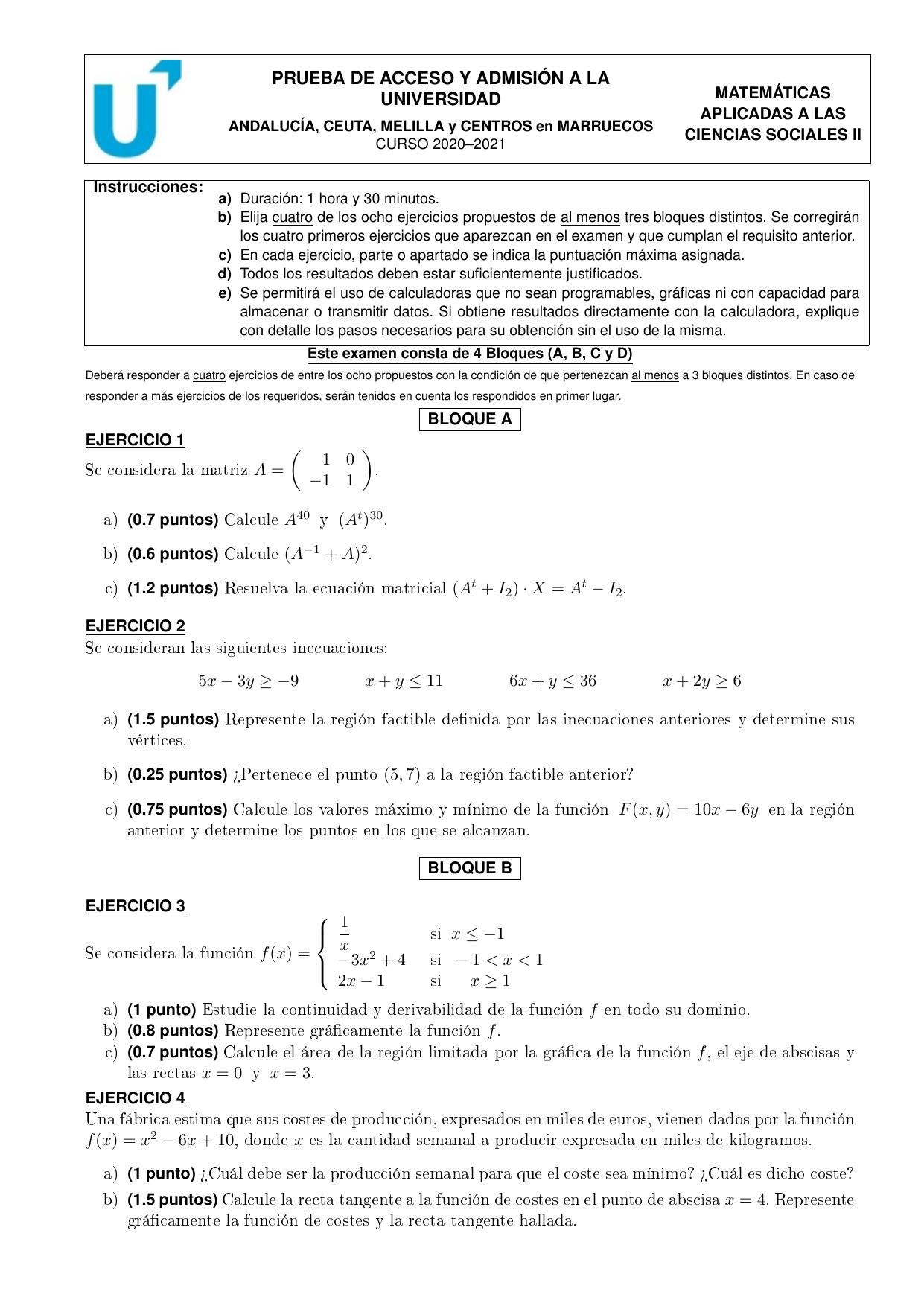
Se considera la matriz A=(1011)A = \begin{pmatrix} 1 & 0 \\ -1 & 1 \end{pmatrix}.

a) Calcule A40A^{40} y (At)30(A^t)^{30}.b) Calcule (A1+A)2(A^{-1} + A)^2.c) Resuelva la ecuación matricial (At+I2)X=AtI2(A^t + I_2) \cdot X = A^t - I_2.
Potencia de una matrizEcuación matricialInversa de una matriz
a) Calcule A40A^{40} y (At)30(A^t)^{30}.

Primero calculamos las primeras potencias de AA para encontrar un patrón:

A=(1011)A = \begin{pmatrix} 1 & 0 \\ -1 & 1 \end{pmatrix}
A2=(1011)(1011)=(1021)A^2 = \begin{pmatrix} 1 & 0 \\ -1 & 1 \end{pmatrix} \begin{pmatrix} 1 & 0 \\ -1 & 1 \end{pmatrix} = \begin{pmatrix} 1 & 0 \\ -2 & 1 \end{pmatrix}
A3=A2A=(1021)(1011)=(1031)A^3 = A^2 \cdot A = \begin{pmatrix} 1 & 0 \\ -2 & 1 \end{pmatrix} \begin{pmatrix} 1 & 0 \\ -1 & 1 \end{pmatrix} = \begin{pmatrix} 1 & 0 \\ -3 & 1 \end{pmatrix}

Se observa un patrón, que es An=(10n1)A^n = \begin{pmatrix} 1 & 0 \\ -n & 1 \end{pmatrix}. Por lo tanto, para n=40n=40:

A40=(10401)A^{40} = \begin{pmatrix} 1 & 0 \\ -40 & 1 \end{pmatrix}

Ahora calculamos (At)30(A^t)^{30}. Primero obtenemos la matriz traspuesta de AA:

At=(1101)A^t = \begin{pmatrix} 1 & -1 \\ 0 & 1 \end{pmatrix}

Calculamos las primeras potencias de AtA^t:

(At)2=(1101)(1101)=(1201)(A^t)^2 = \begin{pmatrix} 1 & -1 \\ 0 & 1 \end{pmatrix} \begin{pmatrix} 1 & -1 \\ 0 & 1 \end{pmatrix} = \begin{pmatrix} 1 & -2 \\ 0 & 1 \end{pmatrix}
(At)3=(At)2At=(1201)(1101)=(1301)(A^t)^3 = (A^t)^2 \cdot A^t = \begin{pmatrix} 1 & -2 \\ 0 & 1 \end{pmatrix} \begin{pmatrix} 1 & -1 \\ 0 & 1 \end{pmatrix} = \begin{pmatrix} 1 & -3 \\ 0 & 1 \end{pmatrix}

El patrón para (At)n(A^t)^n es (At)n=(1n01)(A^t)^n = \begin{pmatrix} 1 & -n \\ 0 & 1 \end{pmatrix}. Por lo tanto, para n=30n=30:

(At)30=(13001)(A^t)^{30} = \begin{pmatrix} 1 & -30 \\ 0 & 1 \end{pmatrix}
b) Calcule (A1+A)2(A^{-1} + A)^2.

Primero calculamos la matriz inversa A1A^{-1}. El determinante de AA es det(A)=110(1)=1\text{det}(A) = 1 \cdot 1 - 0 \cdot (-1) = 1.La adjunta de AA es adj(A)=(10(1)1)t=(1011)\text{adj}(A) = \begin{pmatrix} 1 & -0 \\ -(-1) & 1 \end{pmatrix}^t = \begin{pmatrix} 1 & 0 \\ 1 & 1 \end{pmatrix}.La inversa de AA es:

A1=1det(A)adj(A)=11(1011)=(1011)A^{-1} = \frac{1}{\text{det}(A)} \text{adj}(A) = \frac{1}{1} \begin{pmatrix} 1 & 0 \\ 1 & 1 \end{pmatrix} = \begin{pmatrix} 1 & 0 \\ 1 & 1 \end{pmatrix}

Ahora calculamos la suma A1+AA^{-1} + A:

A1+A=(1011)+(1011)=(1+10+0111+1)=(2002)=2I2A^{-1} + A = \begin{pmatrix} 1 & 0 \\ 1 & 1 \end{pmatrix} + \begin{pmatrix} 1 & 0 \\ -1 & 1 \end{pmatrix} = \begin{pmatrix} 1+1 & 0+0 \\ 1-1 & 1+1 \end{pmatrix} = \begin{pmatrix} 2 & 0 \\ 0 & 2 \end{pmatrix} = 2I_2

Finalmente, calculamos (A1+A)2(A^{-1} + A)^2:

(A1+A)2=(2I2)2=(2I2)(2I2)=4I22=4I2=(4004)(A^{-1} + A)^2 = (2I_2)^2 = (2I_2)(2I_2) = 4I_2^2 = 4I_2 = \begin{pmatrix} 4 & 0 \\ 0 & 4 \end{pmatrix}
c) Resuelva la ecuación matricial (At+I2)X=AtI2(A^t + I_2) \cdot X = A^t - I_2.

Primero calculamos los términos de la ecuación. At=(1101)A^t = \begin{pmatrix} 1 & -1 \\ 0 & 1 \end{pmatrix}.Calculamos At+I2A^t + I_2:

At+I2=(1101)+(1001)=(2102)A^t + I_2 = \begin{pmatrix} 1 & -1 \\ 0 & 1 \end{pmatrix} + \begin{pmatrix} 1 & 0 \\ 0 & 1 \end{pmatrix} = \begin{pmatrix} 2 & -1 \\ 0 & 2 \end{pmatrix}

Calculamos AtI2A^t - I_2:

AtI2=(1101)(1001)=(0100)A^t - I_2 = \begin{pmatrix} 1 & -1 \\ 0 & 1 \end{pmatrix} - \begin{pmatrix} 1 & 0 \\ 0 & 1 \end{pmatrix} = \begin{pmatrix} 0 & -1 \\ 0 & 0 \end{pmatrix}

La ecuación matricial es BX=CB \cdot X = C, donde B=At+I2B = A^t + I_2 y C=AtI2C = A^t - I_2. Tenemos B=(2102)B = \begin{pmatrix} 2 & -1 \\ 0 & 2 \end{pmatrix} y C=(0100)C = \begin{pmatrix} 0 & -1 \\ 0 & 0 \end{pmatrix}.Para resolver X=B1CX = B^{-1}C, necesitamos calcular la inversa de BB. El determinante de BB es det(B)=22(1)0=4\text{det}(B) = 2 \cdot 2 - (-1) \cdot 0 = 4.La adjunta de BB es adj(B)=(2(1)02)t=(2102)t=(2012)\text{adj}(B) = \begin{pmatrix} 2 & -(-1) \\ -0 & 2 \end{pmatrix}^t = \begin{pmatrix} 2 & 1 \\ 0 & 2 \end{pmatrix}^t = \begin{pmatrix} 2 & 0 \\ 1 & 2 \end{pmatrix}.La inversa de BB es:

B1=14(2012)=(1/201/41/2)B^{-1} = \frac{1}{4} \begin{pmatrix} 2 & 0 \\ 1 & 2 \end{pmatrix} = \begin{pmatrix} 1/2 & 0 \\ 1/4 & 1/2 \end{pmatrix}

Finalmente, calculamos X=B1CX = B^{-1} \cdot C:

X=(1/201/41/2)(0100)=((1/2)0+00(1/2)(1)+00(1/4)0+(1/2)0(1/4)(1)+(1/2)0)X = \begin{pmatrix} 1/2 & 0 \\ 1/4 & 1/2 \end{pmatrix} \begin{pmatrix} 0 & -1 \\ 0 & 0 \end{pmatrix} = \begin{pmatrix} (1/2)\cdot 0 + 0\cdot 0 & (1/2)\cdot (-1) + 0\cdot 0 \\ (1/4)\cdot 0 + (1/2)\cdot 0 & (1/4)\cdot (-1) + (1/2)\cdot 0 \end{pmatrix}
X=(01/201/4)X = \begin{pmatrix} 0 & -1/2 \\ 0 & -1/4 \end{pmatrix}