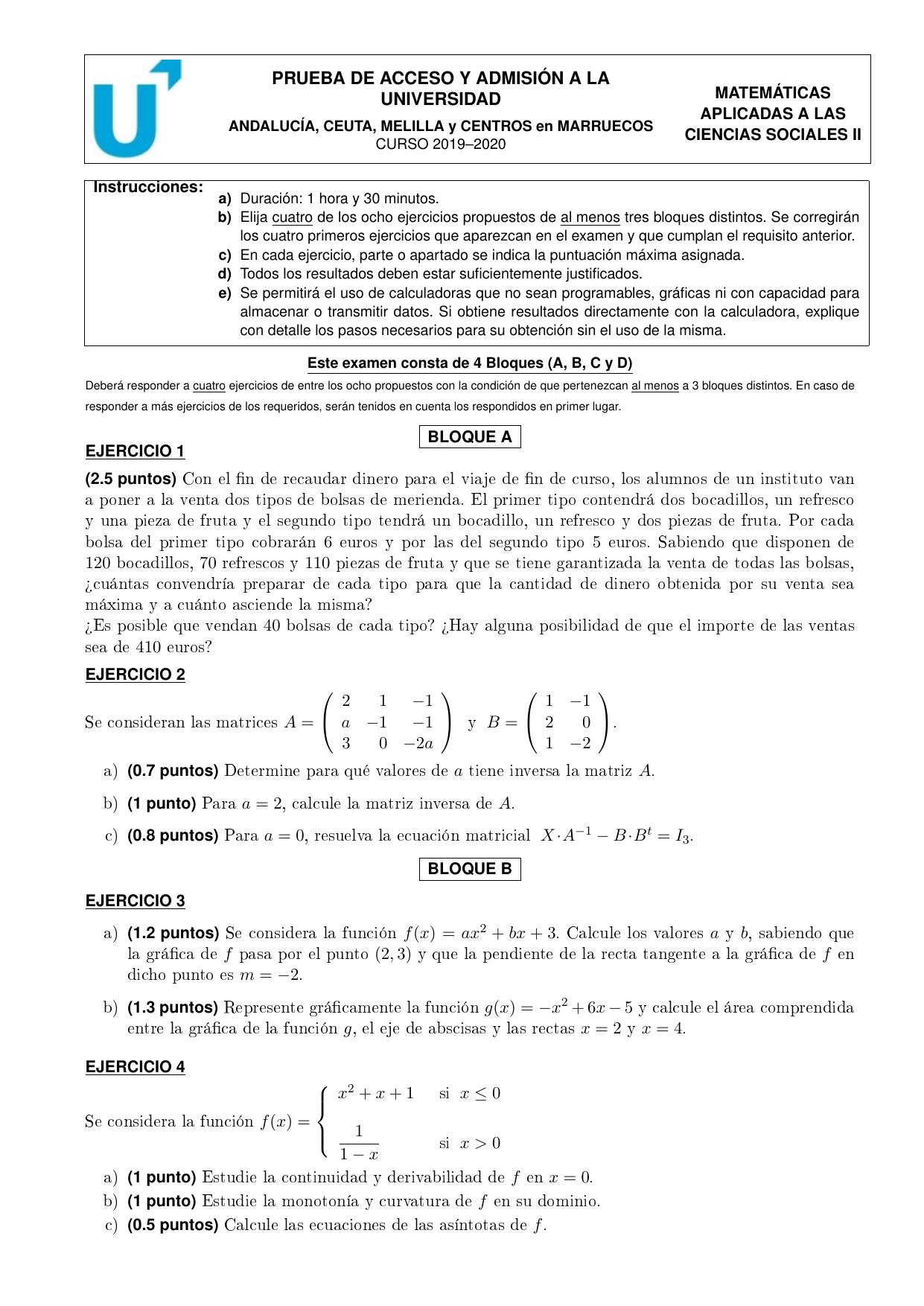
a) Determine para qué valores de a a a tiene inversa la matriz A A A . Una matriz tiene inversa si y solo si su determinante es no nulo. Calculamos el determinante de A A A .
A = ( 2 1 − 1 a − 1 − 1 3 0 − 2 a ) A = \begin{pmatrix} 2 & 1 & -1 \\ a & -1 & -1 \\ 3 & 0 & -2a \end{pmatrix} A = 2 a 3 1 − 1 0 − 1 − 1 − 2 a \det(A) = 2 \cdot ((-1)(-2a) - (-1)(0)) - 1 \cdot ((a)(-2a) - (-1)(3)) + (-1) \cdot ((a)(0) - (-1)(3))
\det(A) = 2(2a) - 1(-2a^2 + 3) - 1(3)
det ( A ) = 4 a + 2 a 2 − 3 − 3 \det(A) = 4a + 2a^2 - 3 - 3 det ( A ) = 4 a + 2 a 2 − 3 − 3 det ( A ) = 2 a 2 + 4 a − 6 \det(A) = 2a^2 + 4a - 6 det ( A ) = 2 a 2 + 4 a − 6 Para que la matriz A A A tenga inversa, el determinante debe ser distinto de cero. Encontramos los valores de a a a para los cuales el determinante es cero:
2 a 2 + 4 a − 6 = 0 2a^2 + 4a - 6 = 0 2 a 2 + 4 a − 6 = 0 a 2 + 2 a − 3 = 0 a^2 + 2a - 3 = 0 a 2 + 2 a − 3 = 0 Resolvemos la ecuación cuadrática:
( a + 3 ) ( a − 1 ) = 0 (a+3)(a-1) = 0 ( a + 3 ) ( a − 1 ) = 0 a = − 3 o a = 1 a = -3 \quad \text{o} \quad a = 1 a = − 3 o a = 1 Por lo tanto, la matriz A A A tiene inversa para todos los valores de a a a excepto a = − 3 a=-3 a = − 3 y a = 1 a=1 a = 1 . Es decir, para a ∈ R ∖ { − 3 , 1 } a \in \mathbb{R} \setminus \{-3, 1\} a ∈ R ∖ { − 3 , 1 } .
b) Para a = 2 a=2 a = 2 , calcule la matriz inversa de A A A . Para a = 2 a=2 a = 2 , la matriz A A A es:
A = ( 2 1 − 1 2 − 1 − 1 3 0 − 4 ) A = \begin{pmatrix} 2 & 1 & -1 \\ 2 & -1 & -1 \\ 3 & 0 & -4 \end{pmatrix} A = 2 2 3 1 − 1 0 − 1 − 1 − 4 Calculamos el determinante para a = 2 a=2 a = 2 :
det ( A ) = 2 ( 2 2 ) + 4 ( 2 ) − 6 = 2 ( 4 ) + 8 − 6 = 8 + 8 − 6 = 10 \det(A) = 2(2^2) + 4(2) - 6 = 2(4) + 8 - 6 = 8 + 8 - 6 = 10 det ( A ) = 2 ( 2 2 ) + 4 ( 2 ) − 6 = 2 ( 4 ) + 8 − 6 = 8 + 8 − 6 = 10 Calculamos la matriz de cofactores C C C :
C 11 = + ∣ − 1 − 1 0 − 4 ∣ = 4 C_{11} = +\begin{vmatrix} -1 & -1 \\ 0 & -4 \end{vmatrix} = 4 C 11 = + − 1 0 − 1 − 4 = 4 C 12 = − ∣ 2 − 1 3 − 4 ∣ = − ( − 8 − ( − 3 ) ) = 5 C_{12} = -\begin{vmatrix} 2 & -1 \\ 3 & -4 \end{vmatrix} = -(-8 - (-3)) = 5 C 12 = − 2 3 − 1 − 4 = − ( − 8 − ( − 3 )) = 5 C 13 = + ∣ 2 − 1 3 0 ∣ = 0 − ( − 3 ) = 3 C_{13} = +\begin{vmatrix} 2 & -1 \\ 3 & 0 \end{vmatrix} = 0 - (-3) = 3 C 13 = + 2 3 − 1 0 = 0 − ( − 3 ) = 3 C 21 = − ∣ 1 − 1 0 − 4 ∣ = − ( − 4 − 0 ) = 4 C_{21} = -\begin{vmatrix} 1 & -1 \\ 0 & -4 \end{vmatrix} = -(-4 - 0) = 4 C 21 = − 1 0 − 1 − 4 = − ( − 4 − 0 ) = 4 C 22 = + ∣ 2 − 1 3 − 4 ∣ = − 8 − ( − 3 ) = − 5 C_{22} = +\begin{vmatrix} 2 & -1 \\ 3 & -4 \end{vmatrix} = -8 - (-3) = -5 C 22 = + 2 3 − 1 − 4 = − 8 − ( − 3 ) = − 5 C 23 = − ∣ 2 1 3 0 ∣ = − ( 0 − 3 ) = 3 C_{23} = -\begin{vmatrix} 2 & 1 \\ 3 & 0 \end{vmatrix} = -(0 - 3) = 3 C 23 = − 2 3 1 0 = − ( 0 − 3 ) = 3 C 31 = + ∣ 1 − 1 − 1 − 1 ∣ = − 1 − 1 = − 2 C_{31} = +\begin{vmatrix} 1 & -1 \\ -1 & -1 \end{vmatrix} = -1 - 1 = -2 C 31 = + 1 − 1 − 1 − 1 = − 1 − 1 = − 2 C 32 = − ∣ 2 − 1 2 − 1 ∣ = − ( − 2 − ( − 2 ) ) = 0 C_{32} = -\begin{vmatrix} 2 & -1 \\ 2 & -1 \end{vmatrix} = -(-2 - (-2)) = 0 C 32 = − 2 2 − 1 − 1 = − ( − 2 − ( − 2 )) = 0 C 33 = + ∣ 2 1 2 − 1 ∣ = − 2 − 2 = − 4 C_{33} = +\begin{vmatrix} 2 & 1 \\ 2 & -1 \end{vmatrix} = -2 - 2 = -4 C 33 = + 2 2 1 − 1 = − 2 − 2 = − 4 La matriz de cofactores es:
C = ( 4 5 3 4 − 5 3 − 2 0 − 4 ) C = \begin{pmatrix} 4 & 5 & 3 \\ 4 & -5 & 3 \\ -2 & 0 & -4 \end{pmatrix} C = 4 4 − 2 5 − 5 0 3 3 − 4 La matriz adjunta es la traspuesta de la matriz de cofactores:
Adj ( A ) = C t = ( 4 4 − 2 5 − 5 0 3 3 − 4 ) \text{Adj}(A) = C^t = \begin{pmatrix} 4 & 4 & -2 \\ 5 & -5 & 0 \\ 3 & 3 & -4 \end{pmatrix} Adj ( A ) = C t = 4 5 3 4 − 5 3 − 2 0 − 4 Finalmente, la inversa de A A A es:
A − 1 = 1 det ( A ) Adj ( A ) = 1 10 ( 4 4 − 2 5 − 5 0 3 3 − 4 ) A^{-1} = \frac{1}{\det(A)} \text{Adj}(A) = \frac{1}{10} \begin{pmatrix} 4 & 4 & -2 \\ 5 & -5 & 0 \\ 3 & 3 & -4 \end{pmatrix} A − 1 = det ( A ) 1 Adj ( A ) = 10 1 4 5 3 4 − 5 3 − 2 0 − 4 A − 1 = ( 2 / 5 2 / 5 − 1 / 5 1 / 2 − 1 / 2 0 3 / 10 3 / 10 − 2 / 5 ) A^{-1} = \begin{pmatrix} 2/5 & 2/5 & -1/5 \\ 1/2 & -1/2 & 0 \\ 3/10 & 3/10 & -2/5 \end{pmatrix} A − 1 = 2/5 1/2 3/10 2/5 − 1/2 3/10 − 1/5 0 − 2/5 c) Para a = 0 a=0 a = 0 , resuelva la ecuación matricial X ⋅ A − 1 − B ⋅ B t = I 3 X \cdot A^{-1} - B \cdot B^t = I_3 X ⋅ A − 1 − B ⋅ B t = I 3 . Para a = 0 a=0 a = 0 , la matriz A A A es:
A = ( 2 1 − 1 0 − 1 − 1 3 0 0 ) A = \begin{pmatrix} 2 & 1 & -1 \\ 0 & -1 & -1 \\ 3 & 0 & 0 \end{pmatrix} A = 2 0 3 1 − 1 0 − 1 − 1 0 El determinante de A A A para a = 0 a=0 a = 0 es:
det ( A ) = 2 ( 0 ) 2 + 4 ( 0 ) − 6 = − 6 \det(A) = 2(0)^2 + 4(0) - 6 = -6 det ( A ) = 2 ( 0 ) 2 + 4 ( 0 ) − 6 = − 6 Despejamos X X X de la ecuación matricial:
X ⋅ A − 1 − B ⋅ B t = I 3 X \cdot A^{-1} - B \cdot B^t = I_3 X ⋅ A − 1 − B ⋅ B t = I 3 X ⋅ A − 1 = I 3 + B ⋅ B t X \cdot A^{-1} = I_3 + B \cdot B^t X ⋅ A − 1 = I 3 + B ⋅ B t Multiplicamos por A A A por la derecha en ambos lados:
X ⋅ A − 1 ⋅ A = ( I 3 + B ⋅ B t ) ⋅ A X \cdot A^{-1} \cdot A = (I_3 + B \cdot B^t) \cdot A X ⋅ A − 1 ⋅ A = ( I 3 + B ⋅ B t ) ⋅ A X = ( I 3 + B ⋅ B t ) ⋅ A X = (I_3 + B \cdot B^t) \cdot A X = ( I 3 + B ⋅ B t ) ⋅ A Calculamos B ⋅ B t B \cdot B^t B ⋅ B t :
B = ( 1 − 1 2 0 1 − 2 ) , B t = ( 1 2 1 − 1 0 − 2 ) B = \begin{pmatrix} 1 & -1 \\ 2 & 0 \\ 1 & -2 \end{pmatrix}, \quad B^t = \begin{pmatrix} 1 & 2 & 1 \\ -1 & 0 & -2 \end{pmatrix} B = 1 2 1 − 1 0 − 2 , B t = ( 1 − 1 2 0 1 − 2 ) B ⋅ B t = ( 1 − 1 2 0 1 − 2 ) ( 1 2 1 − 1 0 − 2 ) B \cdot B^t = \begin{pmatrix} 1 & -1 \\ 2 & 0 \\ 1 & -2 \end{pmatrix} \begin{pmatrix} 1 & 2 & 1 \\ -1 & 0 & -2 \end{pmatrix} B ⋅ B t = 1 2 1 − 1 0 − 2 ( 1 − 1 2 0 1 − 2 ) B ⋅ B t = ( 1 ( 1 ) + ( − 1 ) ( − 1 ) 1 ( 2 ) + ( − 1 ) ( 0 ) 1 ( 1 ) + ( − 1 ) ( − 2 ) 2 ( 1 ) + 0 ( − 1 ) 2 ( 2 ) + 0 ( 0 ) 2 ( 1 ) + 0 ( − 2 ) 1 ( 1 ) + ( − 2 ) ( − 1 ) 1 ( 2 ) + ( − 2 ) ( 0 ) 1 ( 1 ) + ( − 2 ) ( − 2 ) ) B \cdot B^t = \begin{pmatrix} 1(1)+(-1)(-1) & 1(2)+(-1)(0) & 1(1)+(-1)(-2) \\ 2(1)+0(-1) & 2(2)+0(0) & 2(1)+0(-2) \\ 1(1)+(-2)(-1) & 1(2)+(-2)(0) & 1(1)+(-2)(-2) \end{pmatrix} B ⋅ B t = 1 ( 1 ) + ( − 1 ) ( − 1 ) 2 ( 1 ) + 0 ( − 1 ) 1 ( 1 ) + ( − 2 ) ( − 1 ) 1 ( 2 ) + ( − 1 ) ( 0 ) 2 ( 2 ) + 0 ( 0 ) 1 ( 2 ) + ( − 2 ) ( 0 ) 1 ( 1 ) + ( − 1 ) ( − 2 ) 2 ( 1 ) + 0 ( − 2 ) 1 ( 1 ) + ( − 2 ) ( − 2 ) B ⋅ B t = ( 2 2 3 2 4 2 3 2 5 ) B \cdot B^t = \begin{pmatrix} 2 & 2 & 3 \\ 2 & 4 & 2 \\ 3 & 2 & 5 \end{pmatrix} B ⋅ B t = 2 2 3 2 4 2 3 2 5 Calculamos I 3 + B ⋅ B t I_3 + B \cdot B^t I 3 + B ⋅ B t :
I 3 + B ⋅ B t = ( 1 0 0 0 1 0 0 0 1 ) + ( 2 2 3 2 4 2 3 2 5 ) = ( 3 2 3 2 5 2 3 2 6 ) I_3 + B \cdot B^t = \begin{pmatrix} 1 & 0 & 0 \\ 0 & 1 & 0 \\ 0 & 0 & 1 \end{pmatrix} + \begin{pmatrix} 2 & 2 & 3 \\ 2 & 4 & 2 \\ 3 & 2 & 5 \end{pmatrix} = \begin{pmatrix} 3 & 2 & 3 \\ 2 & 5 & 2 \\ 3 & 2 & 6 \end{pmatrix} I 3 + B ⋅ B t = 1 0 0 0 1 0 0 0 1 + 2 2 3 2 4 2 3 2 5 = 3 2 3 2 5 2 3 2 6 Finalmente, calculamos X = ( I 3 + B ⋅ B t ) ⋅ A X = (I_3 + B \cdot B^t) \cdot A X = ( I 3 + B ⋅ B t ) ⋅ A :
X = ( 3 2 3 2 5 2 3 2 6 ) ( 2 1 − 1 0 − 1 − 1 3 0 0 ) X = \begin{pmatrix} 3 & 2 & 3 \\ 2 & 5 & 2 \\ 3 & 2 & 6 \end{pmatrix} \begin{pmatrix} 2 & 1 & -1 \\ 0 & -1 & -1 \\ 3 & 0 & 0 \end{pmatrix} X = 3 2 3 2 5 2 3 2 6 2 0 3 1 − 1 0 − 1 − 1 0 X = ( 3 ( 2 ) + 2 ( 0 ) + 3 ( 3 ) 3 ( 1 ) + 2 ( − 1 ) + 3 ( 0 ) 3 ( − 1 ) + 2 ( − 1 ) + 3 ( 0 ) 2 ( 2 ) + 5 ( 0 ) + 2 ( 3 ) 2 ( 1 ) + 5 ( − 1 ) + 2 ( 0 ) 2 ( − 1 ) + 5 ( − 1 ) + 2 ( 0 ) 3 ( 2 ) + 2 ( 0 ) + 6 ( 3 ) 3 ( 1 ) + 2 ( − 1 ) + 6 ( 0 ) 3 ( − 1 ) + 2 ( − 1 ) + 6 ( 0 ) ) X = \begin{pmatrix} 3(2)+2(0)+3(3) & 3(1)+2(-1)+3(0) & 3(-1)+2(-1)+3(0) \\ 2(2)+5(0)+2(3) & 2(1)+5(-1)+2(0) & 2(-1)+5(-1)+2(0) \\ 3(2)+2(0)+6(3) & 3(1)+2(-1)+6(0) & 3(-1)+2(-1)+6(0) \end{pmatrix} X = 3 ( 2 ) + 2 ( 0 ) + 3 ( 3 ) 2 ( 2 ) + 5 ( 0 ) + 2 ( 3 ) 3 ( 2 ) + 2 ( 0 ) + 6 ( 3 ) 3 ( 1 ) + 2 ( − 1 ) + 3 ( 0 ) 2 ( 1 ) + 5 ( − 1 ) + 2 ( 0 ) 3 ( 1 ) + 2 ( − 1 ) + 6 ( 0 ) 3 ( − 1 ) + 2 ( − 1 ) + 3 ( 0 ) 2 ( − 1 ) + 5 ( − 1 ) + 2 ( 0 ) 3 ( − 1 ) + 2 ( − 1 ) + 6 ( 0 ) X = ( 6 + 0 + 9 3 − 2 + 0 − 3 − 2 + 0 4 + 0 + 6 2 − 5 + 0 − 2 − 5 + 0 6 + 0 + 18 3 − 2 + 0 − 3 − 2 + 0 ) X = \begin{pmatrix} 6+0+9 & 3-2+0 & -3-2+0 \\ 4+0+6 & 2-5+0 & -2-5+0 \\ 6+0+18 & 3-2+0 & -3-2+0 \end{pmatrix} X = 6 + 0 + 9 4 + 0 + 6 6 + 0 + 18 3 − 2 + 0 2 − 5 + 0 3 − 2 + 0 − 3 − 2 + 0 − 2 − 5 + 0 − 3 − 2 + 0 X = ( 15 1 − 5 10 − 3 − 7 24 1 − 5 ) X = \begin{pmatrix} 15 & 1 & -5 \\ 10 & -3 & -7 \\ 24 & 1 & -5 \end{pmatrix} X = 15 10 24 1 − 3 1 − 5 − 7 − 5