🔍
Escribe al menos 2 caracteres...
AndalucíaAndalucía
MadridMadrid
CataluñaCataluña
GaliciaGalicia
MurciaMurcia
ValenciaValencia
En construcciónAñadimos comunidades, materias, años y soluciones de forma progresiva y constante.
Ecuaciones matriciales
Problema
2023 · Ordinaria · Titular
2
Examen
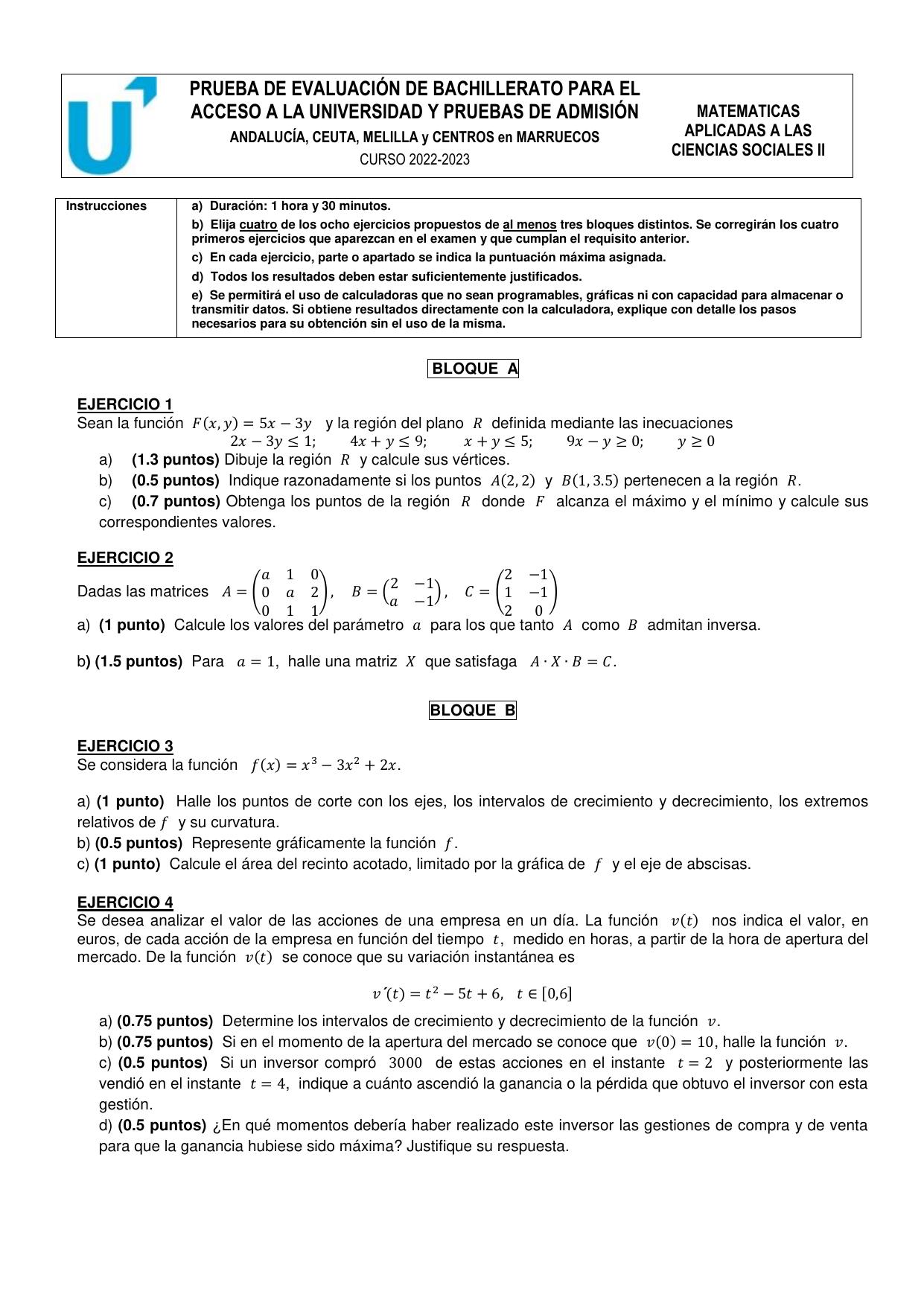
BLOQUE A - EJERCICIO 2

Dadas las matrices:

A=(a100a2011),B=(21a1),C=(211120)A = \begin{pmatrix} a & 1 & 0 \\ 0 & a & 2 \\ 0 & 1 & 1 \\ \end{pmatrix}, \quad B = \begin{pmatrix} 2 & -1 \\ a & -1 \\ \end{pmatrix}, \quad C = \begin{pmatrix} 2 & -1 \\ 1 & -1 \\ 2 & 0 \\ \end{pmatrix}
a) Calcule los valores del parámetro aa para los que tanto AA como BB admitan inversa.b) Para a=1a = 1, halle una matriz XX que satisfaga AXB=CA \cdot X \cdot B = C.
MatricesMatriz InversaEcuación Matricial
a) Calcule los valores del parámetro aa para los que tanto AA como BB admitan inversa.

Para que una matriz admita inversa, su determinante debe ser distinto de cero.Calculamos el determinante de la matriz A=(a100a2011)A = \begin{pmatrix} a & 1 & 0 \\ 0 & a & 2 \\ 0 & 1 & 1 \\ \end{pmatrix}:

det(A)=aa21110201+00a01\det(A) = a \begin{vmatrix} a & 2 \\ 1 & 1 \end{vmatrix} - 1 \begin{vmatrix} 0 & 2 \\ 0 & 1 \end{vmatrix} + 0 \begin{vmatrix} 0 & a \\ 0 & 1 \end{vmatrix}
det(A)=a(a121)1(00)+0=a(a2)\det(A) = a(a \cdot 1 - 2 \cdot 1) - 1(0 - 0) + 0 = a(a-2)

Para que AA tenga inversa, det(A)0\det(A) \neq 0, lo que implica:

a(a2)0    a0ya2a(a-2) \neq 0 \implies a \neq 0 \quad \text{y} \quad a \neq 2

Ahora calculamos el determinante de la matriz B=(21a1)B = \begin{pmatrix} 2 & -1 \\ a & -1 \\ \end{pmatrix}:

\det(B) = (2)(-1) - (-1)(a) = -2 + a

Para que BB tenga inversa, det(B)0\det(B) \neq 0, lo que implica:

2+a0    a2-2 + a \neq 0 \implies a \neq 2

Para que ambas matrices, AA y BB, admitan inversa, se deben cumplir todas las condiciones simultáneamente.

a0ya2a \neq 0 \quad \text{y} \quad a \neq 2
b) Para a=1a = 1, halle una matriz XX que satisfaga AXB=CA \cdot X \cdot B = C.

Sustituimos a=1a=1 en las matrices AA y BB:

A=(110012011),B=(2111),C=(211120)A = \begin{pmatrix} 1 & 1 & 0 \\ 0 & 1 & 2 \\ 0 & 1 & 1 \\ \end{pmatrix}, \quad B = \begin{pmatrix} 2 & -1 \\ 1 & -1 \\ \end{pmatrix}, \quad C = \begin{pmatrix} 2 & -1 \\ 1 & -1 \\ 2 & 0 \\ \end{pmatrix}

La ecuación a resolver es AXB=CA \cdot X \cdot B = C. Para despejar XX, multiplicamos por la inversa de AA por la izquierda y por la inversa de BB por la derecha:

A1(AXB)B1=A1CB1A^{-1} \cdot (A \cdot X \cdot B) \cdot B^{-1} = A^{-1} \cdot C \cdot B^{-1}
(A1A)X(BB1)=A1CB1(A^{-1} \cdot A) \cdot X \cdot (B \cdot B^{-1}) = A^{-1} \cdot C \cdot B^{-1}
IXI=A1CB1I \cdot X \cdot I = A^{-1} \cdot C \cdot B^{-1}
X=A1CB1X = A^{-1} \cdot C \cdot B^{-1}

Calculamos A1A^{-1} para a=1a=1:

A=(110012011)A = \begin{pmatrix} 1 & 1 & 0 \\ 0 & 1 & 2 \\ 0 & 1 & 1 \\ \end{pmatrix}

Ya hemos calculado det(A)=a(a2)\det(A) = a(a-2). Para a=1a=1, det(A)=1(12)=1\det(A) = 1(1-2) = -1.Calculamos la matriz de cofactores McofM_{cof}:

Mcof=(+(1)(0)+(0)(1)+(1)(1)+(2)(2)+(1))=(100111221)M_{cof} = \begin{pmatrix} +(-1) & -(0) & +(0) \\ -(1) & +(1) & -(-1) \\ +(2) & -(-2) & +(1) \\ \end{pmatrix} = \begin{pmatrix} -1 & 0 & 0 \\ -1 & 1 & 1 \\ 2 & 2 & 1 \\ \end{pmatrix}

La matriz adjunta es la traspuesta de la matriz de cofactores:

adj(A)=McofT=(112012011)\text{adj}(A) = M_{cof}^T = \begin{pmatrix} -1 & -1 & 2 \\ 0 & 1 & 2 \\ 0 & 1 & 1 \\ \end{pmatrix}

La matriz inversa A1A^{-1} es:

A1=1det(A)adj(A)=11(112012011)=(112012011)A^{-1} = \frac{1}{\det(A)} \text{adj}(A) = \frac{1}{-1} \begin{pmatrix} -1 & -1 & 2 \\ 0 & 1 & 2 \\ 0 & 1 & 1 \\ \end{pmatrix} = \begin{pmatrix} 1 & 1 & -2 \\ 0 & -1 & -2 \\ 0 & -1 & -1 \\ \end{pmatrix}

Revisando adjunta, M23=((1)(1)(0)(1))=1M_{23} = -((1)(1) - (0)(1)) = -1, entonces Mcof23=(1)=1M_{cof_{23}} = -(-1) = 1. M32=((1)(2)(0)(0))=2M_{32} = -((1)(2) - (0)(0)) = -2, Mcof32=(2)=2M_{cof_{32}} = -(-2) = 2. Así que adjunta es:

adj(A)=(112012011)\text{adj}(A) = \begin{pmatrix} -1 & -1 & 2 \\ 0 & 1 & -2 \\ 0 & -1 & 1 \\ \end{pmatrix}
A1=11(112012011)=(112012011)A^{-1} = \frac{1}{-1} \begin{pmatrix} -1 & -1 & 2 \\ 0 & 1 & -2 \\ 0 & -1 & 1 \\ \end{pmatrix} = \begin{pmatrix} 1 & 1 & -2 \\ 0 & -1 & 2 \\ 0 & 1 & -1 \\ \end{pmatrix}

Calculamos B1B^{-1} para a=1a=1:

B=(2111)B = \begin{pmatrix} 2 & -1 \\ 1 & -1 \\ \end{pmatrix}

Ya hemos calculado det(B)=2+a\det(B) = -2 + a. Para a=1a=1, det(B)=2+1=1\det(B) = -2 + 1 = -1.

B1=1det(B)adj(B)=11(1112)=(1112)B^{-1} = \frac{1}{\det(B)} \text{adj}(B) = \frac{1}{-1} \begin{pmatrix} -1 & 1 \\ -1 & 2 \\ \end{pmatrix} = \begin{pmatrix} 1 & -1 \\ 1 & -2 \\ \end{pmatrix}

Ahora calculamos el producto A1CA^{-1} \cdot C:

A1C=(112012011)(211120)A^{-1} \cdot C = \begin{pmatrix} 1 & 1 & -2 \\ 0 & -1 & 2 \\ 0 & 1 & -1 \\ \end{pmatrix} \cdot \begin{pmatrix} 2 & -1 \\ 1 & -1 \\ 2 & 0 \\ \end{pmatrix}
A1C=((1)(2)+(1)(1)+(2)(2)(1)(1)+(1)(1)+(2)(0)(0)(2)+(1)(1)+(2)(2)(0)(1)+(1)(1)+(2)(0)(0)(2)+(1)(1)+(1)(2)(0)(1)+(1)(1)+(1)(0))A^{-1} \cdot C = \begin{pmatrix} (1)(2)+(1)(1)+(-2)(2) & (1)(-1)+(1)(-1)+(-2)(0) \\ (0)(2)+(-1)(1)+(2)(2) & (0)(-1)+(-1)(-1)+(2)(0) \\ (0)(2)+(1)(1)+(-1)(2) & (0)(-1)+(1)(-1)+(-1)(0) \\ \end{pmatrix}
A1C=(2+1411+001+40+1+00+1201+0)=(123111)A^{-1} \cdot C = \begin{pmatrix} 2+1-4 & -1-1+0 \\ 0-1+4 & 0+1+0 \\ 0+1-2 & 0-1+0 \\ \end{pmatrix} = \begin{pmatrix} -1 & -2 \\ 3 & 1 \\ -1 & -1 \\ \end{pmatrix}

Finalmente, calculamos X=(A1C)B1X = (A^{-1} \cdot C) \cdot B^{-1}:

X=(123111)(1112)X = \begin{pmatrix} -1 & -2 \\ 3 & 1 \\ -1 & -1 \\ \end{pmatrix} \cdot \begin{pmatrix} 1 & -1 \\ 1 & -2 \\ \end{pmatrix}
X=((1)(1)+(2)(1)(1)(1)+(2)(2)(3)(1)+(1)(1)(3)(1)+(1)(2)(1)(1)+(1)(1)(1)(1)+(1)(2))X = \begin{pmatrix} (-1)(1)+(-2)(1) & (-1)(-1)+(-2)(-2) \\ (3)(1)+(1)(1) & (3)(-1)+(1)(-2) \\ (-1)(1)+(-1)(1) & (-1)(-1)+(-1)(-2) \\ \end{pmatrix}
X=(121+43+132111+2)X = \begin{pmatrix} -1-2 & 1+4 \\ 3+1 & -3-2 \\ -1-1 & 1+2 \\ \end{pmatrix}
X=(354523)X = \begin{pmatrix} -3 & 5 \\ 4 & -5 \\ -2 & 3 \\ \end{pmatrix}