Resolución del ejercicio
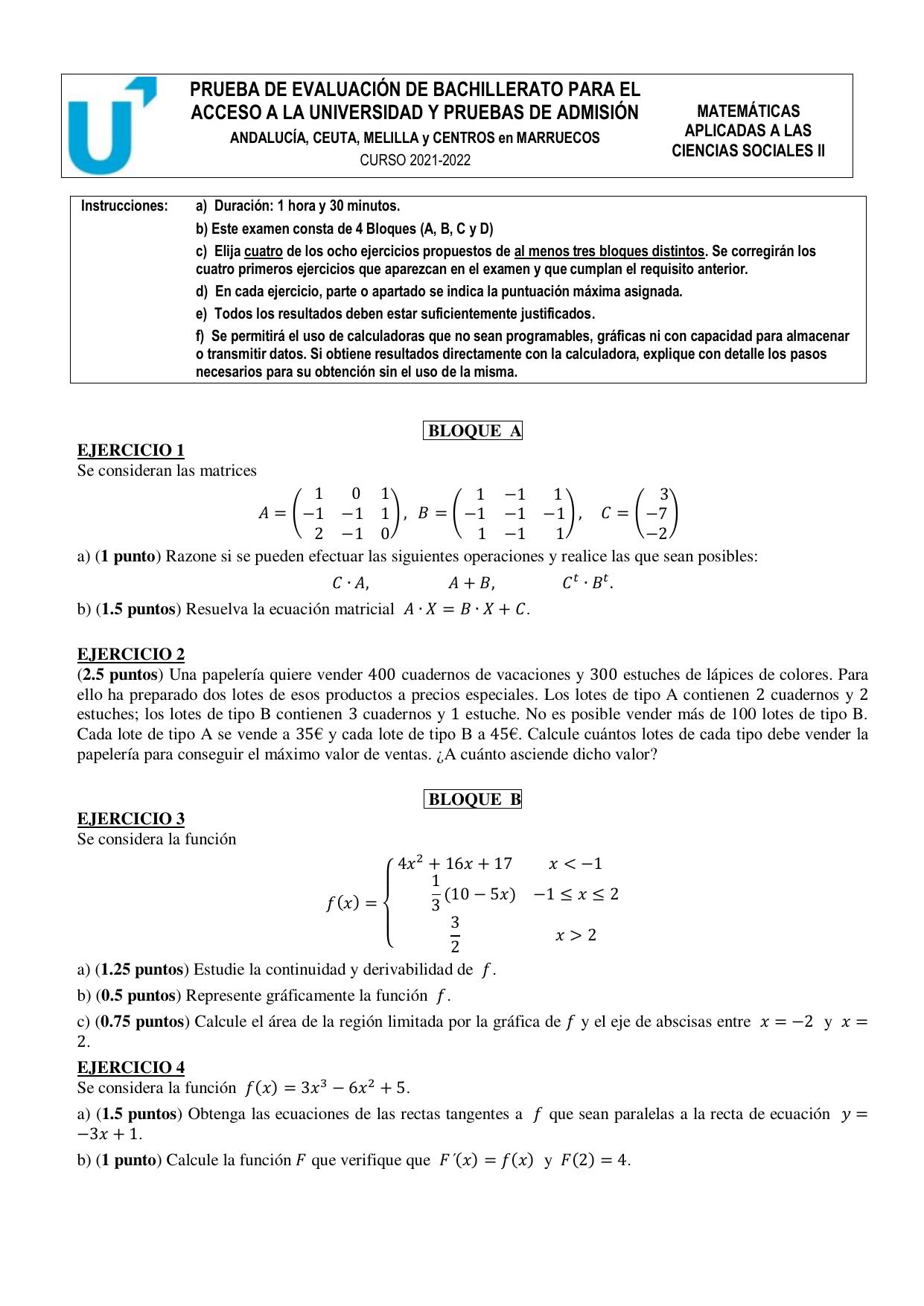
Se tienen las matrices:
A = ( 1 0 1 − 1 − 1 1 2 − 1 0 ) , B = ( 1 − 1 1 − 1 − 1 − 1 1 − 1 1 ) , C = ( 3 − 7 − 2 ) A = \begin{pmatrix} 1 & 0 & 1 \\ -1 & -1 & 1 \\ 2 & -1 & 0 \end{pmatrix}, B = \begin{pmatrix} 1 & -1 & 1 \\ -1 & -1 & -1 \\ 1 & -1 & 1 \end{pmatrix}, C = \begin{pmatrix} 3 \\ -7 \\ -2 \end{pmatrix} A = 1 − 1 2 0 − 1 − 1 1 1 0 , B = 1 − 1 1 − 1 − 1 − 1 1 − 1 1 , C = 3 − 7 − 2 Las dimensiones de estas matrices son:
dim ( A ) = 3 × 3 dim ( B ) = 3 × 3 dim ( C ) = 3 × 1 \text{dim}(A) = 3 \times 3 \quad \text{dim}(B) = 3 \times 3 \quad \text{dim}(C) = 3 \times 1 dim ( A ) = 3 × 3 dim ( B ) = 3 × 3 dim ( C ) = 3 × 1 a) Razone si se pueden efectuar las siguientes operaciones y realice las que sean posibles: C ⋅ A , A + B , C t ⋅ B t C \cdot A, A + B, C^t \cdot B^t C ⋅ A , A + B , C t ⋅ B t . Para la operación C ⋅ A C \cdot A C ⋅ A :
dim ( C ) = 3 × 1 dim ( A ) = 3 × 3 \text{dim}(C) = 3 \times 1 \quad \text{dim}(A) = 3 \times 3 dim ( C ) = 3 × 1 dim ( A ) = 3 × 3 El número de columnas de C C C (1) no coincide con el número de filas de A A A (3). Por lo tanto, la operación C ⋅ A C \cdot A C ⋅ A no se puede efectuar. Para la operación A + B A + B A + B :
dim ( A ) = 3 × 3 dim ( B ) = 3 × 3 \text{dim}(A) = 3 \times 3 \quad \text{dim}(B) = 3 \times 3 dim ( A ) = 3 × 3 dim ( B ) = 3 × 3 Ambas matrices tienen las mismas dimensiones. Por lo tanto, la operación A + B A + B A + B se puede efectuar. El resultado es:
A + B = ( 1 0 1 − 1 − 1 1 2 − 1 0 ) + ( 1 − 1 1 − 1 − 1 − 1 1 − 1 1 ) = ( 1 + 1 0 − 1 1 + 1 − 1 − 1 − 1 − 1 1 − 1 2 + 1 − 1 − 1 0 + 1 ) = ( 2 − 1 2 − 2 − 2 0 3 − 2 1 ) A + B = \begin{pmatrix} 1 & 0 & 1 \\ -1 & -1 & 1 \\ 2 & -1 & 0 \end{pmatrix} + \begin{pmatrix} 1 & -1 & 1 \\ -1 & -1 & -1 \\ 1 & -1 & 1 \end{pmatrix} = \begin{pmatrix} 1+1 & 0-1 & 1+1 \\ -1-1 & -1-1 & 1-1 \\ 2+1 & -1-1 & 0+1 \end{pmatrix} = \begin{pmatrix} 2 & -1 & 2 \\ -2 & -2 & 0 \\ 3 & -2 & 1 \end{pmatrix} A + B = 1 − 1 2 0 − 1 − 1 1 1 0 + 1 − 1 1 − 1 − 1 − 1 1 − 1 1 = 1 + 1 − 1 − 1 2 + 1 0 − 1 − 1 − 1 − 1 − 1 1 + 1 1 − 1 0 + 1 = 2 − 2 3 − 1 − 2 − 2 2 0 1 Para la operación C t ⋅ B t C^t \cdot B^t C t ⋅ B t : Primero, calculamos las matrices transpuestas:
C t = ( 3 − 7 − 2 ) dim ( C t ) = 1 × 3 C^t = \begin{pmatrix} 3 & -7 & -2 \end{pmatrix} \quad \text{dim}(C^t) = 1 \times 3 C t = ( 3 − 7 − 2 ) dim ( C t ) = 1 × 3 B t = ( 1 − 1 1 − 1 − 1 − 1 1 − 1 1 ) t = ( 1 − 1 1 − 1 − 1 − 1 1 − 1 1 ) dim ( B t ) = 3 × 3 B^t = \begin{pmatrix} 1 & -1 & 1 \\ -1 & -1 & -1 \\ 1 & -1 & 1 \end{pmatrix}^t = \begin{pmatrix} 1 & -1 & 1 \\ -1 & -1 & -1 \\ 1 & -1 & 1 \end{pmatrix} \quad \text{dim}(B^t) = 3 \times 3 B t = 1 − 1 1 − 1 − 1 − 1 1 − 1 1 t = 1 − 1 1 − 1 − 1 − 1 1 − 1 1 dim ( B t ) = 3 × 3 El número de columnas de C t C^t C t (3) coincide con el número de filas de B t B^t B t (3). Por lo tanto, la operación C t ⋅ B t C^t \cdot B^t C t ⋅ B t se puede efectuar. El resultado es:
C t ⋅ B t = ( 3 − 7 − 2 ) ⋅ ( 1 − 1 1 − 1 − 1 − 1 1 − 1 1 ) C^t \cdot B^t = \begin{pmatrix} 3 & -7 & -2 \end{pmatrix} \cdot \begin{pmatrix} 1 & -1 & 1 \\ -1 & -1 & -1 \\ 1 & -1 & 1 \end{pmatrix} C t ⋅ B t = ( 3 − 7 − 2 ) ⋅ 1 − 1 1 − 1 − 1 − 1 1 − 1 1 = ( 3 ( 1 ) + ( − 7 ) ( − 1 ) + ( − 2 ) ( 1 ) 3 ( − 1 ) + ( − 7 ) ( − 1 ) + ( − 2 ) ( − 1 ) 3 ( 1 ) + ( − 7 ) ( − 1 ) + ( − 2 ) ( 1 ) ) = \begin{pmatrix} 3(1)+(-7)(-1)+(-2)(1) & 3(-1)+(-7)(-1)+(-2)(-1) & 3(1)+(-7)(-1)+(-2)(1) \end{pmatrix} = ( 3 ( 1 ) + ( − 7 ) ( − 1 ) + ( − 2 ) ( 1 ) 3 ( − 1 ) + ( − 7 ) ( − 1 ) + ( − 2 ) ( − 1 ) 3 ( 1 ) + ( − 7 ) ( − 1 ) + ( − 2 ) ( 1 ) ) = ( 3 + 7 − 2 − 3 + 7 + 2 3 + 7 − 2 ) = ( 8 6 8 ) = \begin{pmatrix} 3+7-2 & -3+7+2 & 3+7-2 \end{pmatrix} = \begin{pmatrix} 8 & 6 & 8 \end{pmatrix} = ( 3 + 7 − 2 − 3 + 7 + 2 3 + 7 − 2 ) = ( 8 6 8 ) b) Resuelva la ecuación matricial A ⋅ X = B ⋅ X + C A \cdot X = B \cdot X + C A ⋅ X = B ⋅ X + C . Reordenamos la ecuación para aislar X X X :
A ⋅ X − B ⋅ X = C A \cdot X - B \cdot X = C A ⋅ X − B ⋅ X = C ( A − B ) ⋅ X = C (A - B) \cdot X = C ( A − B ) ⋅ X = C Sea D = A − B D = A - B D = A − B . Calculamos D D D :
D = ( 1 0 1 − 1 − 1 1 2 − 1 0 ) − ( 1 − 1 1 − 1 − 1 − 1 1 − 1 1 ) = ( 1 − 1 0 − ( − 1 ) 1 − 1 − 1 − ( − 1 ) − 1 − ( − 1 ) 1 − ( − 1 ) 2 − 1 − 1 − ( − 1 ) 0 − 1 ) = ( 0 1 0 0 0 2 1 0 − 1 ) D = \begin{pmatrix} 1 & 0 & 1 \\ -1 & -1 & 1 \\ 2 & -1 & 0 \end{pmatrix} - \begin{pmatrix} 1 & -1 & 1 \\ -1 & -1 & -1 \\ 1 & -1 & 1 \end{pmatrix} = \begin{pmatrix} 1-1 & 0-(-1) & 1-1 \\ -1-(-1) & -1-(-1) & 1-(-1) \\ 2-1 & -1-(-1) & 0-1 \end{pmatrix} = \begin{pmatrix} 0 & 1 & 0 \\ 0 & 0 & 2 \\ 1 & 0 & -1 \end{pmatrix} D = 1 − 1 2 0 − 1 − 1 1 1 0 − 1 − 1 1 − 1 − 1 − 1 1 − 1 1 = 1 − 1 − 1 − ( − 1 ) 2 − 1 0 − ( − 1 ) − 1 − ( − 1 ) − 1 − ( − 1 ) 1 − 1 1 − ( − 1 ) 0 − 1 = 0 0 1 1 0 0 0 2 − 1 Ahora, la ecuación es D ⋅ X = C D \cdot X = C D ⋅ X = C . Para resolverla, necesitamos la inversa de D D D , D − 1 D^{-1} D − 1 . Primero, calculamos el determinante de D D D para verificar si es invertible:
det ( D ) = 0 ⋅ det ( 0 2 0 − 1 ) − 1 ⋅ det ( 0 2 1 − 1 ) + 0 ⋅ det ( 0 0 1 0 ) \det(D) = 0 \cdot \det\begin{pmatrix} 0 & 2 \\ 0 & -1 \end{pmatrix} - 1 \cdot \det\begin{pmatrix} 0 & 2 \\ 1 & -1 \end{pmatrix} + 0 \cdot \det\begin{pmatrix} 0 & 0 \\ 1 & 0 \end{pmatrix} det ( D ) = 0 ⋅ det ( 0 0 2 − 1 ) − 1 ⋅ det ( 0 1 2 − 1 ) + 0 ⋅ det ( 0 1 0 0 ) det ( D ) = 0 − 1 ( 0 − 2 ) + 0 = − 1 ( − 2 ) = 2 \det(D) = 0 - 1(0 - 2) + 0 = -1(-2) = 2 det ( D ) = 0 − 1 ( 0 − 2 ) + 0 = − 1 ( − 2 ) = 2 Dado que det ( D ) = 2 ≠ 0 \det(D) = 2 \neq 0 det ( D ) = 2 = 0 , la matriz D D D es invertible. Calculamos la matriz de cofactores de D D D :
C 11 = 0 C 12 = − ( − 2 ) = 2 C 13 = 0 C_{11} = 0 \quad C_{12} = -(-2) = 2 \quad C_{13} = 0 C 11 = 0 C 12 = − ( − 2 ) = 2 C 13 = 0 C 21 = − ( − 1 ) = 1 C 22 = 0 C 23 = − ( − 1 ) = 1 C_{21} = -(-1) = 1 \quad C_{22} = 0 \quad C_{23} = -(-1) = 1 C 21 = − ( − 1 ) = 1 C 22 = 0 C 23 = − ( − 1 ) = 1 C 31 = 2 C 32 = − 0 = 0 C 33 = 0 C_{31} = 2 \quad C_{32} = -0 = 0 \quad C_{33} = 0 C 31 = 2 C 32 = − 0 = 0 C 33 = 0 cof ( D ) = ( 0 2 0 1 0 1 2 0 0 ) \text{cof}(D) = \begin{pmatrix} 0 & 2 & 0 \\ 1 & 0 & 1 \\ 2 & 0 & 0 \end{pmatrix} cof ( D ) = 0 1 2 2 0 0 0 1 0 La matriz adjunta es la transpuesta de la matriz de cofactores:
adj ( D ) = ( cof ( D ) ) t = ( 0 1 2 2 0 0 0 1 0 ) \text{adj}(D) = (\text{cof}(D))^t = \begin{pmatrix} 0 & 1 & 2 \\ 2 & 0 & 0 \\ 0 & 1 & 0 \end{pmatrix} adj ( D ) = ( cof ( D ) ) t = 0 2 0 1 0 1 2 0 0 La matriz inversa D − 1 D^{-1} D − 1 es:
D − 1 = 1 det ( D ) adj ( D ) = 1 2 ( 0 1 2 2 0 0 0 1 0 ) = ( 0 1 / 2 1 1 0 0 0 1 / 2 0 ) D^{-1} = \frac{1}{\det(D)} \text{adj}(D) = \frac{1}{2} \begin{pmatrix} 0 & 1 & 2 \\ 2 & 0 & 0 \\ 0 & 1 & 0 \end{pmatrix} = \begin{pmatrix} 0 & 1/2 & 1 \\ 1 & 0 & 0 \\ 0 & 1/2 & 0 \end{pmatrix} D − 1 = det ( D ) 1 adj ( D ) = 2 1 0 2 0 1 0 1 2 0 0 = 0 1 0 1/2 0 1/2 1 0 0 Finalmente, resolvemos para X = D − 1 ⋅ C X = D^{-1} \cdot C X = D − 1 ⋅ C :
X = ( 0 1 / 2 1 1 0 0 0 1 / 2 0 ) ⋅ ( 3 − 7 − 2 ) X = \begin{pmatrix} 0 & 1/2 & 1 \\ 1 & 0 & 0 \\ 0 & 1/2 & 0 \end{pmatrix} \cdot \begin{pmatrix} 3 \\ -7 \\ -2 \end{pmatrix} X = 0 1 0 1/2 0 1/2 1 0 0 ⋅ 3 − 7 − 2 X = ( ( 0 ) ( 3 ) + ( 1 / 2 ) ( − 7 ) + ( 1 ) ( − 2 ) ( 1 ) ( 3 ) + ( 0 ) ( − 7 ) + ( 0 ) ( − 2 ) ( 0 ) ( 3 ) + ( 1 / 2 ) ( − 7 ) + ( 0 ) ( − 2 ) ) X = \begin{pmatrix} (0)(3) + (1/2)(-7) + (1)(-2) \\ (1)(3) + (0)(-7) + (0)(-2) \\ (0)(3) + (1/2)(-7) + (0)(-2) \end{pmatrix} X = ( 0 ) ( 3 ) + ( 1/2 ) ( − 7 ) + ( 1 ) ( − 2 ) ( 1 ) ( 3 ) + ( 0 ) ( − 7 ) + ( 0 ) ( − 2 ) ( 0 ) ( 3 ) + ( 1/2 ) ( − 7 ) + ( 0 ) ( − 2 ) X = ( 0 − 7 / 2 − 2 3 + 0 + 0 0 − 7 / 2 + 0 ) = ( − 11 / 2 3 − 7 / 2 ) X = \begin{pmatrix} 0 - 7/2 - 2 \\ 3 + 0 + 0 \\ 0 - 7/2 + 0 \end{pmatrix} = \begin{pmatrix} -11/2 \\ 3 \\ -7/2 \end{pmatrix} X = 0 − 7/2 − 2 3 + 0 + 0 0 − 7/2 + 0 = − 11/2 3 − 7/2